

[비즈한국] “We hope you don’t view our opposition as mere NIMBY (Not In My Backyard) sentiment.”
As conflicts surrounding the construction of data centers continue in Doksan-dong, Geumcheon-gu, Seoul, residents' backlash is intensifying following the submission of additional building permit applications. Residents are opposing the projects, citing concerns over safety issues such as fire and noise, given that the data centers are being built in close proximity to residential facilities.
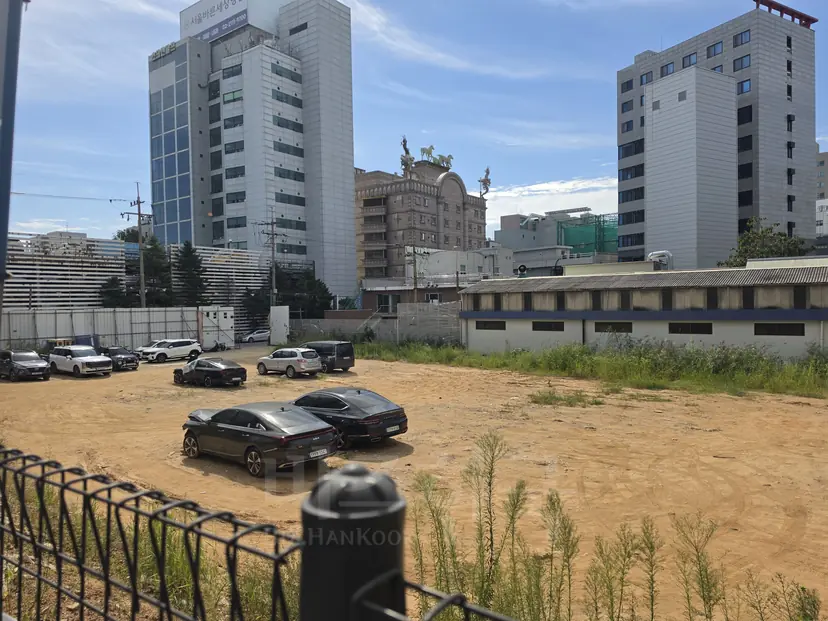
Currently, building permits for data centers at Doksan-dong 1X1-5 and 1X1-16·17 are under review. The two plots are effectively adjacent; 1X1-5 is currently home to a church, while 1X1-16·17 is an empty lot used as a parking area.
According to Geumcheon-gu, if the permits are granted, a data center with a total floor area of approximately 11,117㎡ and a maximum height of about 40.5m is planned for 1X1-5, and a data center with a total floor area of about 8,889㎡ and a maximum height of about 48.7m is planned for 1X1-16·17.
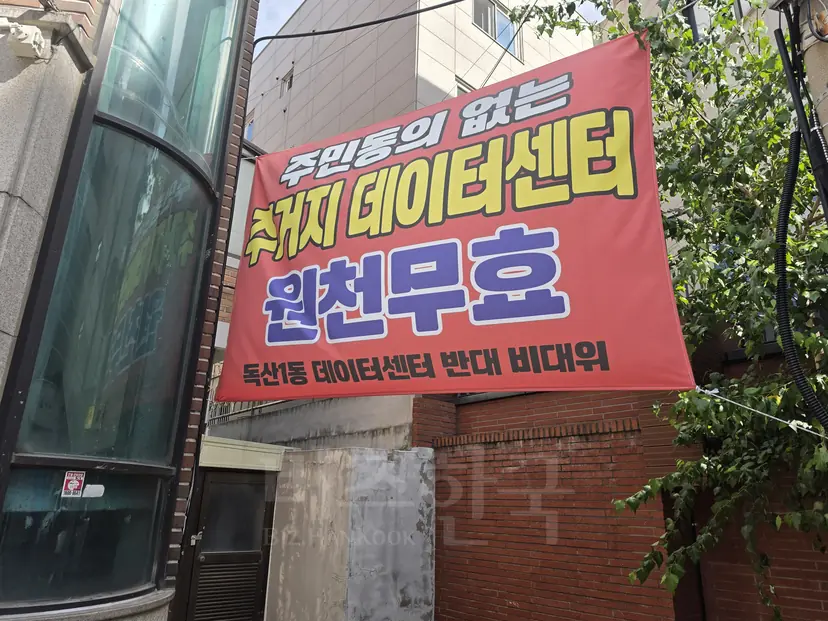
On the 11th, banners opposing the data center construction were seen posted throughout the Doksan-dong 1X1 area. The strong opposition of the residents was evident in phrases written on the banners such as “Null and void from the start” and “Absolutely not.”
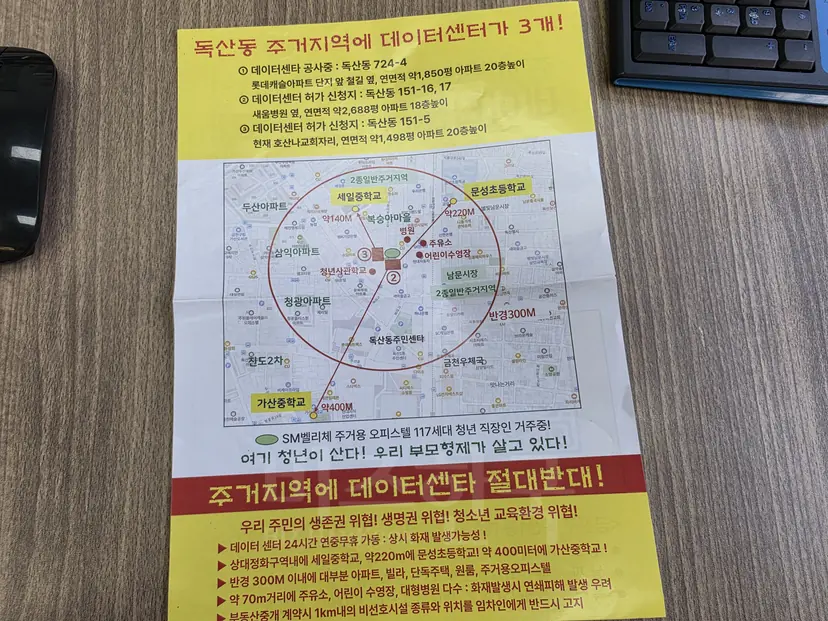
Residential areas are densely packed around the sites where the building permits are under review. A 117-unit residential officetel is located nearby, and a residential neighborhood known as Peach Village sits across the road. Facilities used daily by residents, such as schools and hospitals, are also nearby. Not only are there clusters of houses and businesses, but some of the roads are also narrow.
Residents met on-site identified the proximity of the data centers to their living area as the biggest issue. They worry that if a data center is built near residential facilities, their living environment could be affected by noise, low-frequency sound, and electromagnetic waves.
A resident in his 70s, identified as Mr. A, who lives nearby, said, “I understand that data centers are necessary, but I don’t understand why they have to build them in the middle of a residential area,” adding, “We keep hearing that there are no issues with electromagnetic waves or low-frequency sound, but honestly, I can’t believe it.”
The issue residents are particularly sensitive to is the risk of fire. Data centers are equipped with Uninterruptible Power Supply (UPS) systems and battery facilities to prepare for power outages. Recalling the 2024 Aricel factory fire in Hwaseong, Gyeonggi-do, residents worry that if a battery fire occurs, it will be difficult to extinguish, and the damage could be significant due to the density of nearby housing.
The narrow roads are another cause for concern. The worry is that in the event of a fire, access for fire trucks and rescue personnel might be hindered.
Under the current system, data center construction in the Doksan-dong 1X1 area is permitted. Data centers are classified as broadcasting and communication facilities under the Building Act, which allows them to be built in semi-industrial areas, and the Doksan-dong 1X1 area is designated as such.
The problem is that being in a semi-industrial area doesn't mean it only contains industrial facilities. There are many places, like Doksan-dong, where homes and neighborhood living facilities coexist. However, current laws and regulations do not have a national standard for a minimum separation distance between data centers and residential facilities. This is why residents are demanding that a separation distance standard be established between residential areas and data centers for the sake of safety.
An official from the Emergency Committee against the Construction of the Doksan 1-dong Data Center emphasized, “Currently, there are no standards for separation distances,” adding, “We must change the law to mandate a minimum separation distance in residential areas.” The official continued, “We hope that this issue will be viewed not as simple local selfishness, but as a matter involving the safety and survival of residents.”
In response to the recurring data center conflicts, Geumcheon-gu established a “Resident-Participatory Review System for Data Centers” in July. It reviews 47 items across 5 categories, including building plans, environmental impact, environmental pollution, fire prevention, and facility safety, with 12 experts in fields such as disaster prevention, mechanical engineering, noise/vibration, electromagnetic waves, and the environment participating. If necessary, experts recommended by residents can also participate in the review process.
An official from the Geumcheon-gu Office stated, “We are fully aware of the residents’ concerns and will continue to communicate and consult with them.” The official added, “For sites where building permits have not yet been granted, we plan to make decisions in accordance with relevant laws by comprehensively considering the opinions of residents and the results of expert reviews.”
Meanwhile, there are ongoing moves to improve the system regarding location standards between data centers and residential facilities. The Seoul Metropolitan Council has urged for an amendment to the Building Act to ensure that the appropriateness of a location, environmental impact, and resident acceptance can be comprehensively reviewed by the Architecture Committee during the data center permitting process. In Gwacheon, Gyeonggi-do, an ordinance that would have required a certain separation distance between data centers and residential areas was proposed but ultimately rejected. As the number of data center constructions continues to rise, attention is focused on how location standards between data centers and residential areas will be concretized in the future.