

[비즈한국] It takes a significant amount of time to eliminate risks in facilities. While current law requires the repair and reinforcement of facility defects within a certain period, actions in the field are often delayed due to costs or decision-making issues. Experts point out that we must manage the high-risk status until repairs and reinforcements are complete, and simultaneously prepare support and enforcement measures to ensure actual actions are taken.
As of the end of June this year, there were 7,196 cases of facilities identified as requiring repair or reinforcement due to serious defects. Of these, 3,377 cases have yet to be addressed, and 389 have even exceeded their legal compliance deadlines. Since last December, the duty to perform repairs and reinforcements has been imposed on facilities designated as Grade D or E, but none of the 75 such facilities had completed their measures as of the end of June this year.
Even When Legal Deadlines Remain, Risks Persist
The Special Act on the Safety Control of Infrastructure stipulates that facility managers must take necessary actions, such as repairs and reinforcements, when safety issues are identified. Typical cases include receiving an administrative order following an emergency safety inspection, or being notified of serious defects during safety inspections or diagnostic processes. Following a law revision at the end of 2024, facilities receiving a Grade D or E rating during detailed safety inspections or diagnoses have been included in the scope of mandatory repair and reinforcement obligations starting last December.
Facilities are given a specific compliance deadline for repairs and reinforcements. According to the current enforcement decree, after receiving an action order, notification of a serious defect, or a Grade D/E designation, repairs must in principle be initiated within two years, and unless there are exceptional circumstances, completed within three years from the start date. Following the revision of the enforcement decree last December, the initiation deadline is scheduled to be shortened to within one year, and the completion deadline to within two years from the initiation date starting this December.
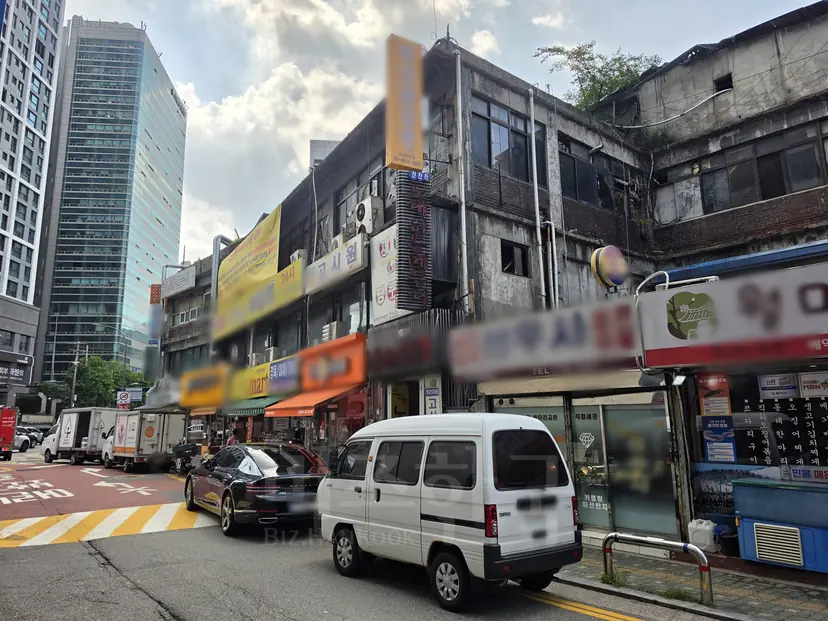
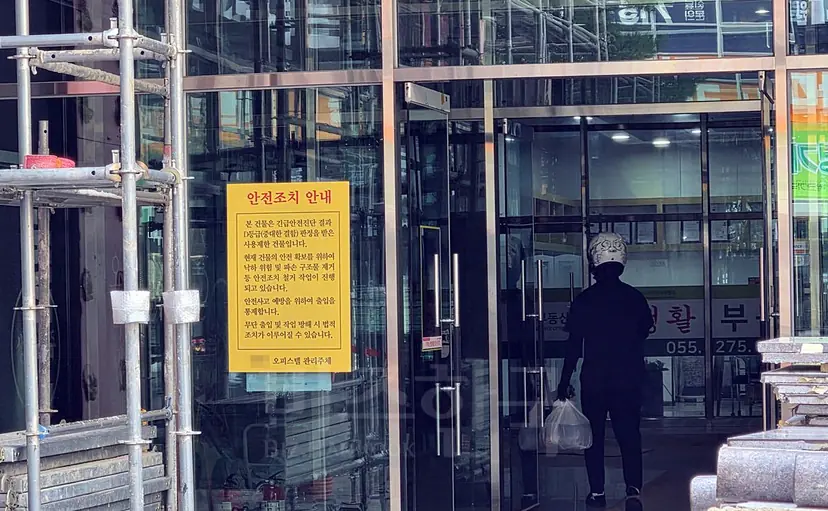
However, the fact that a legal deadline remains does not mean the risk has disappeared. Mapo Gongdeok Market in Seoul, an officetel in Changwon, Gyeongnam, and the Gwangmyeong Tax Office in Gyeonggi-do, all visited by Bizhankook, continued to operate or house residents despite receiving Grade D or E ratings or having serious defects discovered, even though they are facilities used by many people. While some safety measures were taken at each facility, the problems that triggered the grade ratings remained unresolved.
This is why critics argue for a system to monitor facility risks until repairs and reinforcements are finished. Kim Jong-chan, a senior researcher at the Seoul Institute, said, "Because public officials cannot go and inspect every site repeatedly, we can install sensors to monitor for increases in tilt or cracks to see if the damage is worsening. Fixing private property and monitoring risks are different issues. Public resources can be deployed to implement policies for these areas."
Repairs Blocked by Costs… Support and Enforcement Must Go Hand-in-Hand
For private facilities, cost is cited as the biggest obstacle in the repair and reinforcement phase. In addition to construction costs, losses occur due to business closures during the renovation period, and for collective buildings with multiple owners, such as officetels or shopping arcades, agreements on costs and whether to proceed with construction can be delayed. These same issues were confirmed at the Gongdeok Market and the Changwon officetel visited by Bizhankook earlier.
However, it is necessary to actively utilize enforcement measures for high-risk facilities. The Special Act on the Safety Control of Infrastructure allows mayors, county governors, or district heads to order managers to restrict use, prohibit use, demolish, or evacuate residents if a facility's structural condition significantly affects public safety and requires emergency action. If the manager fails to comply with the order, the local government can take safety measures on their behalf and collect the costs under the Administrative Vicarious Execution Act.
In reality, there are instances where local governments' emergency safety orders do not function in a timely manner. Mapo Gongdeok Market in Seoul received a Grade E rating—which requires an immediate ban on use—last January, but even now, about half of the 80 units in the building continue to operate or house residents. Despite the fact that the manager did not voluntarily cease use, the Mapo-gu office has not issued an emergency safety order to prohibit use more than a year later.
Choi Myeong-ki, a professor with the Republic of Korea Industry Site Professor Group, stated, "For facilities where serious safety problems occur, there are ways for the public sector to first invest the budget for measures and charge the costs to the manager, or to carry out forced execution to ensure the facility is not used at all. Since private entities often do not act due to cost issues, local governments need to actively utilize their authority for forced execution."
However, it is difficult to drive repairs and reinforcements through force alone. Critics point out that support and incentives must be provided to managers who struggle to afford construction costs and business losses. Professor Choi added, "Coercion leading only to punishment is not always the best path. Local governments need to explore incentives such as subsidizing a portion of the costs while the manager covers the rest, or providing tax benefits or loans."