

[비즈한국] "It’s not like the old days. Still, I’m holding on thanks to the regular customers who keep coming by."
Stationery stores that once stood guard in front of schools are disappearing one by one. This is because, alongside a declining school-age population and the expansion of digital education, major distribution networks like Daiso and Coupang are rapidly absorbing the demand for stationery. The decline of neighborhood stationery stores is not just a problem for retail shops. A vicious cycle is emerging where, as the major channels for selling domestically produced stationery shrink, the sales outlets for manufacturers are narrowing as well.
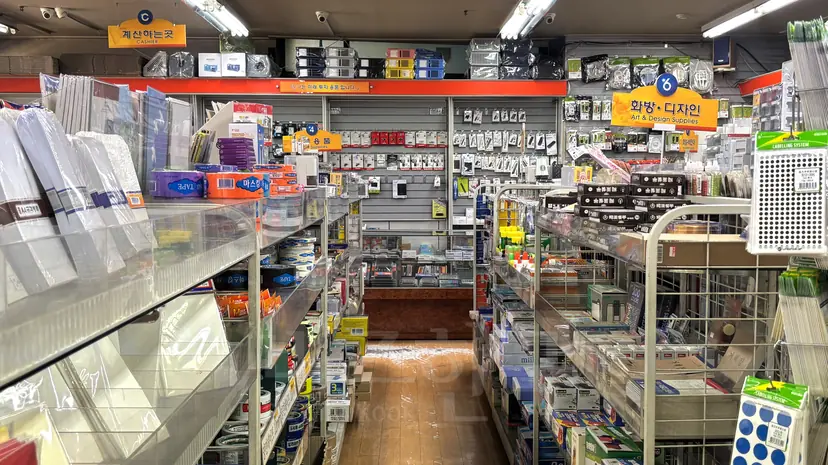
Fewer children, more low-cost retail chains
A man in his 60s surnamed Kim, who has run a stationery store in a university district in Seoul for 28 years, plans to close his shop within this year. "As places selling low-priced products like Daiso have increased, customers are looking for cheaper goods," Kim said. "I am trying to differentiate myself by selling high-end stationery, but it is not easy." He added, "Since the COVID-19 pandemic, foot traffic has decreased significantly, and revenue is clearly different from what it used to be."
The difficulties in the distribution field are also evident in the performance of the stationery franchise Alpha. Alpha's revenue has been on a downward trend, falling from 95.8 billion won in 2023 to 90.5 billion won in 2024, and 84.7 billion won last year. Its operating loss reached 2.13 billion won last year, a 345% increase from the previous year, and its debt-to-equity ratio rose from approximately 150% to 185%.
According to the industry, the number of stationery retail stores nationwide has plummeted by more than half, from 10,000 in 2018 to less than 4,000 last year. Analysis suggests that a declining school-age population, the spread of online shopping, and the growth of ultra-low-cost household goods stores have all contributed simultaneously.
The "school supply support system" is cited as a factor that has further narrowed the standing of stationery stores around schools. Since schools purchase stationery in bulk through bidding and provide them to students for free, there is less reason for students to visit stationery stores themselves.
The Korea Stationery Retail Association claims that many companies from other industries or so-called "paper companies" participate in school bidding rather than local stationery stores, and there are many cases where the winning bidder re-contracts the volume to other companies. Small-scale stationery stores struggle to participate in competitive bidding because they are outmatched in terms of price and supply conditions.
In 2015, the stationery retail industry was designated as a "business suitable for small and medium-sized enterprises" by the Korea Commission for Corporate Partnership, protecting it by preventing the three major large discount stores from selling 18 types of school stationery items individually. However, after the designation period ended in 2022, the request for re-designation as a "livelihood-type suitable business" was not accepted. Instead, the three major large retailers and the stationery industry signed a voluntary coexistence agreement, but critics point out that it is not very effective because the scope of its application is limited.
The stationery industry is calling on the government to restrict stationery sales by large retailers, exempt stationery products from value-added tax, and provide support for the introduction of unmanned sales systems for traditional stationery stores.
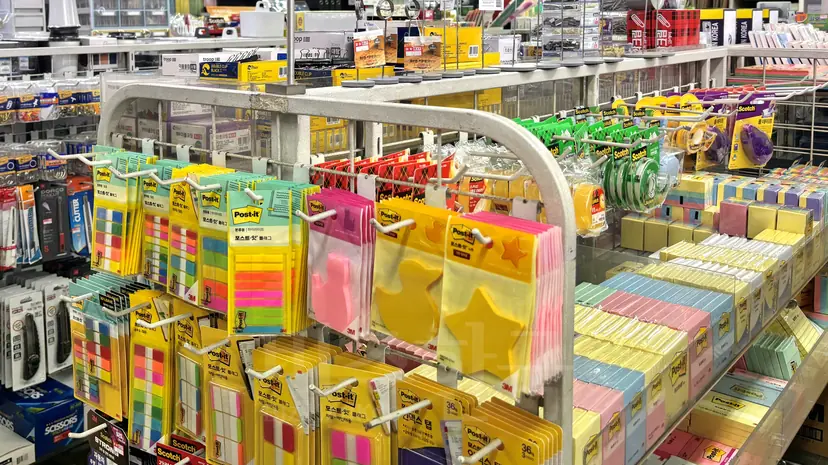
"Costs are up but I can't raise prices": Morning Glory, Monami, and others face sluggish performance
The decline of stationery stores is not just a crisis for the retail industry. In the past, neighborhood stationery stores were key sales outlets where domestic stationery manufacturers met consumers. However, as stationery stores dwindle and the influence of large distribution networks like Daiso and Coupang grows, the sales channels for small and medium-sized manufacturers are also shrinking.
An official from the Korea Stationery Retail Association said, "As local stationery stores disappear, the sales channels for domestic small and medium-sized stationery manufacturers also decrease. In the past, neighborhood stores were the main distribution channel for domestic stationery, but now that the link is broken, a vicious cycle is continuing where manufacturers are also struggling."
The performance of major stationery manufacturers is also poor. According to the Financial Supervisory Service on the 31st, Morning Glory's revenue for the last fiscal year, from July 2024 to June 2025, was recorded at 38.1 billion won, down 6.3% from the previous year. During the same period, operating losses increased by 57.6% compared to the previous year.
Monami has also continued to struggle since switching to a deficit in 2023. Last year's revenue was 131 billion won, a 1.5% decrease from the previous year, and operating losses increased by 54.2% year-on-year to 5.853 billion won.
Manufacturers are suffering not only from a decrease in retail outlets but also from the burden of raw material prices and exchange rates. Production costs have risen as prices for plastic raw materials used in pen bodies, mechanical pencils, folders, and notebook coatings—such as polypropylene (PP), low-density polyethylene (LDPE), and polyvinyl chloride (PVC)—have climbed. For companies with a high proportion of imported raw materials and products, the rise in exchange rates is also a burden.
However, it is difficult to raise product prices sufficiently due to sluggish consumption and competition with ultra-low-cost products. Costs are rising, but sales prices are effectively capped, creating a structure that worsens profitability.
On top of this, as large retailers use sales data to develop their own private brand (PB) products or import products directly from overseas, the position of existing manufacturers is further squeezed. It means the market is shifting to a structure where retailers lead not only sales but also planning and manufacturing.
A stationery industry official emphasized, "Large retailers like Daiso or Coupang are developing their own brand products based on sales data or even importing them directly. In the current structure where distribution and manufacturing happen simultaneously, it is difficult for small and medium-sized manufacturers to compete, so institutional improvements are necessary."
From 'taste-based stationery' to lifestyle: Seeking survival through business diversification
The fact that the traditional school and office stationery market is shrinking does not mean all stationery consumption is disappearing. In Korea, a market is growing where consumers purchase stationery not as a tool for recording or learning, but as goods to express their tastes and personalities. Diary decoration (Daku), stickers, character merchandise, and independent stationery brands are prime examples.
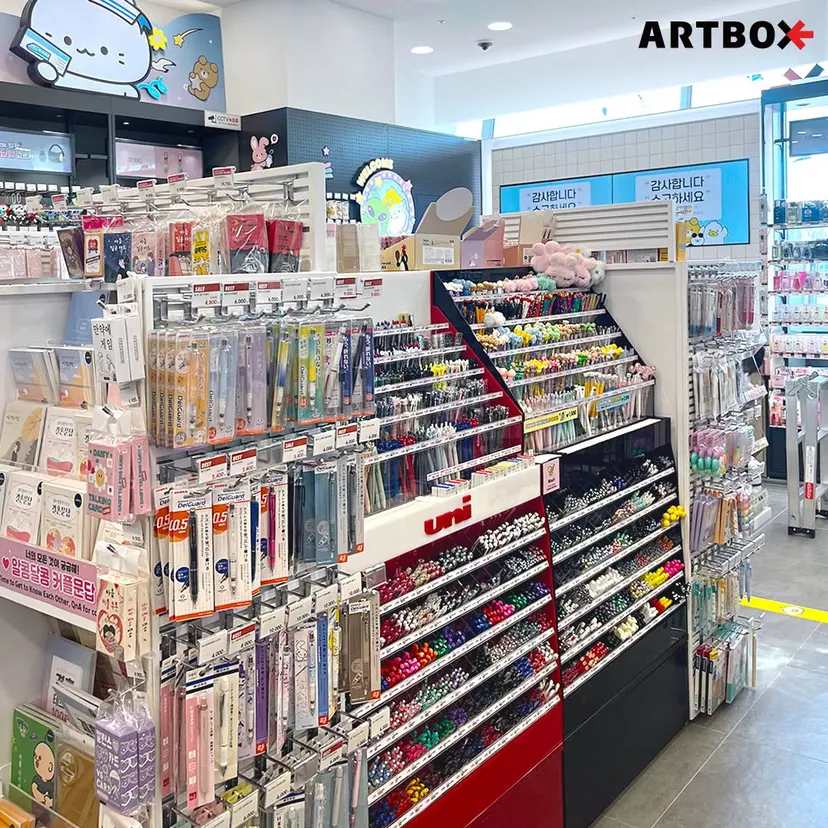
Artbox is a case that showed these changes early on. Beyond just selling school supplies, it developed its own characters and design stationery, and expanded into a lifestyle store that handles household goods, fashion accessories, and beauty/hobby products. Design stationery distribution channels, including Hottracks and 10x10, have also transformed stationery into products purchased for design and taste rather than function.
In Japan, coinciding with the "Oshikatsu" (supporting idols or characters) culture, taste-based stationery like binders, files, and color pens are creating new demand. Korea's consumption of diary decoration and character merchandise is following a similar flow, just in different forms. It is not that the stationery market is disappearing, but that it is splitting into a market for essentials that used to be bought at the store in front of school, and a market for taste-based products that consumers actively seek out and purchase.
However, it is difficult to say that domestic traditional stationery manufacturers are sufficiently enjoying the benefits of these changes. In the taste-based stationery market, character, design, brand awareness, and quick product planning are more important than product function or production scale. The way of competing is different from the mass-produced school supplies that existing manufacturers are strong in.
Some stationery manufacturers are looking for breakthroughs outside of stationery rather than strengthening taste-based products within the stationery market. Monami entered the OEM business for color cosmetics in 2023, and Morning Glory expanded its business scope to sanitary products and furniture. It is a strategy to expand their external reach into lifestyle goods companies in response to the decline in demand for traditional stationery.
Ultimately, the current crisis in the stationery industry stems not from the fact that stationery itself is no longer selling, but from the change in the types of stationery being consumed and the places where they are sold. Cheap school supplies have moved to Daiso and online distribution networks, while products featuring designs and characters have shifted to specialized boutique shops and taste-based brands. In the midst of this, as neighborhood stationery stores and traditional manufacturers are unable to sufficiently absorb the new consumption, they are bearing the full brunt of the market restructuring.