

[BizHanKook] The cryptocurrency market this week saw upward momentum driven by product launches from individual projects and institutional participation, compounded by a recovery in risk-on sentiment toward the end of the reporting period. As uncertainties surrounding the U.S. midterm elections eased and oil prices and Treasury yields declined, Bitcoin and Ethereum rebounded, with buying pressure spreading to mid-cap altcoins in sectors such as payments, Bitcoin scaling, and decentralized finance (DeFi). However, since Bitcoin’s market dominance remains high, the trend was more of a selective rebound centered on tokens with specific catalysts rather than a broad-based altcoin rally.
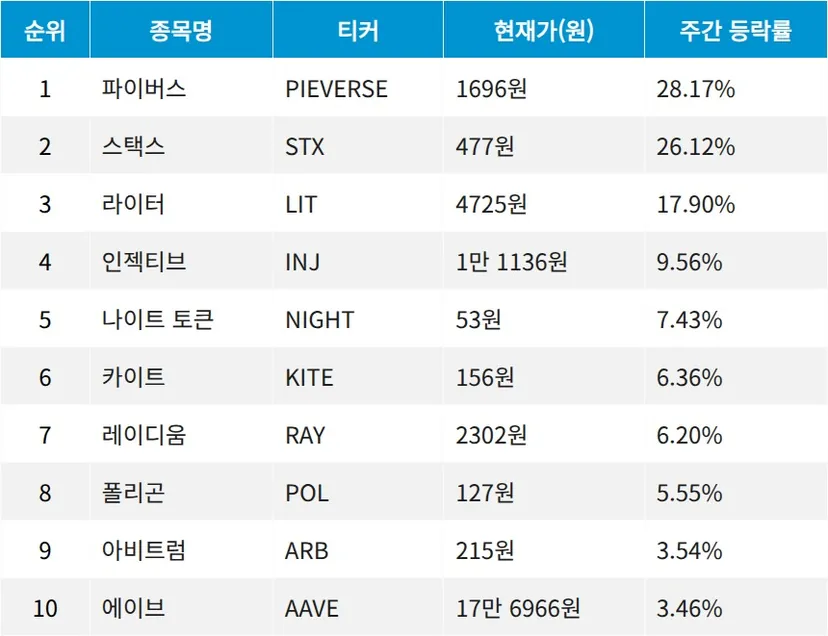
According to CoinMarketCap, a global crypto market tracking site, Pieverse recorded the highest weekly gain of 28.17% in the cryptocurrency market from 6:00 AM on October 30 to 6:00 AM on November 6. Its current price is 1,696 KRW, and it continued its short-term rally with a 6.05% increase over the past 24 hours.
Stacks rose 26.12% over the week to take second place. Its current price is 477 KRW, and it remained flat with a -0.076% change in the last 24 hours. Lyra took third place with a weekly gain of 17.90%. Its current price is 4,725 KRW, and it rose 3.63% over the past 24 hours.
Injective climbed 9.56% over the week to rank fourth. Its current price is 11,136 KRW, having risen 4.35% in the last 24 hours. Knight Token recorded a weekly gain of 7.43% to place fifth. While its current price is 53 KRW, it fell 8.61% over the past 24 hours.
Sixth-place Kite rose 6.36% over the week to trade at 156 KRW. Seventh-place Raydium climbed 6.20% to 2,302 KRW, and eighth-place Polygon rose 5.55% to 127 KRW. Ninth-place Arbitrum rose 3.54% to 215 KRW, and tenth-place Aave traded at 176,966 KRW, up 3.46%.
Pieverse Integrates AI Trading; Stacks Opens Bitcoin Staking for Institutions
Pieverse is a Web3 payment infrastructure designed to allow not just humans, but AI agents and machines, to make payments using stablecoins. It reduces gas fee burdens during the payment process and maintains on-chain records of bills and receipts, while the PIEVERSE token is used for staking, governance, and service fees. During the reporting period, it was announced that Orderly Network’s on-chain perpetual futures trading infrastructure would be integrated into "Perfect Claw," Pieverse’s AI agent execution environment. Users can perform market inquiries, collateral deposits, and order/position management via conversational commands, with designs requiring user confirmation before actual trades are executed. With the expansion of product features and a higher volume of transactions than usual, the asset showed price resilience beyond the overall market rebound.
Stacks is a scaling network built to execute smart contracts and decentralized applications while utilizing Bitcoin’s security. This week, its staking structure, which allows institutions to utilize their held Bitcoin without separate loans or wrapping, was highlighted. On November 3, BitGo announced that it would support qualified institutional clients in participating in Stacks’ bonding program while keeping their Bitcoin in custodial accounts. Participants lock their Bitcoin on the Bitcoin network for a set period and are allocated some STX, earning rewards in Bitcoin. Subsequently, the third round of bonding, which included participation from 21Shares and the crypto exchange Bullish, was fully subscribed. While the concrete use case connecting institutional custody with staking served as a catalyst to re-evaluate STX demand, the upward momentum slowed to a flat trend in the last 24 hours.
Lyra is a decentralized derivatives exchange that verifies order execution and liquidation results using zero-knowledge proofs. During the reporting period, the network underwent an upgrade and expanded its supported assets to 23 by adding tokenized stock items that can be used as collateral on its Robinhood-chain based service. The platform also continued to repurchase LIT tokens using exchange revenues. The repurchase volume confirmed from October 29 to November 4 was approximately 1.43 million USD, a structure where platform trading activity feeds into token demand, supporting the price increase. However, as a derivatives exchange token, price and trading activity can fluctuate sharply when market volatility rises.
From Institutional Trading Rails to Privacy, Combining Individual Catalysts with Market Rebounds
Injective is a finance-focused Layer 1 network designed to process tokenized asset issuance, spot/derivatives trading, and payments on a single network. "Injective Institutional Rails," unveiled on November 2, is an institutional access layer that allows banks and professional traders to deliver transactions to validators through a dedicated interface and predict block inclusion times. The project highlights that participating institutions retain custody of their assets while final settlement is processed through consensus among all validators. As the announcement of this institutional trading infrastructure served as a direct catalyst, combined with the market rebound late in the reporting period, the token continued its upward trend over the last 24 hours.
Knight Token is an asset of the Midnight network, which is designed to reveal only necessary portions of transaction information using zero-knowledge proofs. On October 28, the Midnight Foundation, in collaboration with the Cygnet Network, unveiled a structure that allows Ethereum applications to utilize Midnight’s privacy features without moving assets or liquidity to other chains. In this method, only the final transaction is left on Ethereum, while individual balances and activity history are protected on Midnight. Although Knight Token rose for the week, it fell 8.61% in the last 24 hours, making it the only one among the top five to show a clear pullback. This can be interpreted as profit-taking following a short-term rally driven by new technological catalysts.
The composition from 6th to 10th place indicates that risk appetite has spread across multiple sectors rather than just one. Kite is a dedicated blockchain that handles stablecoin payments by granting AI agents identity, wallets, and spending limits; Raydium is a Solana-based automated market maker exchange. Polygon and Arbitrum provide scaling infrastructure to reduce Ethereum's processing costs and speed issues, respectively, while Aave is a decentralized lending protocol for depositing and borrowing crypto assets. The fact that AI payments, exchanges, Ethereum scaling networks, and lending markets are all in the top tier suggests that buying pressure has broadened across overall on-chain activity rather than focusing on a single theme.
Among the top gainers this week, specific changes close to price action were identified, such as Pieverse's expansion of AI trading functions, Stacks' institutional custodial Bitcoin staking, and Lyra's expansion of collateral assets and token buybacks. Injective and Knight Token also pushed forward with different use cases: institutional accessibility and data privacy. Furthermore, with Ethereum rebounding more sharply than Bitcoin and DeFi tokens joining the rally, individual positive news connected into a market rotation.
However, the trends of the top-performing tokens were not uniform. While Pieverse, Lyra, and Injective continued to rise in the final 24 hours of the reporting period, Stacks remained flat and Knight Token plunged. There are also indications that short position liquidations during the market rebound amplified the gains, so it is too early to interpret this rally as a permanent shift toward a long-term trend. The sustainability of the subsequent rally depends on whether it is backed by actual usage and spot buying pressure, rather than project announcements.
※ This article was co-written by Bizhankook and MetaVX’s generative AI.