

[비즈한국] This week, the price resilience of high-volatility altcoins stood out more than Bitcoin’s rebound. Pons, Arbitrum, and Uniswap—all linked to the Robinhood Chain ecosystem—topped the gains, with buying interest expanding into decentralized finance (DeFi) and privacy coins. While uncertainty remains ahead of U.S. employment data and the Federal Reserve’s September monetary policy decision, the decline in U.S. Treasury yields and a rebound in tech stocks have partially revived investor sentiment for risk assets.
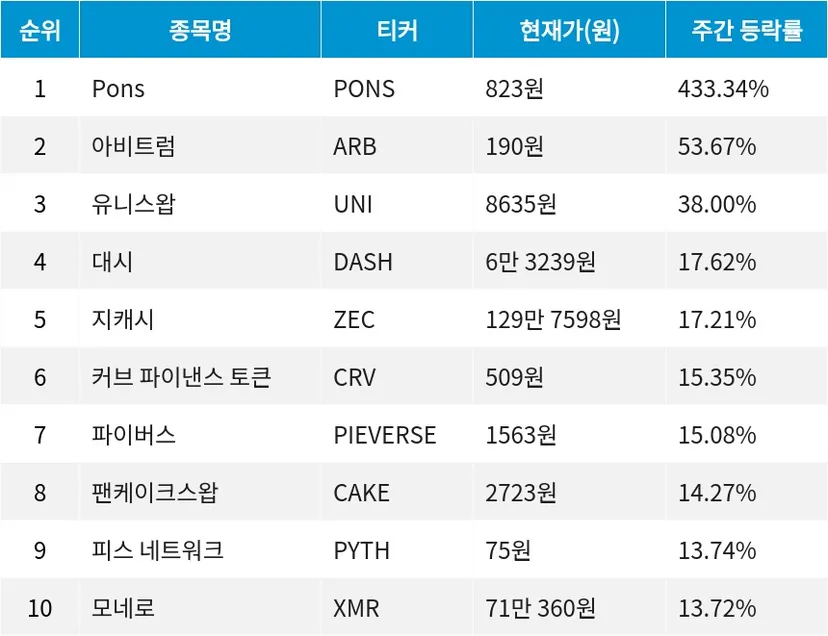
According to CoinMarketCap, a global crypto market data aggregator, Pons ranked first in the cryptocurrency market with a weekly gain of 433.34% from 6:00 AM on August 28 to 6:00 AM on September 4. Its current price is 823 KRW, and it surged 47.21% over the last 24 hours alone. Its market capitalization stands at 582.17921 billion KRW, with a 24-hour trading volume of 158.81106 billion KRW. The turnover was exceptionally active, with daily trading volume exceeding one-fourth of its total market cap.
Arbitrum rose 53.67% over the week to take second place. The current price is 190 KRW, with a 24-hour change of 14.09%, indicating sustained short-term buying pressure. Uniswap ranked third with a weekly gain of 38.00%. It is currently trading at 8,635 KRW, up 8.81% over the past 24 hours.
Dash climbed 17.62% over the week to place fourth. Its current price is 63,239 KRW, with a 24-hour rise of 9.50%. Zcash took fifth place with a weekly gain of 17.21%, trading at 1,297,598 KRW after jumping 17.60% in the last 24 hours. A significant portion of Zcash’s weekly gains occurred in the final day of the observation period.
The sixth-ranked Curve DAO Token rose 15.35% over the week to trade at 509 KRW. Seventh-ranked Phibius recorded a 15.08% weekly gain and is trading at 1,563 KRW. Eighth-ranked PancakeSwap rose 14.27% to 2,723 KRW, while ninth-ranked Pyth Network stood at 75 KRW, up 13.74%. Tenth-ranked Monero rose 13.72% to trade at 710,360 KRW.
The Connection Created by Robinhood Chain Listing Expansion and Arbitrum Upgrades
Pons is a non-custodial launch platform on the Robinhood Chain that allows anyone to create tokens and trade directly via wallets without coding. The platform does not hold user assets, and launched tokens are issued in fixed quantities and traded within locked liquidity pools. A portion of the transaction fees is used to buy back and burn PONS tokens from the market; currently, 80% of protocol fees are allocated via an automated fractional buyback structure.
The direct catalyst for the price spike was increased trading accessibility. KuCoin began spot trading for PONS on August 27, and on August 31, it became tradable on Solana through the cross-chain issuance infrastructure, Sunrise. A listing on BingX and a fee waiver promotion also preceded the final reporting period. The combination of expanded buying routes through centralized exchanges and Solana liquidity, coupled with the token buyback/burn structure, fueled the surge. However, as 47.21% of the 433.34% weekly gain occurred in the final 24 hours, the impact of late-stage chase buying was significant.
Arbitrum is a Layer 2 platform that bundles Ethereum transactions off-chain and records only the results on Ethereum, thereby reducing fees and processing time. ARB is used as a governance token to determine network operations and fiscal spending. Since the Robinhood Chain was built using Arbitrum technology, the "Pons fever" provided a pivot for the revaluation of the Arbitrum ecosystem.
The Arbitrum Foundation announced in its first-half report on September 2 that it had processed 478 million transactions in six months, with average monthly stablecoin transfers exceeding 70 billion USD. Prior to this, on August 20, they launched "ArbOS Elara," which added regulatory compliance filters and priority fee settings to its dedicated chain, and improved the base fee calculation for Arbitrum One. It appears that the upgrade, which strengthened control functions for enterprise chains, combined with the disclosure of real-world usage metrics, amplified ARB’s growth alongside the broader market rebound.
Uniswap is a decentralized exchange protocol that uses asset pools deposited by liquidity providers to swap tokens without a central operator. UNI is used for governance, deciding on protocol fee policies and major changes. Uniswap acts as a core automated market maker (AMM) on the Robinhood Chain, and tokens launched on Pons are also traded via Uniswap liquidity pools.
On August 24, Uniswap unveiled the operating structure for "Permissioned Pools," which allow assets with restricted eligibility—such as tokenized funds—to be traded via the AMM mechanism. A system to buy back and burn UNI using protocol fees is also in operation across several networks, including Ethereum and Arbitrum. However, it is difficult to attribute the entire weekly gain solely to a single new announcement regarding UNI. Given the concurrent surges of Pons and Arbitrum, as well as the strength of Curve and PancakeSwap, it is more likely that rotation buying into decentralized exchange (DEX) tokens played a significant role.
Buying Interest Expands from DeFi to Privacy Coins
Dash is a digital cash project that utilizes a masternode structure to provide fast payments and network governance. In early August, shielded transactions applying Zcash’s Orchard technology were introduced to the Dash Evolution mainnet, and the "Dash Anywhere" feature, which allows users to convert Dash to other cryptocurrencies directly within the wallet, was also unveiled. While no major specific announcements were confirmed during the tracking period, the trend of strengthening both payment and transaction privacy features aligned with the rotation into privacy coins.
Zcash is a privacy coin designed to allow users to choose the disclosure level of sender, receiver, and amount using zero-knowledge proofs. Grayscale’s Zcash exchange-traded product, ZCSH, began trading on the NYSE Arca on August 25, opening a path for ZEC price exposure through standard brokerage accounts. This was a more direct factor in this week's price action than mere anticipation of filings or approvals. The vote to finalize the scope of the upcoming network upgrade, NU7, which began on August 27, also re-highlighted supply adjustment methods and future development directions.
In ranks 6 through 10, the trend showed an expansion of themes rather than the dominance of a single sector. Curve DAO Token and PancakeSwap are DeFi assets responsible for stablecoin-focused liquidity trading and multi-chain token swaps, respectively. Pyth Network is an oracle project that provides external market prices to blockchain applications, and Monero is a privacy coin designed to make transaction tracking difficult. Even small-to-mid-cap tokens like Phibius recorded double-digit growth. The composition of rising price data infrastructure and privacy assets shows that capital is moving beyond one sector into high-volatility altcoins as a whole.
This week’s market was characterized by a combination of individual positive news and sector rotation. Pons saw the convergence of exchange listings, expanded Solana distribution, and an internal buyback/burn structure, while Arbitrum followed up with upgrades and network performance disclosures. Zcash secured an independent catalyst in the launch of its exchange-traded product. In contrast, the synchronized rise of Uniswap, Curve, and PancakeSwap reflects a broader buying spree spreading across the DeFi sector.
Bitcoin and Ethereum also rebounded toward the end of the period, but the gap with the top-performing assets was significant. Therefore, rather than characterizing this as a strong trend reversal for the entire cryptocurrency market, it is more reasonable to view this as a market phase where risk appetite has spread to the Robinhood Chain, DeFi, and privacy coins, supported by price stability in larger assets. In particular, tokens like Pons, which show both high weekly growth and high trading turnover, may face increased volatility ahead as new distribution channels have quickly driven prices higher.
※ This article was co-written by Bizhankook and MetaVX’s generative AI.