

[BizHanKook] This week, buying pressure first flowed into projects with service launches, expanded trading support, and token burn mechanisms. As Bitcoin recovered the $60,000 mark toward the end of the reporting period, the scope of the rebound expanded to sectors including payments, artificial intelligence, privacy, and Layer 1. However, rather than a clear recovery in spot demand, the market was characterized by the influence of derivatives and short-term rotational buying in the process of reversing losses from previous sharp declines.
According to CoinMarketCap, a global crypto market data provider, Payverse topped the market with a weekly gain of 32.89% from November 20 at 6:00 AM to November 27 at 6:00 AM. Its current price is 5,301 KRW, and it continued its upward trend until the very end of the reporting period, rising 8.36% in the last 24 hours alone.

Venice Token followed in second place with a weekly gain of 20.12%. Its current price is 35,866 KRW, but it fell 4.02% in the last 24 hours as momentum slowed following its weekly surge. Stable rose 14.53% over the week to take third place. It is currently trading at 34 KRW and also saw a 2.72% increase in the last 24 hours.
Knight Token rose 9.15% for the week to rank fourth. It is currently priced at 65 KRW and fell 1.75% in the last 24 hours. Algorand placed fifth with a weekly gain of 6.84%. Its current price is 109 KRW, with a 3.68% increase over the last 24 hours.
Sixth-place Kite rose 6.39% for the week to trade at 193 KRW. Seventh-place Sei recorded a 5.23% gain over the week, reaching 53 KRW. Eighth-place Litecoin rose 3.85% to 58,899 KRW, while ninth-place Falcon Finance traded at 139 KRW, up 3.59%. Tenth-place Chainlink is currently at 12,489 KRW, a 3.58% weekly increase.
Expanded trading support, token burns, and stablecoin utility lead the top ranks
Payverse is a Web3 payment infrastructure that allows not only regular users but also AI agents to make payments using stablecoins, leaving a record in the form of on-chain invoices and receipts. It supports gas-free payments via the x402b protocol, and the Payverse token is used for fee discounts, staking, and governance.
At the start of this week's reporting period on November 20, HTX launched spot and grid trading for the token, and on the same day, Binance Alpha and Binance Wallet initiated a competition rewarding users based on their buying volume. Just before that, on November 16, "Confidential Agents," which protect the data and work contents of AI agents in an isolated environment, were released on a limited basis. The confluence of new service releases, increased trading accessibility, and volume-based rewards appears to have stimulated short-term demand. However, as the vesting of team and investor tokens began in mid-November, supply pressure remains regardless of the price increase.
Venice is an AI service that emphasizes not storing user conversation content on central servers for long periods. The structure allows users to earn rewards by staking VVV, while a separate token, DIEM, is used to secure usage limits for AI models and APIs. The fact that a portion of service subscription fees and API credit sales revenue is used to buy back and burn VVV from the market directly ties to supply and demand. Venice burned 21,657 VVV on November 9, valued at approximately $458,000 at the time. Burning due to API credit usage also reached record levels for the week ending November 22, with additional funds injected for future buybacks. While this structure supported the price, the token fell over the last 24 hours, indicating that buying intensity has weakened after the initial surge.
Stable is a Layer 1 blockchain designed to handle stablecoin issuance, payments, and cross-border settlement. On November 25, it launched the "Stableon Prime PYUSD Vault," which allows users to deposit or use PayPal’s dollar-pegged stablecoin, PYUSD, for collateralized loans. It utilizes the infrastructure of the lending protocol Morpho, with Galaxy managing operational terms, and launched with the ability to borrow PYUSD using Ether.fi's weETH as collateral. The announcement, which expanded PYUSD from a simple transfer tool to an on-chain lending asset, combined with the overall market rebound to fuel the upward trend.
Rebound scope expands from individual catalysts to payments, Layer 1, and oracles
Knight Token is the native token of the Midnight Network, designed to prove necessary information without revealing all transaction details. UK-based Monument Bank launched a tokenized deposit product for individual customers using the Midnight Network on the 16th (local time), and Midnight highlighted these achievements in a monthly report on the 25th. That same month, "Ledger 9," which supports inter-smart contract calls and Bitcoin/Ethereum wallet signature standards, was applied to the mainnet. Binance's start of a NIGHT trading competition on November 25 also boosted short-term trading demand. However, the drop over the last 24 hours shows that some of the gains were retraced after the announcements.
Algorand is a Layer 1 blockchain that supports fast payments and smart contract execution based on validator participation. No clear new project announcements were identified as the driver for its price increase during this reporting period. It is interpreted that the effect of buying pressure rotating toward large-scale Layer 1 projects as the previously crashed market rebounded was relatively significant. The fact that more than half of the weekly gain (6.84%) was concentrated in the last 24 hours (3.68%) confirms that buying interest was heavily skewed toward the end of the period.
Looking at the 6th to 10th places, the market was far from a situation where funds were concentrated in a single technological sector. Kite is a Layer 1 supporting identity verification and micro-payments for AI agents, and Sei is a blockchain targeting fast order processing for trading and financial applications. Litecoin is an asset for payments and transfers, Falcon Finance is a DeFi project issuing synthetic USDf collateralized by cryptocurrencies, and Chainlink is an oracle infrastructure that delivers external prices and data to blockchains. The fact that projects ranging from AI payments to major platforms, transfers, DeFi, and oracles were all in the top tier suggests that rather than a single trend, short-term buying pressure spread across altcoins that had previously experienced deep losses.
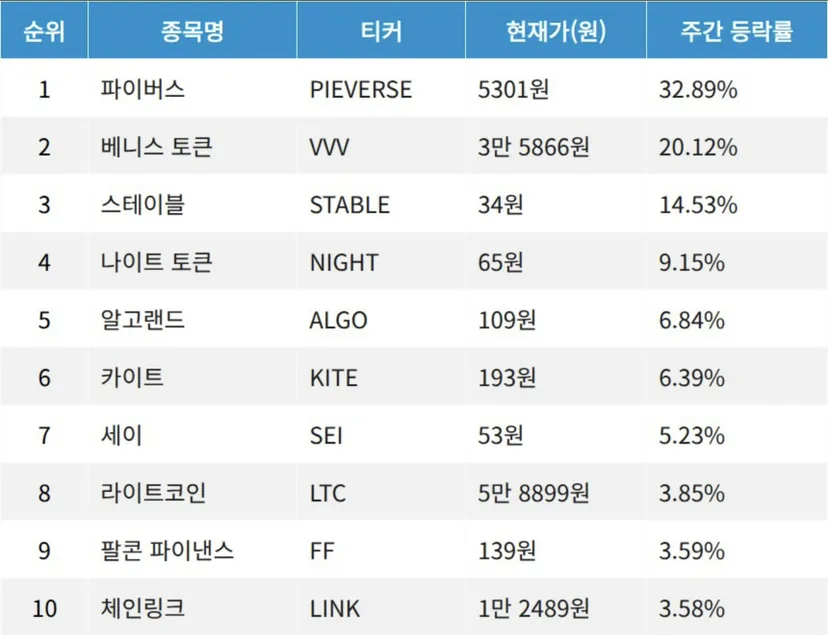
The top performers this week saw their price reactions diverge based on the strength of individual catalysts. Payverse saw sustained demand throughout the week thanks to new trading support and buy-side reward events, while Venice's structure of linking service revenue to token buybacks and burns stood out. Stable and Knight Token also presented concrete use cases: stablecoin lending services and bank deposit tokenization, respectively. Conversely, Algorand and some mid-to-large-cap coins were influenced more by market rebounds and rotational buying than by independent positive news.
Bitcoin and Ethereum also rebounded after their sharp drops, but it is difficult to conclude that spot trading has seen a strong recovery. With continued outflows from Bitcoin spot ETFs and weak spot demand, the increased share of derivatives has made prices more sensitive to liquidations and position adjustments. Therefore, it is more reasonable to view the rise of this week's top-performing coins as a result of loss recovery and high-volatility rotational buying centered on projects backed by specific business catalysts, rather than a signal that the market trend has completely shifted.
※ This article was written by BizHankook and MetaVX's generative AI.