

[비즈한국] This week, individual news—specifically Quant securing a contract with the U.S. banking sector—triggered the strongest price response. Buying momentum subsequently spread to Pump.fun, with its token buyback and burn structure, and Night Token, which emphasizes data privacy. The scope of gains further expanded to include interoperability, Bitcoin scaling, and decentralized finance (DeFi) projects. Meanwhile, inflows into U.S. spot Bitcoin exchange-traded funds (ETFs) showed early gains but turned to net outflows on September 30, confirming that the recovery in risk appetite is not one-sided.
According to CoinMarketCap, a global cryptocurrency market data provider, Quant recorded the highest weekly gain of 191.06% between 6:00 AM on September 25 and 6:00 AM on October 2. Its current price is 344,784 KRW, though it fell 11.12% over the last 24 hours, indicating short-term profit-taking following the surge.
Night Token ranked second with a weekly gain of 61.59%. Its current price is 53 KRW, continuing its upward trend with a 3.30% rise over the last 24 hours. Pump.fun took third place with a 51.19% gain over the week. Its current price is 7.95 KRW, showing a slight bullish trend with a 24-hour fluctuation of 0.18%.
LayerZero ranked fourth with a weekly gain of 26.16%. The current price is 2,514 KRW, with strong buying pressure continuing into the final hours of the reporting period, rising 11.33% over the last 24 hours. Stacks took fifth place, rising 20.56% over the week. Its current price is 514 KRW, up 5.22% in the last 24 hours.
Just is trading at 180 KRW, up 17.21% for the week. Aave is trading at 230,900 KRW, a 17.02% increase over the week. XDC Network sits at 47 KRW, up 16.21%. Sui recorded a weekly gain of 16.04% and is trading at 1,606 KRW. Sei is currently at 97 KRW, up 14.44% over the week.
U.S. Banking Tokenized Deposit Networks and Pump.fun Buybacks Define the Top Performers
Quant provides infrastructure based on its "Overledger," which connects different blockchains with existing bank payment systems. QNT is the token used for utilizing related networks, services, and transaction processing. The Clearing House, an operator of payment infrastructure owned by major U.S. banks, selected Quant as a technology provider for its "On-Chain Money Initiative" on September 24. Quant will build a layer to coordinate the clearing and settlement of tokenized bank deposits and connect existing payment rails like RTP and CHIPS. The service is expected to be provided to participating financial institutions in the first half of 2027.
The fact that the company secured a project with real-world utility in institutional finance acted as a direct catalyst for the price increase. On September 28, the trading volume of QNT derivatives significantly exceeded spot trading volume, and a short squeeze amplified the gains as short positions liquidated in the 24-hour window outnumbered long positions. However, the announcement did not include details requiring participating banks to directly purchase or hold QNT. The surge reflects both expectations that the project will drive token demand and the impact of leveraged trading. The recent 24-hour double-digit decline is consistent with the process of unwinding these rapidly accumulated positions.
Night Token is the utility token for the Midnight Network, which is designed to use zero-knowledge proofs to disclose only necessary facts while keeping other information private. NIGHT holders can generate DUST, a network resource used for transaction processing. No major listings or new partnerships were confirmed during this period that would have driven the price. Instead, social media narratives surrounding privacy-focused blockchains spread, and trading volume saw a significant increase on September 30. While the Midnight mainnet's public node and indexer provision system shifted to Blockfrost on the same day, it is difficult to attribute the entire weekly gain solely to this infrastructure change. The movement was driven more by increased trading volume and a rotation of interest into the privacy theme rather than new business developments.
Pump.fun is an issuance platform on Solana that allows anyone to create tokens and trade them via automated price curves. The key supply/demand mechanism for the platform's token, PUMP, is its structure of using half of its revenue for market buybacks and burns. According to official records, the cumulative buyback and burn amount reached $463.5 million by September 25, with 16.791% of the total supply removed. As platform activity increased at the end of September, spot trading volume also surged, pushing prices up through a combination of supply reduction and a recovery in meme coin trading. However, PUMP is more price-volatile than general technical infrastructure tokens due to its sensitivity to platform revenue and speculative trading.
Reflecting the Expansion from Institutional Stablecoins to Bitcoin Staking
LayerZero is a communication protocol that transmits assets and messages between blockchains. Anchorage Digital, a U.S. federally chartered digital asset bank, selected LayerZero as an interoperability partner for its proprietary stablecoin on September 21. Starting with Tether's USAT, the structure allows the same token to be moved across multiple networks using LayerZero's OFT standard. The existing supply/demand mechanism, where a portion of Stargate transfer fees is used for ZRO market purchases, also continued. Given that the 24-hour gain was significant within the weekly total, the trend appears to be a mix of institutional stablecoin news and short-term market rotation.
Stacks is a scaling network that runs smart contracts and financial services while using Bitcoin as the final settlement base. STX is used for transaction fees and network participation, and users can receive Bitcoin rewards in the staking process. On September 24, Anchorage Digital announced a Stacks Bitcoin staking custody service for institutional clients. In the previously launched Genesis Bond, 230 BTC and 310,000 STX were combined in the first 14 days, and weekly Bitcoin reward payments have begun. The confirmation of institutional custody infrastructure and actual staking performance added momentum to Stacks' rise.
The assets from 6th to 10th place span a variety of sectors. Just and Aave are DeFi protocols providing lending and deposit functions in the TRON ecosystem and multi-chain markets, respectively. XDC Network is a blockchain focused on trade finance and enterprise asset tokenization, while Sui and Sei are smart contract platforms emphasizing fast transaction processing. The simultaneous entry of financial services, enterprise networks, and Layer 1 platforms into the top ranks suggests that buying has spread across a wider range of high-volatility altcoins rather than being confined to a single technology theme.
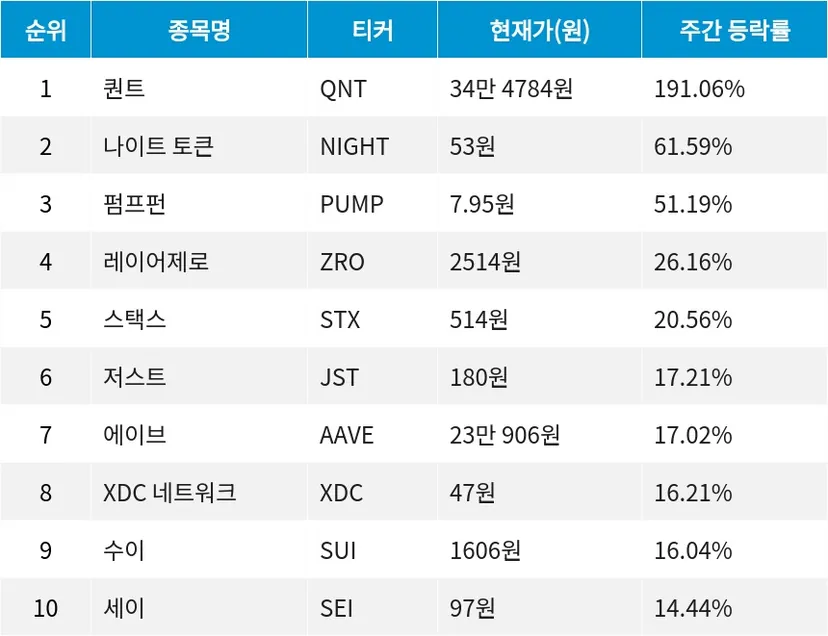
The top 10 assets this week showed a clear distinction between individual catalysts and market supply/demand factors. Quant, LayerZero, and Stacks saw concrete business progress in banking payment rails, regulated stablecoins, and institutional Bitcoin staking. On the other hand, Night Token and Pump.fun were more heavily influenced by privacy narratives, increased volume, revenue-based buybacks, and the recovery of meme coin trading.
The fact that Just, Aave, Sui, and Sei joined the rally indicates that capital did not stay limited to a few small-cap assets. However, as evidenced by Quant’s recent 24-hour decline and the shift to net outflows for spot Bitcoin ETFs, the pressure for profit-taking and the risks of leverage during the rally have increased. This flow appears to be more of a short-term rotation that began with assets tied to verifiable business developments and spread to high-volatility altcoins, rather than a definitive new long-term trend.
※ This article was written by BizHankook and MetaVX's generative AI.