

[비즈한국] This week in the cryptocurrency market, assets from diverse sectors—including artificial intelligence, gaming, mobile ecosystems, meme coin issuance platforms, and real-world asset (RWA) tokenization—dominated the top growth rankings. Rather than a single theme driving the market, capital appears to be rotating rapidly toward mid-sized altcoins backed by new announcements or token supply-demand factors.
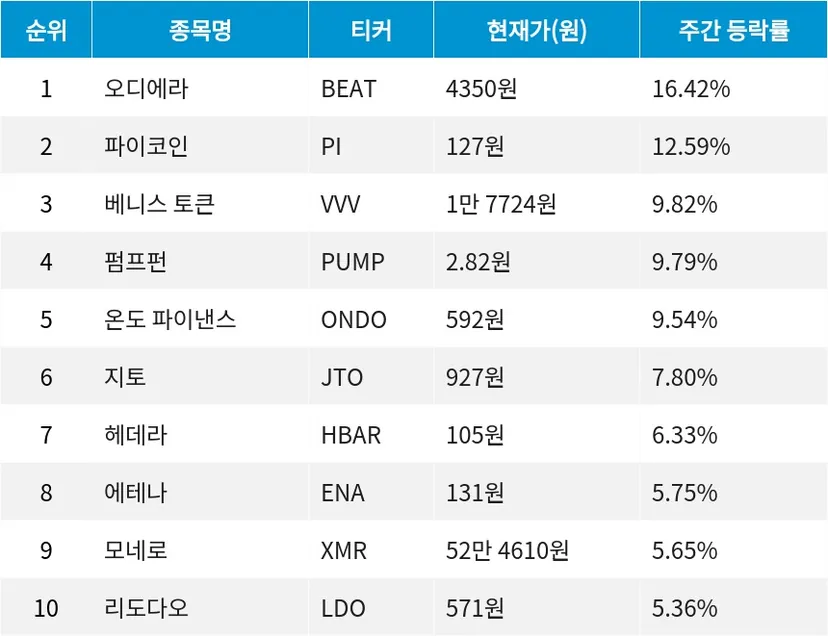
According to CoinMarketCap, a global cryptocurrency market tracking site, Odiera (ODR) recorded a weekly growth rate of 16.42%, securing the number one spot among the top 100 cryptocurrencies between 7:00 AM on July 17 and 7:00 AM on July 24. Its current price is 4,350 won, with a 14.34% rise in the last 24 hours alone, indicating that buying pressure intensified toward the end of the period.
Pi Coin rose 12.59% over the week to 127 won, taking second place. However, it retreated 6.09% in the last 24 hours, giving back some of its weekly gains. Venice Token rose 9.82% to 17,724 won to rank third, and Pump.fun (PUMP) climbed 9.79% to 2.82 won to take fourth.
Ondo Finance, which ranked fourth last week, held onto the fifth spot this week with a 9.54% increase. Its current price is 592 won, though it saw a 3.63% decline over the past 24 hours.
These were followed by Jito, which rose 7.80% to 927 won, and Hedera, which increased 6.33% to 105 won. Ethena rose 5.75% to 131 won, Monero gained 5.65% to 524,610 won, and Lido DAO climbed 5.36% to 571 won.
Odiera: Rotation Between AI Agents and GameFi
Odiera is a project that combines intellectual property from music and dance games with artificial intelligence and blockchain-based reward structures. It promotes an ecosystem where users create music, participate in games, and interact with AI characters to earn rewards.
Recently, the project has emphasized a vision of expanding AI from a simple creative tool into independent "agents" that hold their own wallets, create content, participate in games, and engage in economic activities. In this structure, AI agents create music and content while competing or collaborating with users.
While there were no major new announcements to clearly explain this week's surge, the influx of rotation into AI agents and GameFi, combined with a 14.34% jump in the final 24 hours, suggests that short-term speculative buying drove the weekly gains.
Odiera experienced similar volatile, double-digit daily swings back in June. It is important to monitor subsequent trading volume and price stability rather than assuming this rise marks a mid-to-long-term trend reversal.
Pi Coin: Anticipation for Protocol v25 Upgrade
Pi Coin is a blockchain project that has expanded its user and developer ecosystem based on its smartphone application.
The plan for the Protocol v25 upgrade served as the main catalyst this week. Pi Network announced on July 15 that the upcoming upgrade will introduce new privacy protection features and revamp the mining application's interface and usage structure.
Previously, they added backend infrastructure support and app design features to Pi App Studio, which allows users to build applications using AI. This attempt to expand from mobile mining into a development ecosystem for building actual applications seems to have stimulated investor sentiment.
However, despite the 12.59% weekly gain, the price fell 6.09% in the last 24 hours. This suggests that profit-taking occurred after upgrade expectations were priced in; future performance will depend on the actual rollout schedule and user activity.
Venice Token: Linking AI Usage Fees to Token Demand
Venice is a service providing applications and developer APIs that allow users to utilize AI models privately. By staking the Venice Token (VVV), users receive continuous access to a certain proportion of AI computing resources rather than paying per request.
Regarding token supply and demand, the automated structure that buys back and burns VVV from the market whenever paid subscriptions occur has drawn attention. In April, Venice introduced a system that automatically buys and burns a certain amount of VVV based on subscription tiers, which runs alongside existing discretionary burn mechanisms.
As projects that link AI service performance to token demand regain attention, it appears buying pressure has flowed into VVV. However, this growth is likely a combination of the existing burn mechanism and rotation into AI tokens rather than a single new announcement this week.
Pump.fun: Burning Half of Revenue
Pump.fun is a platform that allows users to create Solana-based tokens and initiate early trading without any development knowledge. While it grew rapidly by simplifying meme coin issuance, it has also faced issues regarding user protection and speculative overheating.
The most clear factor behind PUMP's rise this week is its buy-and-burn mechanism. Pump.fun allocates approximately 50% of its protocol revenue to buying and burning PUMP, and it burned approximately 230 million to 260 million tokens per day between July 17 and 21. The daily buyback volume was roughly $400,000 to $500,000.
Essentially, the structure where token supply decreases as platform revenue increases has supported the price. That said, the growth rate in the final 24 hours of the counting period was only 0.043%, indicating that buying and selling reached an equilibrium following the weekly surge.
Ondo Finance: Beyond US Markets to Japanese Stocks
Ondo Finance is an RWA (Real-World Asset) tokenization project that connects traditional financial assets like US Treasury bonds and stocks to the blockchain.
Following last week's rise driven by the announcement of US stock tokenization products, entry into the Japanese financial market became the new catalyst this week. On July 16, Ondo formed a strategic partnership with Japan's SBI Group to issue Japanese stocks as on-chain assets and distribute Ondo's tokenized products within the SBI ecosystem. They also aim to utilize SBI's yen-pegged stablecoin for settlement and collateral.
Previously, Ondo introduced tokenized stocks based on securities held by US central securities depositories and has been expanding its business of moving US stocks and ETFs into the blockchain within existing financial infrastructure.
The 9.54% rise this week, following a 16.81% gain last week, can be seen as a continuous reflection of the scalability of their tokenized securities business spanning the US and Japan, rather than just a single short-term announcement. However, a 3.63% decline in the last 24 hours shows that some short-term profit-taking also occurred.
This week highlighted the importance of how projects generate token demand. Pump.fun linked revenue to buybacks/burns, and Venice combined paid subscriptions with VVV burns. Ondo expanded the assets it could tokenize and its geographic reach, while Pi Coin teased functional expansions of its network and app ecosystem.
Whether Odiera’s growth—which is somewhat underwhelming for the top weekly gainer—will sustain its momentum to re-challenge its previous high, or if this was merely a partial recovery from losses, remains the key point to watch.
※ This article was written by the generative AI of BizHankook and MetaVX.