

[비즈한국] The universe is expanding. Extremely distant galaxies are moving away from us. In general, the further away a galaxy is, the faster it recedes. Up to this point, this is a fact no one doubts today. However, the center of cosmological debate has recently shifted to a slightly different territory.
Is the expansion of the universe accelerating, is the rate of acceleration weakening, or has it perhaps already transitioned into deceleration?
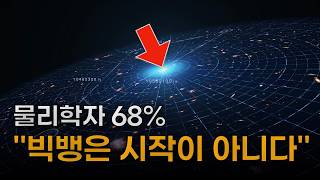
Using a car as an analogy, it is asking whether the universe is still stepping on the gas pedal, gradually lifting its foot off, or if it has finally hit the brakes.
This question does not stop at simply predicting the future of the universe. It is a controversy regarding the essence of dark energy, which is currently believed to account for about 70% of the total energy in the universe. It has shifted toward questions of whether dark energy truly exists, whether it remains constant over time, or whether it increases or decreases depending on the era.
This massive story began in 1998. Two research teams observed Type Ia supernovae that exploded in galaxies deep in the distant universe. One team was led by Saul Perlmutter, and the other by Brian Schmidt and Adam Riess. What they originally intended to confirm was how much the expansion of the universe was "slowing down" due to gravity. At the outset, they began their research with the goal of confirming decelerating expansion, not accelerated expansion.
The universe is filled with a great deal of matter. Matter pulls on itself through gravity. Therefore, even if the universe expanded after the Big Bang, the gravity of matter should act like a brake, gradually slowing the expansion of the universe. This is a much more natural prediction. However, both teams observed the exact opposite. The distant supernovae analyzed by the Riess team appeared to be about 10–15% farther away on average than predicted by existing values in a low-density universe without dark energy. The Perlmutter team reached a similar conclusion using 42 high-redshift supernovae. The fact that distant supernovae looked dimmer than expected was interpreted to mean that they were further away than expected. It meant that from some point in the past, the universe had been expanding faster than anticipated, pushing them further out. Thus, both teams concluded that the expansion of the universe was not slowing down, but rather accelerating.
For this discovery, Perlmutter, Schmidt, and Riess were awarded the Nobel Prize in Physics in 2011. The problem then arises: what on earth is making the expansion of the universe accelerate?
In general relativity, cosmic acceleration does not happen easily just because there is a lot of energy. Normal matter and radiation decelerate the expansion of the universe through gravity. To accelerate the expansion, something very strange with a positive density but negative pressure is required. Expressed as a cosmological equation of state, the acceleration/deceleration of the universe can be represented as ρ + 3P/c^2 (combining energy density (ρ) and pressure (P)). For the universe to accelerate, this value must be negative. The pressure must be less than minus one-third of the energy density for the universe to expand in an accelerated fashion. Astronomers call this bizarre component, which is entirely unfathomable, "dark energy."
The laziest and most convenient interpretation is the "cosmological constant," which suggests that empty space itself possesses energy. In this case, dark energy has perfect negative pressure, and the equation of state for dark energy becomes -1. This creates a very strange state where the density neither decreases nor changes even as space expands. However, this is merely a mathematical description, not a confirmation of its existence. We still know nothing about what dark energy is or if it truly exists. If one simply assumes that vacuum energy is dark energy, an overwhelming amount of dark energy emerges, far exceeding what is needed to explain the universe. This is no solution.
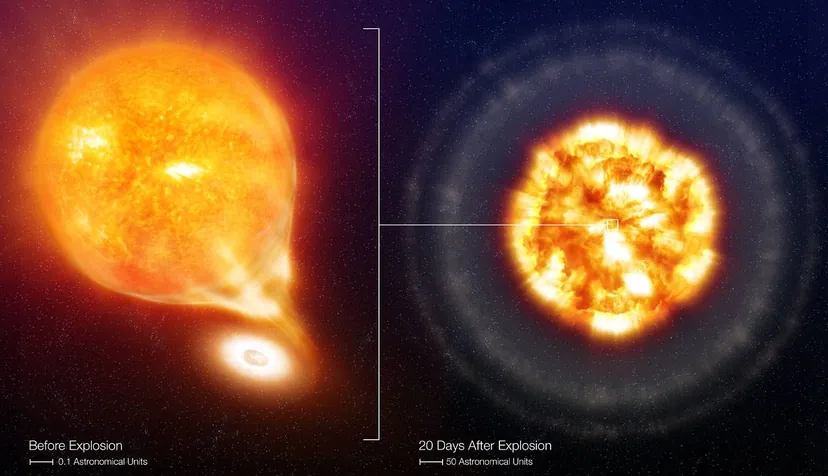
However, the discovery by the supernova research teams at the time had one important premise: that we knew exactly how brightly Type Ia supernovae shine. A Type Ia supernova is the result of a thermonuclear explosion occurring in a stellar system containing a white dwarf. A white dwarf is the remnant left behind after a star with a mass similar to the Sun finishes its lifespan. It is a high-density celestial body with the mass of the Sun compressed into the size of Earth. If the white dwarf is not alone but has a companion star, it steals matter from the companion and becomes heavier. It was understood that the moment the white dwarf becomes heavier than the "Chandrasekhar limit"—1.4 times the mass of the Sun—a supernova explosion occurs.
But today, the explosion mechanism of Type Ia supernovae has become more complex and diverse. Explosions occur in various ways, not just in binaries where a white dwarf is paired with a normal star. Type Ia supernova explosions with similar spectral patterns can occur when two white dwarfs collide. In this case, a spark starting on the surface of a white dwarf can lead to an explosion at a mass lower than the Chandrasekhar limit. We still have no grasp of what proportion of these different types of explosions occur among the Type Ia supernovae observed in the universe. Therefore, treating Type Ia supernovae as perfect "standard candles" that always explode with the same brightness could be a flawed premise.
However, by measuring how quickly the brightness fades after the explosion and how red the light appears, the original brightness of a supernova can be corrected to some extent. Generally, brighter supernovae tend to dim more slowly after reaching peak brightness. This is called the width-luminosity relationship of supernova light curves. Astronomer Robert Tripp created a technique to standardize the brightness using these light variation patterns, and many studies have since utilized the correction equation created by Tripp.
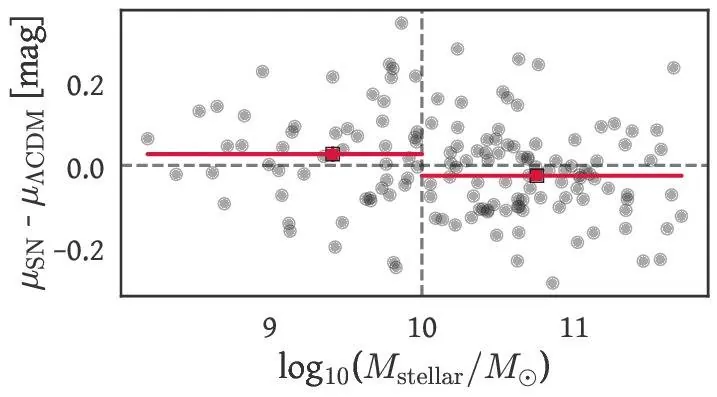
But even after such corrections, subtle differences remain. A prime example is the "mass step" of supernovae. Simply put, even after standardization, there is a subtle difference in the brightness of a supernova depending on the mass of the galaxy in which it occurred. Generally, there is a small difference of a few hundredths of a magnitude between supernovae that exploded in high-mass galaxies and those in low-mass galaxies. It is not yet clear whether this difference is due to the galaxy mass itself, or to factors that vary with mass, such as metallicity, light-obscuring dust, or star formation efficiency. The recent debate started right here.
What if the cause of the mass step stems from the age of the galaxy or the progenitor star before the supernova exploded? If there was actually a difference in the peak brightness of white dwarfs created from old stars versus those from young stars—even after standardization—it could lead to a serious bias as we observe the distant universe. Seeing a distant galaxy means looking into the deeper past of the universe. In other words, we are going back to a time when the universe was younger. While there are many relatively old galaxies in the supernova samples from the nearby universe, there are more young galaxies as we go further into the deep universe. If Type Ia supernovae that exploded in a young universe were actually dimmer even after standardization, we might mistakenly assume they appear dimmer because they are further away.
If so, the discovery of accelerated expansion, which led to the belief that the universe is expanding faster than expected, could be significantly shaken. It could be a fatal optical illusion stemming from the intrinsic brightness differences of supernovae based on the age of their parent galaxies and stars.
In 2025, a research team at Yonsei University reported a correlation of up to 5.5 sigma between the standardized brightness of supernovae and the age of their host galaxies. A difference of 0.03 magnitude appeared for every roughly 1 billion-year difference in the age of the host galaxy. The more the supernova exploded in a young star population, the dimmer the supernova tended to appear, even after standardization. If we compare the nearby universe and the distant universe in extreme terms, the difference in the ages of supernova host galaxies can be over 5 to 6 billion years. Considering this difference, the brightness of distant supernovae could appear about 0.16 magnitude dimmer. It may look like a trivial number, but in cosmology, it is a difference that can never be ignored.
In subsequent research, after additionally correcting for this age bias, they combined this with recent Cosmic Microwave Background (CMB) data and the massive galaxy distribution map from DESI. The result did not match the existing standard cosmological model that assumes dark energy at all. The difference was a staggering 9 sigma. Instead, q_0, the parameter showing whether cosmic expansion is decelerating or accelerating, came out to be 0.092, which is greater than 0. If this value is a positive number greater than 0, it means the universe is undergoing decelerating expansion. Although the margin of error remains large, it is a shocking result that could be interpreted as the universe already having entered a period of decelerating expansion. The important point is that the signs of the steep accelerated expansion of the universe known previously have almost vanished.
In response, the existing research team led by Adam Riess is offering fierce rebuttals. In a recent follow-up paper, the Riess team claimed there is a problem with the Yonsei University team's analysis. Their core argument is that the galaxy age effect and the existing mass step correction are not independent effects. The Yonsei team corrected for differences based on galaxy age and then applied standardization based on galaxy mass together. However, because galaxy age and mass are closely linked, they essentially performed the same correction excessively twice. They claim that if you correct the existing mass step first, there is no significant correlation between the standardized brightness of the supernovae and galaxy age.
They also rebutted the assumption that the host galaxies of distant and nearby supernovae would have an age difference of 5 billion years. They pointed out that such an assumption is exaggerated by about 3 to 5 times compared to the actual age difference. The Yonsei team did not strictly use the age of the progenitor star that created the supernova, but rather the age of the galaxy containing the supernova. While this is an unavoidable compromise due to observational limitations, it is also a significant limitation in that the age of the entire galaxy cannot be equated with the age of the specific star that exploded.
To further verify this issue, a joint research team led by Riess and Murakami analyzed the star formation history of approximately 7,000 galaxies where supernova explosions were confirmed. The result was that the average age of Type Ia supernova progenitors was 3.5 billion years. However, the difference in progenitor age that varies according to cosmic time was only about 1.5 billion years. With such a short age difference, the difference in brightness between distant and nearby supernovae is only about 0.007 magnitude. This effectively disappears to a level that has no significant impact within the margin of error.
However, the fight is not over. The Yonsei team pointed out that the results of Wiseman, who worked with Riess, analyzed galaxies across an excessively broad redshift range all at once, and thus intentionally made the correlation between age and brightness appear flat. They also pointed out that there is a problem with the dust model of the galaxy used when correcting the mass step. Rebuttals and counter-rebuttals continue without end.
However, the fight has reached a new phase with the announcement of the massive DESI data, which observed 14 million galaxies and quasars over the past three years. Combining DESI's observational results with the CMB, dark energy appears to be changing over time rather than being a constant cosmological constant, unlike the existing standard model. Depending on whether the supernova standardization method of the Riess team or the Yonsei University team is applied here, the results vary significantly. The DESI research team is still cautious. While they do not immediately claim that dark energy does not exist and that the universe is decelerating, they are betting on the cautious possibility that dark energy might not be a simple constant but a physical quantity that changes over time.
On top of this, a mathematical argument has emerged suggesting that dark energy itself might not be needed in the first place. By utilizing the Friedmann equations that describe the expansion and state of the universe, they found a new solution showing that the universe could become unstable with even very small perturbations. Standard cosmology assumes that the universe is uniform on large scales and identical in all directions. This is called the cosmological principle. If this assumption is applied, the average expansion of the universe can be explained by a simple Friedmann equation. However, the real universe is not perfectly uniform. There are superclusters where galaxies gather, and voids where there is almost no matter.
According to this latest analysis, the Friedmann solution is actually like the most ideal and unstable state of a pencil standing on its sharp tip. It is mathematically possible, but its realism is low. A tiny breath of air will cause the pencil to fall. Similarly, if there were small density fluctuations in the early universe, a solution that expands faster than the uniform Friedmann universe naturally emerges. It has been shown that even without adding new elements like a cosmological constant or dark energy, a phenomenon similar to accelerated expansion can occur within the framework of Einstein's original equations.
Of course, this does not directly support the Yonsei University team's argument. On the surface, both studies question dark energy through observation and theory, respectively. However, the Yonsei team questions the brightness correction of supernovae, arguing that accelerated expansion itself may be an illusion. Conversely, the recent theoretical analysis does not deny accelerated expansion. It agrees with accelerated expansion. It only argues that there is no need to assume dark energy to explain it.
The Yonsei University team, which doubts accelerated expansion itself, and the theoretical possibilities suggesting that dark energy may not be necessary even while acknowledging accelerated expansion—the battle among astronomers and physicists discussing the fate of the universe is becoming more complex and confusing.
This issue is expected to enter a new phase through more observations in the future. On June 30th, the Vera C. Rubin Observatory in Chile officially began the Legacy Survey of Space and Time (LSST), which will continue for the next 10 years. By continuously scanning the southern sky every few days, it plans to secure data related to 10 million supernovae over 10 years. It will acquire the largest amount of data, surpassing all supernova research produced to date.
Furthermore, observations from the new space telescope launched on August 30th, the Nancy Grace Roman Space Telescope, will provide new hints for supernova cosmology. It will uniformly observe Type Ia supernovae across the most extensive time range, reaching deep into the distant universe, free from the interference of the Earth's atmosphere.
I look forward to the conclusion of this heated battle gradually taking shape, at least within the next 10 to 20 years.
Who is the author Ji Woong-bae? He loves cats and the universe. After watching 'Galaxy Express 999' as a child, he dreamed of spreading the beauty of the universe. Currently, he is an assistant professor in the Division of Liberal Arts at Sejong University, participating in various science communication activities including lectures and writing. He has written books such as 'On the Uselessness of Astronomers', 'We Are All Born as Astronomers', and 'Strange Questions That Come to Mind When Looking at the Universe', and translated books such as 'How I Killed Pluto', 'Quantum Life', and 'UFO'.