

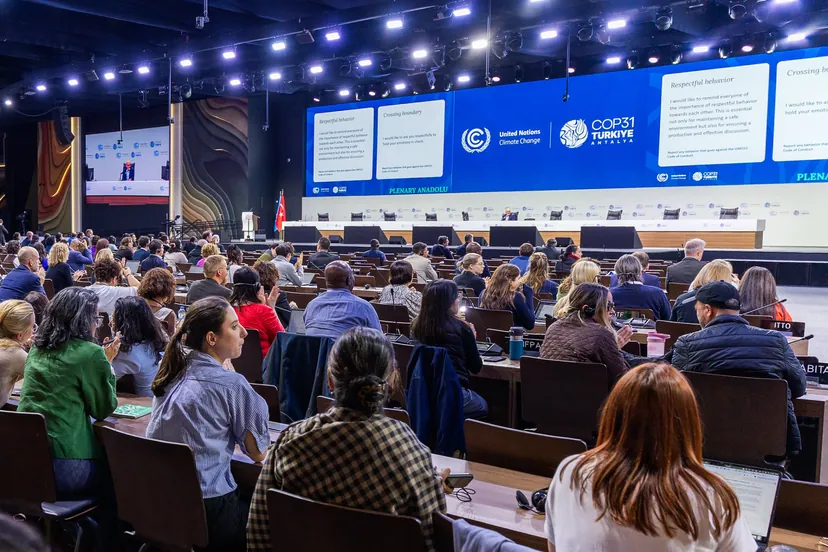
[BizHanKook] The 31st Conference of the Parties to the UN Framework Convention on Climate Change (COP31) officially opened on the 9th (local time) in Antalya, Turkey, marking the 10th anniversary of the entry into force of the Paris Agreement. The conference will be held for two weeks until November 20, with approximately 100,000 attendees, including government delegations from 198 parties, international organizations, civil society groups, and the industrial sector. The South Korean delegation is led by Minister of Climate, Energy, and Environment Kim Seong-hwan, consisting of government officials and experts. This year’s conference places greater emphasis on practical implementation agendas—such as global electrification, AI infrastructure management, and carbon reduction—rather than the drafting of traditional, formal negotiation texts.
Promoting South Korea’s "K-GX" for the Global Electrification Pledge
For the first time in the history of the COP, this conference operates under a split-leadership system. As the host country, Turkey manages the action agenda, while Australia, serving as the negotiation chair, leads the official discussions among parties. The schedule includes subsidiary body meetings for technical negotiations from November 9 to 14, 2026, followed by a high-level segment where heads of delegations will deliver statements from the 17th to the 18th. Minister Kim will participate in the high-level segment from the 16th to the 18th to deliver a national statement and hold bilateral meetings.
The "35 by 35 Global Electrification Pledge," proposed by Turkey as the top-priority action agenda, centers on a quantitative goal to increase the share of electricity in global final energy consumption to 35% by 2035. The South Korean government has decided to join the pledge by promoting its "Korean Green Transformation (K-GX)" strategy and "Electric Nation" vision. The government delegation is pushing for a memorandum of understanding (MOU) on decarbonization cooperation with Australia, discussing collaboration in industrial sectors like low-carbon steel, and co-hosting the "RISE ASIA" side event with the International Energy Agency (IEA) to address the resilience of Asian power systems.
Minister of Climate, Energy, and Environment Kim Seong-hwan stated, "We hope this 31st COP will serve as an opportunity to turn the promises of the Paris Agreement into concrete and practical implementation and advance climate multilateralism. South Korea will also take the lead in implementing the Paris Agreement by expanding the Korean Green Transformation (K-GX) into a global initiative shared with the international community."
Outside the official negotiation halls, discussions are underway among a voluntary coalition of countries seeking to establish a pathway for phasing out fossil fuels. After a roadmap for fossil fuel transition failed to be included in the official agreement at COP30 in 2025 due to opposition from oil-producing nations, the first "Transition Away From Fossil Fuels (TAFF)" meeting, led by Colombia and the Netherlands, was held in Santa Marta in April 2026, with 57 countries participating. While Asian nations like Bangladesh, Nepal, Singapore, and Vietnam attended, South Korea and Japan did not participate in the first plenary session despite submitting TAFF roadmap proposals.
South Korea and Japan have traditionally defined energy security as securing a stable supply of fossil fuels. However, with the 2026 Strait of Hormuz crisis causing volatility in LNG supply and prices, structural dependence on imported fossil fuels is increasingly viewed as a risk to energy security. From 2020 to 2022, South Korea provided an annual average of approximately $10 billion (about 13.8 trillion KRW) in public financing for overseas fossil fuel projects, ranking second globally after Canada. Analysts suggest that norms for fossil fuel transitions in global supply chains are being formed while major Asian importers remain on the sidelines.
AI Data Center Regulatory Vacuum and the "Antalya AI Pledge"
Introduced as an independent agenda item alongside the conference opening, the "Antalya AI Pledge" is a voluntary international commitment proposing the clean energy transition of AI infrastructure, improvement of power and water consumption efficiency, cost-sharing for grid expansion, and disclosure of information regarding the environmental impact of systems.
Jung Seo-yong, a professor at Korea University’s Division of International Studies, explained, "Soft laws such as declarations or initiatives, while not legally binding, carry significant weight in that they allow countries and companies to express political commitments and serve as a starting point for new discussions."
Major overseas nations are moving toward institutionalizing data center regulations. Through its Energy Efficiency Directive (EED), the European Union has mandated the disclosure of energy and water consumption and Power Usage Effectiveness (PUE) for facilities with IT equipment power demand exceeding 500kW. PUE is calculated by dividing the total energy consumed by the data center facility by the energy used by IT equipment for processing; if all power is used for IT, the value is 1. The UK recommends a PUE target of 1.3 or less for new data centers and has set standards for fair cost-sharing in power grid infrastructure. China only issues new permits for data centers with a PUE of 1.5 or lower and has set a 80% renewable energy target for national hubs.
In contrast, while South Korea announced plans to expand AI data center power demand to 18.4GW by 2035 through three major projects, climate and environmental regulations remain in a vacuum. Although the Board of Audit and Inspection requested improvements in the data center management system and the setting of power efficiency targets in 2025, these have not been implemented as policy. In response, the Green Transition Institute, People’s Solidarity for Participatory Democracy, and Korea Environmental Justice issued a joint statement on the 9th, urging the government to join the pledge and introduce climate and environmental regulations for data centers.
Choi Ki-won, team leader of the Economic Transition Team at the Green Transition Institute, stated, "If we are to invest in new data centers or AI infrastructure moving forward, I believe it is crucial to mandate and institutionalize the procurement of carbon-free electricity. In particular, South Korea currently lacks any such legal framework. In this situation, participating in an international pledge can serve as a starting point for the government to demonstrate its will to implement policy."
1.5℃ Reduction Path and South Korea’s Homework Ahead of the Second GST
Coinciding with the start of the second Global Stocktake (GST), which will run through 2028, the adequacy of South Korea’s Nationally Determined Contributions (NDCs) is being put to the test. The government has set a target of a 53–61% reduction from 2018 levels by 2035, but critics point out that at least a 61% reduction is necessary to align with the 1.5℃ pathway, while civil society is demanding at least 65%. The reliance on international mitigation, which accounts for 13% of the reduction target, is also being pointed out as a concern.
Han Soo-yeon, a policy campaigner at Plan 1.5, stated, "South Korea's NDC fills 13% of its total reduction target through international mitigation, effectively shifting the burden of domestic reduction abroad. We must implement our NDC through domestic reductions rather than international achievements that lack environmental integrity."
Responsibility for financial contributions is also being raised. The total amount raised for the UN Fund for Responding to Loss and Damage (FRLD) stands at $820 million (about 1.13 trillion KRW), which is 0.2% of the annual requirement, and the South Korean government’s contribution of $7 million (about 9.7 billion KRW) accounts for only 0.85% of the total fund.
Min Jeong-hee, Executive Director of the International Climate Religious and Citizens Network, urged, "Given that South Korea is one of the world's top 10 emitters and recorded the second-largest current account surplus after China this year, the government must champion climate justice principles and climate science during negotiations, and promise and implement bold, responsible financial contributions beyond mere subsidies."