

[비즈한국] The expansion of artificial intelligence (AI) investment is reshaping the order landscape of the domestic construction industry. As growth in the housing sector slows down, large-scale data centers and the power infrastructure to support them have emerged as a new market. Major construction companies are also expanding their business scopes to include development, investment, and power and energy sectors, building upon their existing construction capabilities.
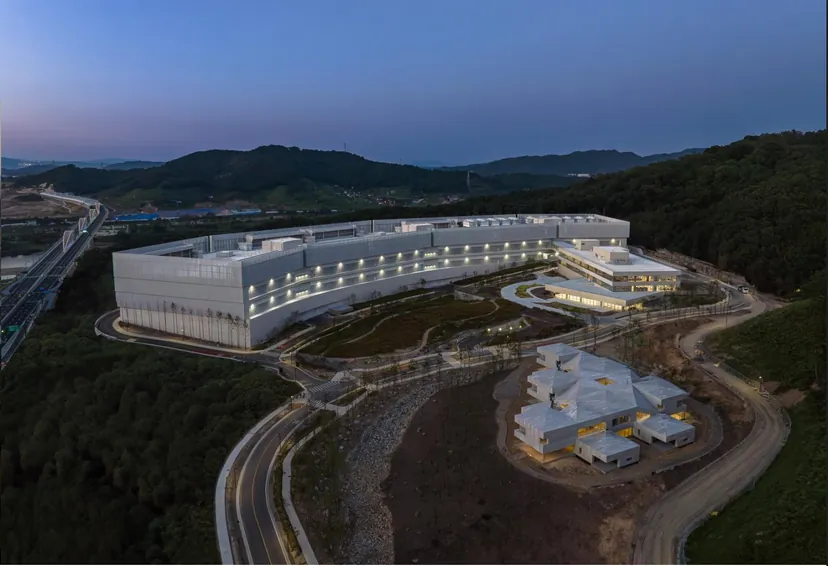
Data centers to fill the housing void… High technical barriers to entry
The backdrop for construction firms accelerating efforts to secure new work lies in the shrinking scope of their housing businesses. In the first half of this year, profitability in the housing sector for major domestic construction firms entered a normalization phase as high-cost projects, which had started during a period of surging construction costs, began to clear. Conversely, housing revenue remains in decline, and many firms have missed their initial targets for new pre-sales (Related article: Operating profit of top 5 listed construction firms rose 25% in the first half... The effect of reduced ‘high-cost projects’).
AI data centers have emerged as the business to fill that void. The government plans to build 8.4GW worth of AI data centers by 2029 in collaboration with SK, GS, and Naver, and to expand the total capacity to 18.4GW by 2035. Separately, telecommunications and IT service companies are also announcing their own expansion plans. While individual data centers are growing to a scale of around 100MW, the creation of GW-class clusters that bundle multiple facilities is also being pursued.
The scale of the AI data center construction market is also significant. On the 10th, LS Securities estimated the related construction market size to be around 100 trillion won, based on long-term AI data center expansion goals announced by major domestic companies. This result applies a construction cost of 12 billion to 13 billion won per MW based on IT load capacity. AI data centers are considered a market with high entry barriers, as mechanical, electrical, and plumbing (MEP) work accounts for 70-80% of construction costs, and the designs for cooling pipes and high-density power distribution are complex.
Lee Gyu-eun, an associate research fellow at the Construction & Economy Research Institute of Korea, said, “As the housing market has become very difficult, many companies are paying attention to data centers as a new future growth engine. However, since AI data centers are mainly handled by a few top-tier companies, it is still difficult to judge how large the market will become or how much it will affect the overall construction market. Furthermore, there is not yet a sufficient supply of personnel to actually perform the construction.”
So far, GS E&C and Hyundai E&C are leading in data center track records. GS E&C and its affiliate Xi C&A have the most data center completions, totaling 17. Hyundai E&C is estimated to be number one in terms of completed capacity. Currently, Xi C&A is carrying out projects in Paju and Sejong worth 320 billion won and 526 billion won respectively, while Hyundai E&C is building data centers in Incheon Gajwa and Ansan, with projects valued between 500 billion and 800 billion won.
Other major construction firms are also accelerating their order intake. Samsung C&T is executing data center projects worth approximately 2 trillion won at 5 sites both domestically and abroad, including Ansan, Yongin Deokseong, and the National AI Computing Center. DL E&C has taken on a 360 billion won Gimpo data center project, while its subsidiary DL Construction has secured a 126.8 billion won Bucheon data center project. Daewoo E&C completed a 350 billion won Gangnam data center last year and is now pursuing follow-up orders.
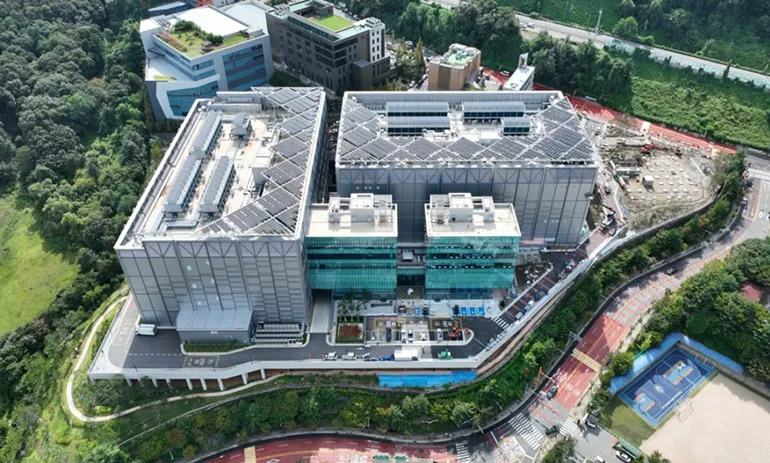
Beyond construction to development and investment… Power infrastructure is also a new revenue stream
Along with market expansion, the roles of construction firms are also changing. Samsung C&T has participated as an investor in the Ansan Global Cloud Center, which is currently under construction. It secured the main construction contract after providing Pre-construction Services (PCS), which involve reviewing designs, construction costs, and schedules before groundbreaking. GS E&C also made an equity investment while constructing the Anyang Epoch Data Center. This is a method of participating in investment and design from the early stages of a project, rather than simply winning a contract to build it.
The need to secure power infrastructure is also increasing due to the trend of data center upscaling. AI data centers consume more power than general data centers and require a stable 24-hour supply. LS Securities analyzed that power demand for semiconductors and AI data centers from the three major mega-projects would reach 6.3GW and 18.4GW respectively, totaling 24.7GW. If the expansion of power generation sources and transmission/substation networks becomes a reality, large nuclear power plants and Small Modular Reactors (SMRs) could also emerge as new order sources for construction companies.
Attempts to link data centers with power generation businesses are also appearing. Samsung C&T began developing a business model in Sweden in 2024 to supply electricity directly from SMRs to data centers, and this year, it proposed the ‘Data Center (DC) + Power Generation Integrated Business’ as a new business model. The GS Group is also pushing for the construction of a large-scale AI data center in the Bukpyeong 2nd General Industrial Complex in Donghae, Gangwon Province, which is adjacent to a power plant.
A construction industry official said, “Driven by the spread of the AI industry and the expansion of global big tech investments, the domestic and international AI data center market is expected to maintain its growth trend in the mid-to-long term. As large-scale power infrastructure and high-efficiency cooling technology are required, business opportunities for construction firms with relevant capabilities will also expand.”