

[BizHanKook] It has been confirmed that there has been a significant recent increase in cases where redevelopment projects undergo re-verification of construction costs after an initial verification has already been completed, due to further cost hikes. In all cases where re-verification was conducted, the construction costs were reduced. Overall, the construction costs proposed by contractors decreased by 28% during the re-verification process. However, as there is no obligation to reflect the verification results in the actual contract, the effectiveness of the system remains limited.
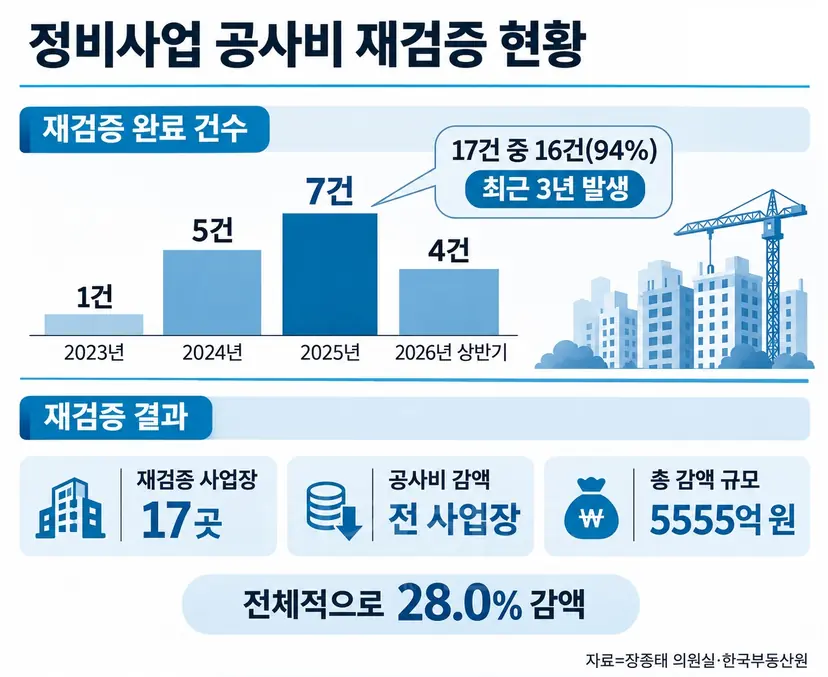
According to data received by the office of Rep. Jang Jong-tae of the National Assembly's Land, Infrastructure and Transport Committee from the Korea Real Estate Board, a total of 17 projects have undergone construction cost re-verification from the introduction of the system in 2019 through June of this year. The number of re-verification cases grew from 1 in 2023 to 5 in 2024, 7 in 2025, and 4 in the first half of 2026. This means that 16 out of the 17 total cases (94%) have occurred in the last three years.
Construction cost verification is a system where a specialized agency examines the appropriateness of the costs proposed by the contractor in a redevelopment project. The current Urban and Residential Environment Maintenance Act requires the project implementer to request a cost verification if: 20% or more of the land owners or union members demand it; the construction cost increases by more than 10% from the initial contract amount after selecting a contractor before the business implementation plan approval; or the cost increases by more than 5% after selecting a contractor following the business implementation plan approval.
Construction cost re-verification targets projects that have already completed one round of verification. According to the Urban and Residential Environment Maintenance Act, if the construction cost (excluding producer price index increases) rises by more than 3% again from the contract amount at the time of the initial verification, the project implementer must request a re-verification from the auditing agency. This structure triggers a re-verification process whenever costs that have already been validated for appropriateness rise again beyond a certain level.
Construction costs were reduced in all projects that underwent re-verification. Out of the 1.9818 trillion won in total construction costs proposed by contractors across the 17 re-verified sites, 555.5 billion won (28.0%) was cut during the verification process. The reduction for individual projects ranged from a minimum of 1.6 billion won to a maximum of 148.6 billion won, with reduction rates reaching as high as 47.1%. In 9 out of the 17 total re-verification cases, more than 20% of the contractor's proposed amount was cut.
The scale of the reduction for some sites exceeded 100 billion won. In a reconstruction project in Seoul this year, the contractor proposed 335.4 billion won during re-verification, but the result led to a reduction of 148.6 billion won (44.3%) to 186.8 billion won. Last year, a reconstruction project in Gwangju saw 108.6 billion won (29.7%) cut from a proposed 365.9 billion won, and a redevelopment project in Gwangju this year also saw a reduction of 72.7 billion won (34.0%) from 214 billion won.
However, the results of the construction cost verification have no binding force. Under the Urban and Residential Environment Maintenance Act, project implementers must undergo verification when certain requirements are met, but they are not forced to adjust the construction costs in the final contract to match the verification results. There are no separate regulations requiring the submission or management of actual contract amounts following verification, making it difficult to determine how much the results are actually reflected in the final contracts.
The government is currently inspecting whether construction cost verification requirements are being followed. A survey conducted by the Ministry of Land, Infrastructure and Transport and local governments between August and September of reconstruction and redevelopment project sites across the country that had selected contractors showed that 138 out of 568 sites had failed to implement the legal cost verification procedure. The Ministry has selected 16 of these sites for special inspections. If illegal activities are confirmed, they plan to issue corrective orders or request investigations.
Lee Eun-hyung, a senior researcher at the Research Institute of Construction Policy, explained, "The increase in re-verification cases is due to the fact that construction costs themselves are continuously rising due to inflation and other factors. Although the verification results are not legally binding, they can be used as an objective standard provided by a third party when unions and contractors negotiate construction cost hikes. Even if negotiations break down and lead to litigation, these results can serve as reference material for the court."