

[비즈한국] An artist who makes everyday life seem the most unfamiliar has chosen chicken as their soul food. Because Choi In-sun is known for making daily life—and the very format of comics themselves—feel strange through brilliant imagination and expressive power, their answer felt, ironically, unfamiliar. It makes sense, though; as Jung Eun-jung, author of “The Republic of Korea Chicken Exhibition,” put it, chicken has been the number one menu item for dining out since 1997 and is already “the soul food of Koreans.” I wondered if the chicken story of Choi In-sun, an “auteur” artist renowned for maintaining their own style while exploring both creative output and artistic spaces, might differ from the clichéd repertoire that begins with “the warm chicken my father pulled from his coat on payday.” Recalling Choi Gyu-seok’s short comic “Love is Protein,” where the soul of a chicken named ‘Dak-dori’ emerges through burps and farts to ascend to heaven, I visited a chicken restaurant in Yeongdeungpo-gu that has been open for over half a century.
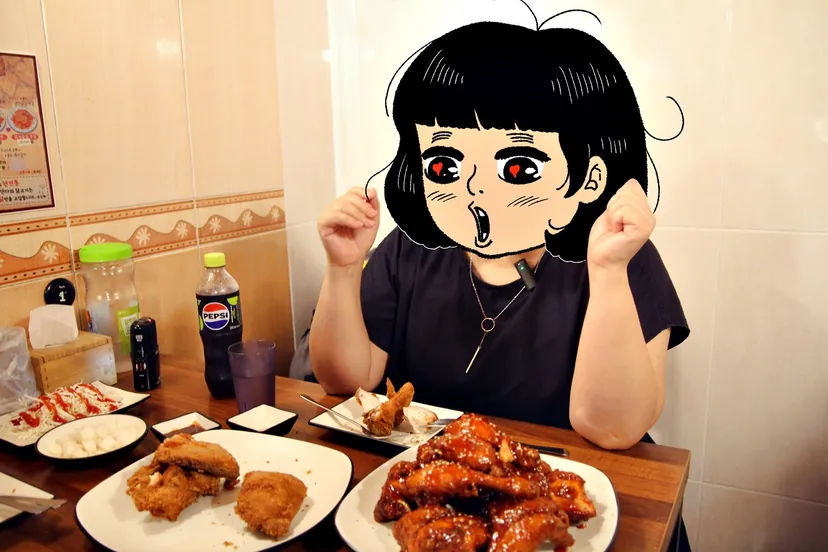
Chicken from the Days When Not Eating It Meant Falling Ill
When artist Choi In-sun was a high school student, Korean-style branded chicken franchises began to emerge. Even then, “tongdak” (whole roast chicken), including electric-rotisserie styles, was quite popular, but the arrival of “fried” and “seasoned” chicken was so sensational that it made previous varieties feel like a prehistoric form of chicken. The artist also loved the handmade sundae from the Heukseok-dong market near where they lived, but it couldn't compare to chicken at that time.
However, even though they had awakened to the taste of chicken, there were days when seeing chicken was a distant dream if their parents didn't buy it; the artist would get physically ill if they didn't have chicken for ten or twenty days. Since chicken always appeared whenever they were bedridden like that, it’s hard to tell whether the illness was a real sickness or something the artist brought upon themselves.
Even when there was an opportunity to eat chicken, there were four siblings, so competition for popular parts like wings and legs was fierce; the competition between the son, who usually monopolized the milk and yogurt, and the daughters, who had to steal them, was an uneven playing field from the start. From then on, the artist’s wish was “my-money-my-bought” (self-purchased) chicken.
At twenty-five, immediately after debuting with the short story “Moebius Strip,” the artist took their first paycheck and headed to a chicken place in front of their house. Although they had no particular connection to Mexico, they ordered half a chicken at a place named after the country, savoring their economic and emotional independence while eating alone. Afterward, relying on the remaining money and the monthly payments to come, they bought a high-end desk in 12-month installments. The serialization ended in just a couple of months when the magazine company suddenly closed, leaving only ten months of installments like cold leftovers. Still, it’s fortunate that they have been using that desk well for over thirty years.
While the artist says they don't like chicken as much as they used to now that they can eat it without being sick, seeing the hint of excitement on their face when faced with the chicken, it’s clear they still love it.

“Shouldn't We Be Doing More Than This?”
When the artist was in the 5th grade of elementary school, they were rumored to be quite good at drawing. A friend named Yeon-hwa from the next class came to visit. After verifying the drawing skills, Yeon-hwa grabbed the artist’s hand, saying there was someone else in another class they should meet. The friend met through Yeon-hwa was Lee Bin, who would later draw “Gaeddongi,” “MANA,” and “Hello Jadoo.” From that day on, the three gathered in the attic of Yeon-hwa’s house and spent time drawing comics. Then, one day, Yeon-hwa suddenly said, “Shouldn't we be doing more than this?”
Yeon-hwa, who had excellent planning and execution skills, took her friends to the Sadang-dong home of Im Eun-mi, a friend of her high school sister, who would later draw “Rain” and “Sunflower Love Song” under the pen name ‘Gimin.’ For them, Im Eun-mi’s room, where over a thousand comic books were stacked on bookshelves lining every wall, was a paradise on earth. After about a year of meeting each other and exchanging letters, Im Eun-mi, who had by then become an apprentice to cartoonist Lee Myung-shin, said, “Shouldn't we be doing more than this?”
They decided to expand the group and form a club, and were joined by artist Lee Hyang-woo (who drew “Astronaut”), artist Moon Gye-ju (“Mom is a Magician”), and her sister Moon Hye-ran. Everyone was either a middle or high school student or just barely an adult, long before they debuted as professional artists. This club, formed around the time Choi In-sun was in their third year of middle school, is ‘Gyeol,’ a name that cannot be left out of the history of Korean amateur comic clubs, alongside ‘KGB,’ ‘PAC,’ and ‘Aram.’
They named the group ‘Gyeol’ (meaning connection/grain), signifying that they were linked together, and began making fanzines. In an era when desktop publishing was unimaginable, they went to Chungmuro to learn everything one by one and began making books. Recalling how they learned pen-drawing techniques like “mang-kkagi,” “dollyeo-chigi,” and “dae-chigi” from the highly skilled Im Eun-mi, the artist drew overlapping lines on a memo pad obtained from the restaurant owner.

At that time, these amateur clubs tended to aim for professional careers with a focus on original creative work, and indeed, quite a few of them debuted as leaders of magazine comics after the 1990s. ‘Gyeol,’ where most of the founding members became professional artists, well illustrates that trend. ‘Gyeol’ published a fanzine every three to four months, and in the late 1980s, held their first solo exhibition, “Winter Entry,” at a gallery in Gangnam, Seoul, the first for any fanzine group.
Artist Choi In-sun left the club after about a year to prepare for art school. Around the same time, artist Lee Bin was scouted by the club ‘Ism’ as their work “The Last People,” published in the fanzine, gained popularity. The artist remarked that the energy of ‘Ism’ at the time seemed to have carried over to the underground magazine ‘MIX,’ and later to ‘Nine.’
Reflecting on those days, artist Choi In-sun said that they and Lee Bin were “people who dig deep in one spot,” so they needed people like Yeon-hwa, who brought them together, or Im Eun-mi, who proposed the formation of ‘Gyeol,’ to lead them toward new orientations. Now that they have become a mid-career artist who must set goals and drive themselves without anyone’s help, they continue a never-ending contemplation on “sustainability as a cartoonist.” While seeking paths by reading various types of books, they have recently been immersing themselves in Jungian psychology. The artist took note of how Jung tried not to be trapped within himself even while digging deep into his inner world. “It seems to explain the process of creating one’s own inner mythology without maximizing personal imagination very well. I thought maybe I could build my own worldview like that, too.”
The World Within, and the ‘100-100-100 Project’
In elementary school, artist Choi In-sun asked themselves, “Why was I born, why did I become me, and why am I invisible?” and began drawing comics to find the answers. Filling countless panels with pencils as they explored questions of existence and perception led to “Moebius Strip” (1995), the short story collection “The See-Through Guy” (1998), and “Drawing You” (2022). They depicted the world opened up by questions from the abyss. Like free-diving, popularized by the movie “The Big Blue,” they measured the depth of the abyss with only their own breath. As contemplation of images and details repeatedly turned into long silence and then burst forth like held breath, their world slowly deepened.
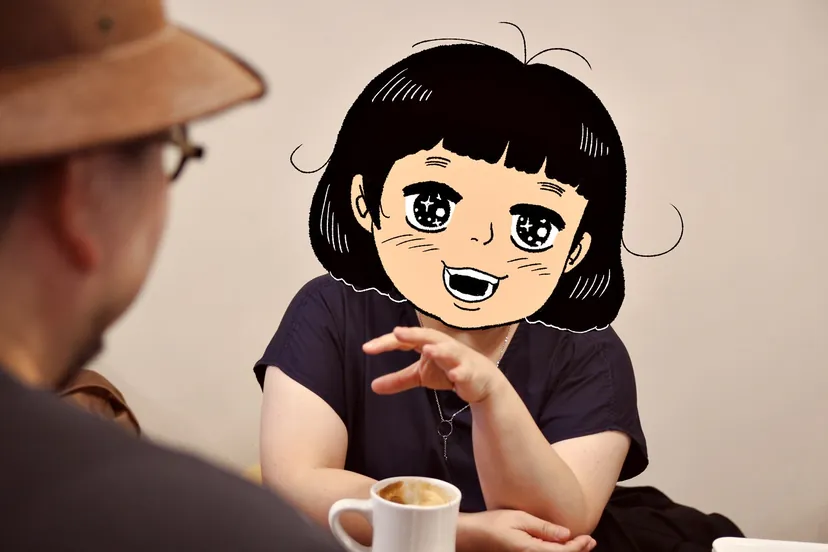
The questions continue to this day; the artist’s thought remains as space in time, and the time of thought is carved into space. Like a “Moebius strip” with no inside or outside (which is also the title of the artist’s debut work), the time and space of thought are connected. When the artist said, “But it can’t be helped,” while explaining while walking along the strip, I suddenly thought of Arthur Danto’s “The Philosophical Disenfranchisement of Art.” Is this what a philosophical cartoonist is? I realized anew why their comics evoke a sensibility that cannot be explained by the clichéd expression of “unique sentiment.”
The artist, who long ruminates on ambiguous images and sensations drawn from ontological reasoning to express them in the format of short stories, finds their very existence as an author threatened since the 2000s, when the momentum of print comics slowed down. In a comic ecosystem centered on commercial webtoons that must be serialized weekly, authors who fail to produce commercial results are, contrary to Roland Barthes’ expectation, dying without the birth of a reader. There was a consensus that it is necessary to supplement systems so that comics aimed at new formats and values, pursuing the production of meaning rather than the reproduction of capital, can survive without being swept away by the swift currents of the market. Just as indie music and indie films brought new vitality to the established popular art market, couldn't alternative comics add meaning and depth to make the comic market more diverse?
Artist Choi In-sun, who cannot sit idly by waiting for the system to improve, has devised a self-rescue measure called the ‘100-100-100 Project.’ It is to make 100 pages of comics, 100 copies, with 1 million won. Of course, there is no content about livelihood in this plan. So, the scheme for making a living—busily hopping between exhibitions, education, and creative support projects—must follow as they have done until now. Yet, there was energy and excitement in their story of living as an artist without being worn down by the grind. It seemed that the artist has started to ask questions of themselves and find their own way forward, even without anyone leading them. “Shouldn't we be doing more than this?” I applaud the artist’s evolution.
As an auteur artist, they have also actively responded to the changing media environment, from the 2003 Flash video “Small Room” to the daily series currently being released on Instagram. In October 2022, they established the one-person publishing house INSUNNY, released their first full-length book “Drawing You,” and serialized “Jeonghwa,” a webtoon series about independence activists. Their 2014 Angoulême International Comics Festival submission, the Japanese military comfort women comic “Where Are We Going?”, sparked a significant response on social media immediately after its release. Other serialized short works include “Starting,” an entry for the 2009 Bucheon International Comics Festival, “The Old Cartoonist’s Story,” a 2016 Bucheon International Comics Festival entry, and “Dalgeori,” an entry for the 2018 Naver special exhibition of 1990s debut artists, ‘Korean Comics 1990.’
The blog is https://blog.naver.com/catspace, and Instagram is https://www.instagram.com/insuncat/.