

[비즈한국] There are many policies aimed at curbing Seoul's housing prices. However, is there a sufficient policy to take responsibility for the next contract of a person who must live in a rented home in Seoul? This is a question the government must answer in a market where "jeonse" (lump-sum deposit) options are shrinking and the burden of monthly rent is growing. The expectation that solving the housing problem will come from inducing multi-home owners to sell and strengthening requirements for actual residency misses a crucial premise. Seoul is not a closed market where the current residents merely trade homes among themselves. It is an open market where demand from outside Seoul is constantly waiting to enter.
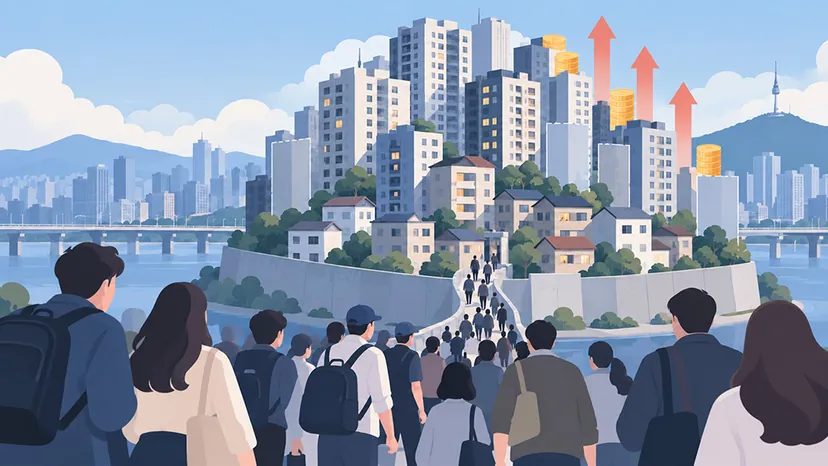
Workers who endure long commutes from Gyeonggi-do and Incheon dream of moving to Seoul. Parents in the provinces look for housing in Seoul as their children enter university or start their careers. Demand to access jobs, education, healthcare, and culture does not stop at administrative boundaries. The buying market is further influenced by the interest of overseas residents and foreigners. This does not mean that overseas demand dictates the entire market. It means that one cannot properly read the market by limiting the scope of those wanting housing in Seoul to only the population registered as Seoul residents.
Of course, not all latent demand is "effective demand" capable of signing a contract immediately. The scale that leads to actual transactions varies depending on prices, interest rates, income, and loan conditions. Nor do housing prices always rise just because it is Seoul. However, one should not judge that the desire to live in Seoul has disappeared just because transactions have decreased. People who lack the purchasing power look for jeonse, and those who lack the jeonse deposit look for "ban-jeonse" (a mix of deposit and monthly rent) or monthly rent. The demand to access Seoul persists while changing its form of housing.
Even if the landlord changes, the tenant's next home remains
The government's concept is understandable. It aims to reduce investment-purpose home ownership and increase the number of homes for sale to broaden opportunities for non-homeowners to buy their own houses. The direction is to induce transactions centered on actual residency and expand supply. The problem lies not in the policy goal, but in the process of reaching that goal. Not all non-homeowners are waiting to buy. There are households that cannot afford to buy right now, and households that choose to rent due to work or family circumstances. What they need are rental homes at a price they can afford to live in [住] right now.
There is a counterargument to the claim that if multi-home owners sell their houses, rental housing supply will decrease. The argument is that if an existing tenant buys that house, one unit of rental supply and one household of rental demand both disappear. That is true. A building does not disappear just because the ownership of a house changes. Therefore, it is not accurate to equate a multi-home owner's sale directly with a "jeonse crisis." However, for this explanation to be sufficient, one must also look at the movement of buyers and existing tenants, and changes in demand by region.
In Seoul, that point is important. If someone living outside Seoul buys a rental home in Seoul and moves in, that house is removed from the Seoul rental market. If the existing tenant still needs to live in Seoul, the rental demand remains. If the house the buyer vacated is in another region, rental conditions there might improve, but the Seoul tenant's workplace and their children's school do not move with them. This is why the explanation that the total number of houses in the country remains the same cannot account for the shortage of rental housing occurring in specific living areas.
Even if a tenant moves to their own home within Seoul, the market does not settle simply. There could be other demand waiting for the jeonse home they vacated. That said, it does not mean that latent demand is infinite or that every vacant house is immediately filled. The key is not to over-interpret the transfer of ownership of a single house as stability for the entire rental market. Residential stability in Seoul is determined by the relationship between available homes and households seeking those homes by living area, rather than by the number of owners.
Strengthening actual residency requirements could reduce rental supply
The actual residency obligation in "Land Transaction Permit Zones" should also be evaluated from this perspective. One must look at the effect of limiting investment demand and the impact on rental supply simultaneously. In transactions where the buyer must move in and live there, it is difficult to maintain the existing rental home as a rental. If the transaction of a house with a tenant is restricted, movement in both the buying and renting markets may not be smooth. Even if the policy goal of "actual residency" is justified, alternatives for tenants who must move in the process are not automatically provided.
The government, conscious of these conflicts, has introduced supplementary directions that recognize grace periods for actual residency and lease renewals. These are necessary measures. However, a grace period is a means to secure time for existing tenants to live there. Its effect is different from a policy that continuously increases rental housing. Even after the grace period ends, the government must answer whether there are enough homes to rent in that living area, and what homes are available for young people and newlyweds newly entering the market. Merely delaying the contract expiration date does not solve the supply problem.
Benefits for registered rental business operators should also be judged by the same criteria. Tax benefits are a policy tool that corresponds to obligations such as long-term leasing and limits on rent increases. If benefits are excessive or the system has been abused, it should be corrected. At the same time, it must be checked whether incentives remain for landlords to maintain stable rentals after the reduction of benefits. While registration cancellation does not immediately mean the extinction of jeonse, what kind of form the housing that was long provided under rent caps changes into is directly linked to the lives of tenants.
The cost of shrinking jeonse and switching to monthly rent falls on the tenant
We must also be wary of asserting that if a landlord's taxes rise, the cost will be passed on to the rent by the same amount. Rent is not decided solely by the landlord's wishes. If there is enough competing rental housing, landlords cannot raise it at will even if their costs increase. Conversely, if there is latent demand and a lack of substitute properties, the tenant's bargaining power weakens. Therefore, what policy should focus on is not just the landlord's cost increase itself, but the issue of maintaining a market where tenants can choose other homes.
Various factors such as interest rates, financial conditions, risks of deposit return, and the landlord's preference for cash flow work into the transition from jeonse to monthly rent. One cannot attribute every change to the result of a single regulation. However, policy intervenes in a market where these changes are already underway. If rental supply is even further constrained in a situation where the incentive to maintain jeonse is already weakening, the burden can grow. Explaining the shrinkage of jeonse as a long-term trend and responding to the rise in housing costs in that process are separate duties.
There is no need to call the increase in monthly rent a failure in itself. If one can live in a place for a long time at a reasonable rent, monthly rent can also be a stable way of living. The problem is when households pushed out of the jeonse market take on larger monthly expenditures without an increase in income. The increased housing cost reduces savings capacity and delays the accumulation of equity capital necessary to buy one's own home. If a policy intended to help non-homeowners buy homes makes it harder for tenants to build assets, the means and goals of that policy must be re-examined.
We must look at tenants' housing costs rather than just market prices
This is why we must worry about 2027. In living areas where there is little new apartment move-in, urban renewal displacement overlaps, and demand for workplaces and school districts is maintained, tenants' options could become even narrower. We should be wary of predictions that the whole country follows the same trend. Even within Seoul, there will be differences depending on the region and housing type. However, if buying restrictions and a reduction in rental supply act simultaneously in living areas where supply is scarce, the burden on households that find it difficult to both buy and rent will become even heavier.
Supply policies need a timetable. Promoting urban renewal and securing land is important, but plans and breaking ground are not homes that can be moved into immediately. While waiting for supply to come in a few years, the condition in which existing rental homes are maintained must also be managed. Public rental housing should not be evaluated by quantity alone. It must be supplied in the size and location that users need. Housing in places where commuting to work or school is difficult cannot fully replace the rental housing reduced in specific living areas of Seoul.
Private rental policy should also go beyond evaluating the number of homes owned and pay attention to the actual housing services provided. It is necessary to provide corresponding incentives to landlords who keep obligations such as long-term leasing, predictable rent, and deposit protection. Conversely, those who violate obligations or pass risks onto tenants must be held strictly accountable. Even when discussing the survival of benefits, one must first calculate what tenants gain or lose as a result.
To disperse demand, the competitiveness outside Seoul must also be improved. Options where one does not have to insist on entering Seoul will only arise when quality jobs, education, healthcare, and transportation are provided together. Just supplying homes outside administrative boundaries does not move the center of life. This, too, is a task that requires time. Therefore, long-term demand dispersal, short-term rental housing maintenance, and the expansion of actual move-in supply must be promoted simultaneously. One should not be used as a substitute for the other.
The report card the government should manage must also change. Not only sale prices and transaction volumes, but also new rental listings by living area, the possibility of contract renewal, and the burden of housing costs relative to income must be looked at together. If sales transactions have decreased but the tenant's monthly expenditure has increased, it cannot be said that residential stability has been achieved. As much as how many properties from multi-home owners have hit the market, it is important to see what conditions the households living in those homes accepted in their next contracts.
Seoul's latent demand does not disappear with just regulatory text. What policy can change is the conditions under which that demand finds housing and the path of supply. The people who suffer the most when that path is narrowed may be tenants who lack funds and have little freedom of movement. The government must now answer: While changing Seoul's landlords, are the lives of those who must rent in Seoul actually getting better?