

[비즈한국] When you go to New York, everyone walks through Central Park at least once. Looking at the forests and lawns stretching endlessly between the skyscrapers, you might think: "How did New York manage to save land like this in the heart of Manhattan?" This is land that could have been used for apartments, hotels, or office buildings. It is among the most expensive real estate in the world. Yet, New York chose not to build on it.
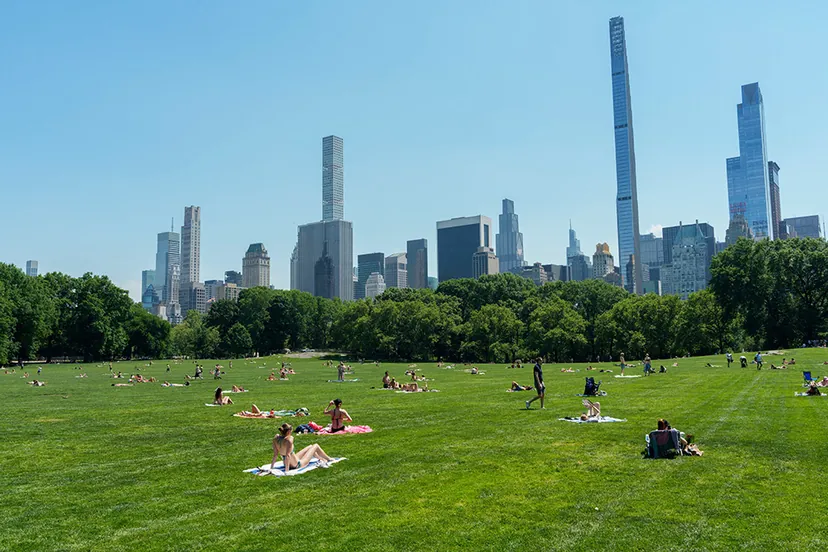
They preserved 843 acres, or about 3.4 square kilometers, as a park. Today, it attracts over 42 million visitors every year. We often admire this, saying, "New York surely planned the city well." However, if you look a little deeper into the history of Central Park, the story becomes more complex. Central Park was not originally empty land. People were living there.
New York Needed a Park in the 1850s
In the mid-19th century, New York was growing explosively. People were flooding in, buildings were going up, and the city was rapidly expanding northward. Residential environments were becoming congested, and there was a lack of space for citizens to access nature. New York decided that it should not continue to fill the entire city with buildings.
In 1853, the New York State Legislature passed a law designating approximately 775 acres between 59th Street and 106th Street in Manhattan as a large-scale park. The park's scope was later expanded to its current boundary at 110th Street. In 1858, the "Greensward Plan," designed by Frederick Law Olmsted and Calvert Vaux, was adopted.
What they wanted to create was not just a simple garden. It was a "space for everyone"—a place where the rich and poor alike could enter and find a momentary escape from the hectic city to encounter nature. From the beginning, Central Park was planned as a kind of democratic public space necessary for a major metropolis.
Viewed today, it is a remarkable decision. Even though it was clear the city would continue to grow, they chose to leave a massive plot of land in the heart of Manhattan vacant. But that decision came at a price.
1,600 People Were Living There
The area designated for Central Park was not a densely built-up residential district like it is today. Small farms, workshops, and houses were scattered between wetlands and rocky hills. But it was not empty land. To create the park, about 1,600 residents had to be forcibly displaced through eminent domain. While compensation was paid to landowners, many protested that the prices were far too low. By the end of 1857, all residents had to leave.
The most famous area among them was Seneca Village, located in the 80s on the west side of today's Central Park. Established in 1825, the village was home to about 225 people by 1855. About two-thirds were Black, and about one-third were of Irish descent. There were about 50 houses, three churches, a school, and a cemetery. Notably, for the Black community in New York at the time, it was rare that a significant number of residents owned their own homes and land. Since the right to vote was tied to property ownership for Black men, owning land meant more than just wealth. For them, Seneca Village was a home, a community, and a foundation for the hard-won freedom they had secured. And that village disappeared. To build a "park for all citizens," someone had to leave their home. It is the most ironic scene in the history of Central Park.
Yet, looking back 170 years later, one starts to think differently. What would have happened if New York had not made that decision back then?
Buildings would likely have been erected where Central Park is today. Perhaps they would have been residential at first. Over time, they would have turned into apartments, hotels, offices, and commercial facilities. And it is highly likely that we would not have the vast green space in the middle of Manhattan that we have now.
Central Park currently encompasses 843 acres of forests, lawns, lakes, athletic fields, and walkways, and it is used by more than 42 million people each year. Its over 18,000 trees lower the urban temperature and purify the air, and the park serves as a habitat for countless wildlife. And most importantly, you do not need to own an apartment to use Central Park. Tourists who don't own a single home in Manhattan can enter. Billionaires jog, students play, office workers eat lunch, and children run on the grass. While land values have become astronomically high, the most significant part of that land is still accessible without paying a dime.
This is the power of public space.
Ironically, the ‘Unbuilt Land’ Made the Surroundings More Expensive
From a real estate perspective, Central Park is also interesting. Generally, as a city grows, there is an urge to build as many structures as possible on good land. Based purely on economic calculations, this is logical.
But Central Park was the opposite. A massive area of the most valuable land was not developed at all. As a result, while the park generated zero sales profit itself, the environment and scarcity created by the park increased the value of the surrounding areas.
When we talk about the value of real estate, we often only look at the buildings. We calculate floor area ratios, how many floors can be built, or how many apartment units can be squeezed in. However, the value of a city is not determined solely by what is built.
Sometimes, what is not built is more important. This applies to parks, plazas, schools, riverfronts, cultural facilities, and walking paths. If a city fills all its land with profit-generating facilities, the city's overall appeal eventually declines. This is the first paradox Central Park teaches us: because they saved the most expensive land, the surrounding land became even more expensive.
But We Must Also Remember Seneca Village
This does not mean that Central Park's success justifies every decision made in the past. Even if a project is deemed necessary for the public good, to those who lived there, a house is not just a plot on a map. It is memories, a way of life, and relationships. Therefore, to properly understand the history of Central Park, one must accept two statements simultaneously.
The creation of Central Park was a great act of urban planning. Simultaneously, there were people who lost their livelihoods in the process. If you erase either one, you see only half the history. Public development cannot be labeled as "good" unconditionally, nor can we say nothing should be done if even one person is harmed. Cities must constantly change. Roads must be built, railways must be laid, parks must be created, and old districts must be redeveloped.
The important thing is not just whether to develop or not. Urban planning involves asking who bears the costs, whether compensation is fair, and who benefits from the development. Central Park has been asking those very questions for 170 years.
The Current Central Park Is Not Yet Complete
An amazing fact is that even this most famous park in the world is constantly changing. In 2025, the $160 million Davis Center opened at the Harlem Meer in the north. Old swimming pool and skating facilities were redesigned to be used as a pool in summer, an ice rink in winter, and a lawn space in spring and autumn. It specifically focused on increasing accessibility and usability for residents in the northern part of Central Park and the Harlem area. This is an interesting point. The city, which pushed out an existing community 170 years ago while creating the park, is now contemplating how to bring the surrounding community further into the park.
Urban planning also evolves with the times. If making the space was important in the past, now it is important to consider who can enjoy that space.
Parks Will No Longer Be ‘Nice-to-Have’ Facilities
Another role is being added to the future of Central Park: climate change. As urban temperatures rise and heavy rains become more frequent, the roles of forests, wetlands, soil, and waterfront spaces grow. The Central Park management currently uses the park as a massive laboratory to analyze climate risks and biodiversity, researching management methods to respond to future climate change. It has also operated the "Central Park Climate Lab" in partnership with institutions like the Yale School of the Environment.
If the park of the 19th century was a place of rest for city dwellers, the park of the 21st century is expanding its role as a resting place, an ecosystem, a heat response facility, a water management facility, and a communal space for the city.
Therefore, the criteria for evaluating a good city in the future will change. How tall are the buildings? How expensive are the apartments? How many corporate headquarters are there? It is becoming difficult to explain a city's competitiveness with just those metrics. How much do people want to walk? Where do children play? Where can one rest on a hot day? How much space is there to linger without spending money? These things are becoming increasingly important.
We Can Ask the Same Questions in Seoul
Looking at Central Park, we don't necessarily have to talk only about New York. The same conflicts repeat in our own cities. Should we pursue reconstruction and redevelopment? How should Yongsan be developed? How should the Han Riverfront be used? How much park and green space should be secured? Should we lift the Green Belt for housing supply? Is it right to save expensive city land for a park, or is it right to supply housing? There is not always a simple correct answer to these issues.
We need houses. We need roads. We need businesses. We need parks. This is why urban planning is difficult. Because we must decide what is needed today and what will be needed 50 years from now simultaneously. There is no way the people of 1850s New York could have accurately predicted the appearance of Manhattan in 2026.
But they made one choice. They decided that no matter how much the city grew, they would save at least one space for people to breathe. We are confirming the value of that choice 170 years later.
Great Cities Decide What to Preserve, Not Just What to Build
Walking through Central Park, the sky suddenly opens up wide between the forest of buildings. Looking at that scenery, we usually think of the great design of Olmsted and Vaux. But now, we need to look at it a bit differently. Beneath those lawns, there was once someone’s home. There were someone’s schools and churches, and children used to run and play. And a new public space was created on the ground where their lives disappeared.
That space, in turn, changed the lives of countless other people.
Central Park is, therefore, more than just a park. It is a massive history book that shows what kind of choices a city must make between individual rights and community interests. The Central Park of the past tells us: sometimes, bold urban planning is necessary for the future. The Central Park of the present says: good public spaces increase the value of the entire city. And the Central Park of the future asks: "What are we leaving behind for the next generation?"
A city does not become great by building many structures. A city that turns even its most expensive land into money is not the wealthiest city. Perhaps a truly wealthy city is one that can give the heart of its most expensive land to everyone.