

[비즈한국] Chung Yong-ji, CEO of Caregen, has revealed plans to develop needle-free, topical treatments for chronic diseases including Alzheimer’s disease and hypertension. The strategy is to expand their platform business by utilizing their proprietary next-generation topical drug delivery platform, ‘Luxidase,’ which enables drugs to cross the skin barrier and reach target tissues.
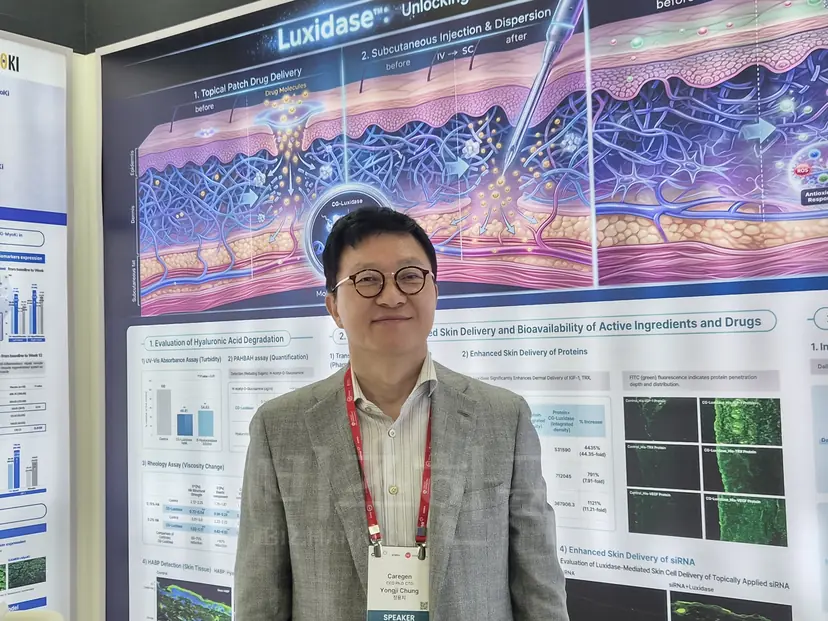
CEO Chung met with our publication on the 25th and stated, “We will develop ‘needle-free topical treatments’ not only for Alzheimer’s but also for chronic conditions such as hypertension.”
On this day, CEO Chung gave a presentation titled ‘From Oral Metabolic Peptides to Topical Drug Delivery: Caregen’s Next-Generation Peptide Platform Innovation’ at a side event of ‘CPHI/HI Korea 2026,’ a global pharmaceutical, bio, and health functional industry exhibition held at COEX in Gangnam-gu, Seoul.
The foundation of CEO Chung’s confidence is Luxidase, which Caregen developed in-house. Luxidase is a topical drug delivery platform based on extracellular matrix-penetrating technology that helps drugs pass through the skin’s epidermis to reach the dermis and target tissues.
Previously, there were limitations in sufficiently delivering active ingredients to tissues beyond the dermis due to the skin barrier. CEO Chung explained that Luxidase is a technology developed to secure pathways within the skin by utilizing Caregen’s peptide design technology, allowing drugs to be delivered to target tissues.
To verify the drug delivery potential of Luxidase, Caregen also conducted permeability tests using Rivastigmine, an existing dementia treatment. According to CEO Chung, the tests yielded data showing that drug release and permeability in the blood were approximately 4 to 5 times higher compared to traditional delivery methods.
However, these figures are results from Caregen’s internal testing; further preclinical and clinical trials are required to confirm efficacy and safety in the actual drug development process.
Caregen is also pursuing procedures to register Luxidase as a pharmaceutical excipient. CEO Chung said, “We are currently in active discussions with multinational companies for technology exports,” adding, “We are preparing for active pharmaceutical ingredient registration with the goal of late 2027 to early 2028, and there is high interest from major global pharmaceutical companies in Japan and China.”
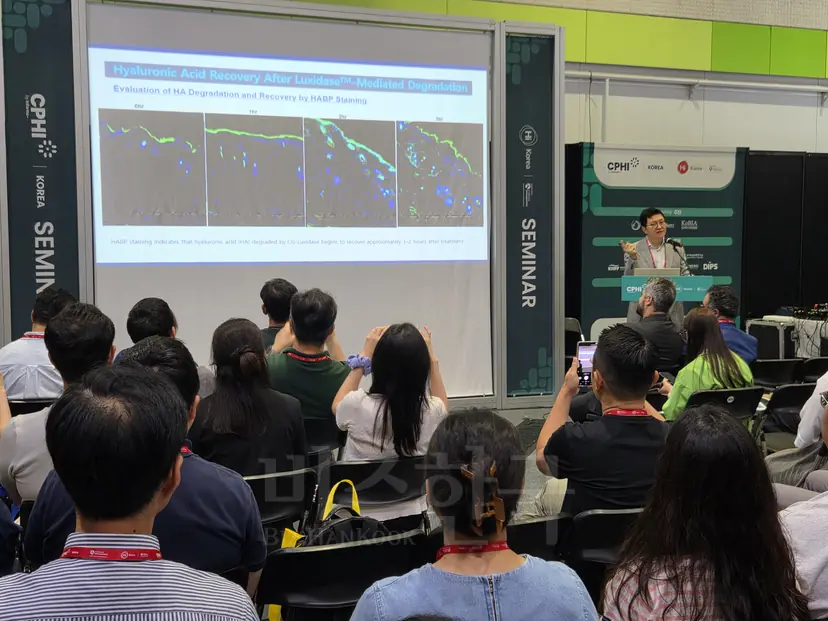
Luxidase is expected to be utilized not only for topical drug delivery to the skin but also as a platform to change the administration routes of injectable drugs. Caregen plans to apply Luxidase to the business of converting intravenous (IV) formulations into subcutaneous (SC) formulations.
Drug delivery technology that converts intravenous drugs into subcutaneous formulations is already commercialized in the global market. Leading companies in this field include Altogen in Korea and Halozyme in the U.S., whose drug delivery technologies are used in the development of subcutaneous versions of global blockbuster drugs such as Keytruda, Darzalex, and Opdivo.
CEO Chung emphasized, “We have applied for patents for this technology domestically and through the PCT (Patent Cooperation Treaty),” and added, “We are currently actively conducting preclinical trials. Since it can be universally applied to almost all drugs administered by injection, including anti-cancer drugs, it is receiving interest from multinational pharmaceutical companies.”