

[비즈한국] Follow-up legislative measures have been initiated following the Constitutional Court’s August 2024 ruling of ‘constitutional nonconformity,’ which determined that the state’s greenhouse gas reduction targets infringed upon the environmental rights of future generations. On July 22, 2026, the Subcommittee of the National Assembly’s Special Committee on the Climate Crisis voted to pass an amendment to the ‘Framework Act on Carbon Neutrality and Green Growth for Coping with the Climate Crisis (Framework Act on Carbon Neutrality).’
The most significant feature of the amendment is that it sets medium- to long-term Nationally Determined Contributions (NDCs) as a ‘range (upper and lower limits)’ rather than a single figure. However, voices of concern have been raised among civil society and experts regarding the impact this bill, the highest-ranking climate-related legislation, will have on subordinate systems such as the Emissions Trading Scheme and the Basic Plan for Electricity Supply and Demand.

The amendment specifies medium- to long-term reduction targets from 2031 to 2049. Specifically, it stipulates that targets be set by Presidential Decree within the following ranges: a lower limit of 53% and an upper limit of 61% by 2035; a lower limit of at least 69% and an upper limit of 80% by 2040; and a lower limit of at least 84% and an upper limit of 90% by 2045.
In addition to setting reduction pathways, various new provisions have been added. A principle was added requiring that when setting reduction targets, the impact on climate-vulnerable groups, scientific analyses by the Intergovernmental Panel on Climate Change (IPCC), and international standards must be comprehensively considered. The role of the National Institute of Climate Science under the Ministry of Climate, Energy, and Environment has also been expanded to carry out analysis and forecasting tasks regarding the total remaining greenhouse gas emissions (carbon budget) permitted after specific years.
The core point of contention regarding the amendment is the legal nature of the ‘lower limit’ within the range-based targets. The amendment defines the lower limit (53%) as a ‘linear reduction pathway’ that decreases at a constant rate until the 2050 carbon neutrality point, while defining the upper limit (61%) as a reduction pathway aimed at limiting the rise in global average temperatures to within 1.5℃.
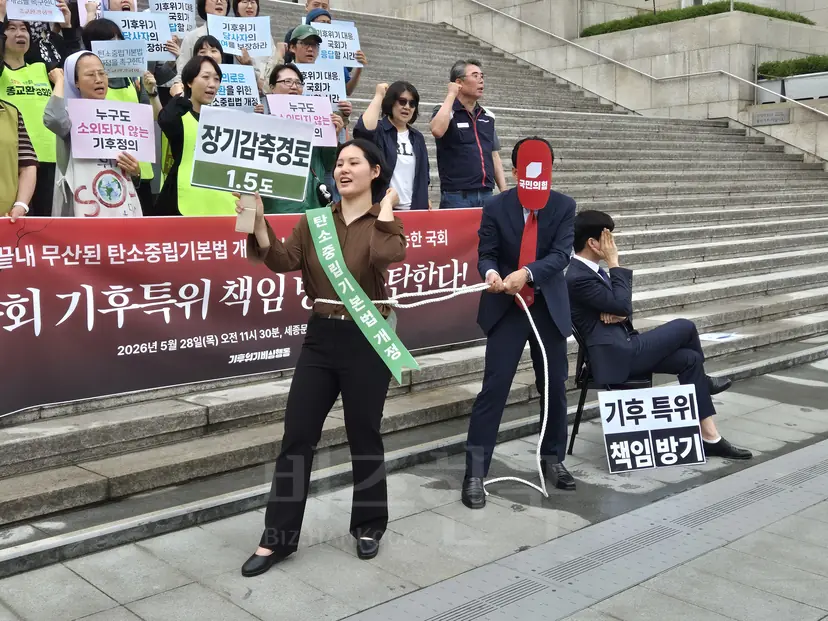
Civil society is pushing back. The organization Plan 1.5 issued a statement of condemnation, criticizing that setting a linear reduction pathway as the lower limit clearly goes against the intent of the Constitutional Court’s ruling. They argue that this results in shifting an excessive burden onto future generations to ease short-term reduction pressures. Furthermore, they pointed out that during the preceding public deliberation process in the National Assembly, 74.9% of citizens supported achieving the 1.5℃ target, while only 19.9% supported a linear reduction pathway, suggesting that this agreement also runs contrary to public consensus.
‘Lower Limit’ Acts as a Substantive Regulatory Benchmark
The reduction targets of the Carbon Neutrality Act take effect when they meet the Emissions Trading Scheme (K-ETS), a practical economic regulatory tool among subordinate systems. The Emissions Trading Scheme allows the government to allocate a total allowable amount of annual greenhouse gas emissions to companies and lets them trade remaining or insufficient permits in the market. This is a powerful yardstick that places a direct ‘carbon cost’ on corporate production activities.
The issue lies in the detailed provisions of the law. While the amendment sets medium- to long-term reduction targets as a range between an upper and lower limit, it explicitly states that the targets to which regulations like the greenhouse gas emissions trading scheme apply are those of the lower limit. Although the reduction pathway is presented as a range, legal binding force is aligned with the lower limit, meaning regulations will practically be applied based on that floor.
Choi Chang-min, a policy activist at Plan 1.5, criticized the move, stating, “The upper limit is effectively a ‘floating number’ with no connection to any regulations. Conversely, by specifying in the law that the lower limit is linked to substantive regulations, it is highly likely that the lower limit will solidify as the actual national NDC.”
Concerns of ‘Downward Leveling’ for Carbon Neutrality and Electricity Plans
The impact of the Carbon Neutrality Act extends to the ‘Basic Plan for Carbon Neutrality and Green Growth (Basic Plan).’ The Basic Plan contains detailed budgets and policies on how the state and local governments intend to achieve their medium- to long-term greenhouse gas reduction targets. Since the higher-ranking Carbon Neutrality Act provides a range between upper and lower limits, the national Basic Plan soon to be established is highly likely to design policies within this category.
Bae Bo-ram, deputy director of the Solutions for Our Climate, predicted, “In a situation where it is clear that the national Basic Plan will be established according to the legal minimum standard, the lower limit, it is unlikely that metropolitan and local governments will voluntarily include higher reduction targets in their plans.”
The ‘Basic Plan for Electricity Supply and Demand (Basic Electricity Plan)’ is also under the influence of the Carbon Neutrality Act. The Basic Electricity Plan is a comprehensive national power plan that forecasts long-term electricity demand for the next 15 years and determines how to configure power generation facilities and transmission/transformation networks accordingly. It is established every two years, with national greenhouse gas reduction targets as its core foundation.
Experts agree that as reduction targets are set as a range, policy uncertainty in the process of establishing the Basic Electricity Plan will increase. Deputy Director Bae Bo-ram warned, “If reduction targets are presented as a range, the options for the energy mix handled in the Basic Electricity Plan and elsewhere will become overly varied. Ultimately, if the overall policy direction, such as the timing of coal phase-outs or the expansion of renewable energy, is relaxed to align with the minimum standard—the lower limit—it will undermine the predictability of climate policy.”