

[BizHanKook] 'Butterfinger Pancakes,' once known as a first-generation American-style brunch brand in Korea, has entered rehabilitation proceedings. Butterfinger Pancakes has been considered a representative brand that led the domestic brunch craze. However, as its business scale has significantly shrunk due to a series of store closures, uncertainty regarding its future operations is mounting.
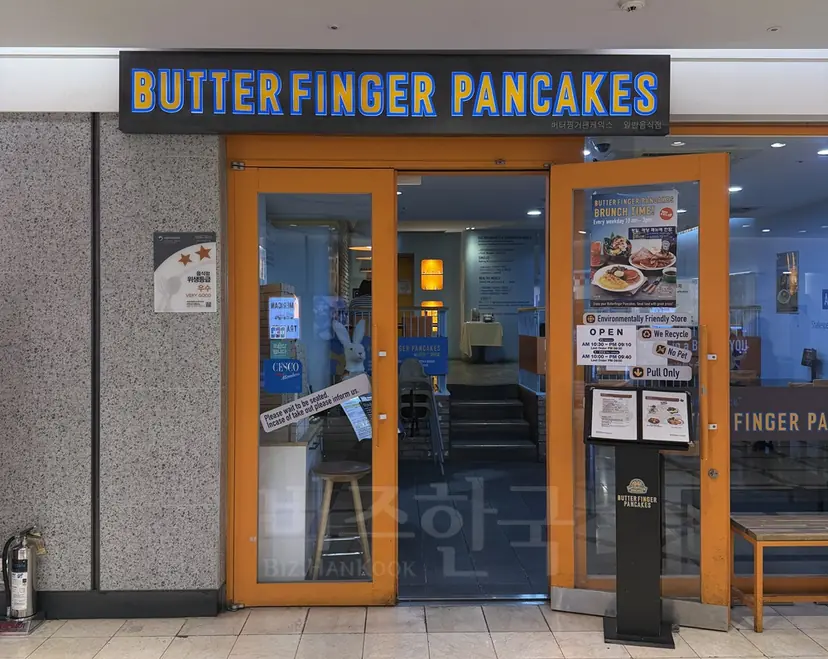
Performance declined in the 2020s, only one store remains
According to BizHankook's coverage, the Suwon Rehabilitation Court issued a decision to commence simplified rehabilitation proceedings for Butterfinger Pancakes Korea on October 29. Simplified rehabilitation is a system available to businesses or sole proprietors whose total rehabilitation claims and secured claims do not exceed 5 billion won.
Butterfinger Pancakes Korea applied for simplified rehabilitation to the court in early October and received a comprehensive prohibition order on October 12. Claims filing will take place from November 13 to 30, and the deadline for submitting the rehabilitation plan has been set for February 11 of next year.
Butterfinger Pancakes Korea is a food service company that operates the brunch specialty store 'Butterfinger Pancakes.' Butterfinger Pancakes is regarded as one of the first-generation brands that introduced American-style brunch culture to Korea. Opening its first store in Cheongdam-dong, Seoul, in 2006, when brunch was still unfamiliar, it gained popularity among consumers in their 20s and 30s by offering items like pancakes and waffles.
Butterfinger Pancakes grew rapidly in the early 2010s, riding the domestic brunch craze. At the time, it recorded annual sales of 7 billion won with just three locations: the Cheongdam, Gangnam, and Bundang branches. It subsequently continued its growth by expanding into major commercial districts and large shopping facilities, such as the Yeongdeungpo Times Square and Lotte Department Store Jamsil branches.
However, its performance deteriorated starting in the 2020s. Revenue for Butterfinger Pancakes Korea dropped from 5.4 billion won in 2021 to 4.3 billion won in 2023. Operating losses also persisted, recording 250 million won in 2021 and 180 million won in 2022, before expanding to 540 million won in 2023.
Amidst poor performance, stores closed one after another. Following the closure of the Bundang Jeongja, Yeongdeungpo Times Square, and Yeonnam branches, even the original Cheongdam location, which opened in 2006, shut its doors last year. Currently, only the Lotte Department Store Jamsil branch remains in operation.
Industry experts view the ongoing decline in revenue and operating losses, compounded by successive store closures, as a sign that Butterfinger Pancakes Korea's financial difficulties have deepened. The company will seek to normalize management through future procedures, including claim investigations and the preparation of a rehabilitation plan.
As the brunch craze cools, related brands disappear one after another
As American-style brunch culture spread in Korea in the mid-2000s, brunch specialty stores began to appear successively in major commercial hubs such as Itaewon, Cheongdam-dong, and Gangnam. At the time, brunch attracted attention as a new dining culture among young consumers, and famous stores were characterized by long lines of customers waiting to get in.
However, as the brunch craze subsided, the status of the brands that were in the spotlight at the time shifted. 'Suzie's,' an American-style brunch specialty store that started in Itaewon in 2005, grew to as many as five stores at one point, but ended its domestic operations after closing its Itaewon branch in 2016 and its last remaining COEX branch in 2019.
The American egg sandwich brand 'Eggslut' also withdrew from the Korean market. Introduced by Samlip (formerly SPC Samlip) with its first store in COEX in 2020, Eggslut initially drew attention for its long queues. Although it expanded to locations like Gangnam, Hannam-dong, and Yeouido, it ceased operations in 2024.
The brunch chain 'Cafe Mamas' is also struggling. Once popular for its ricotta cheese salad and panini, Cafe Mamas operated over 20 stores and recorded annual sales of 22.8 billion won in 2014. However, as store numbers continued to shrink, only four branches remain today. Revenue for the operator, Mamas Food, also fell to 11 billion won in 2025. In 2024, it signed a stock purchase agreement for a sale to Simone Asset Management, but the deal ultimately fell through.
The shift in dining consumption trends appears to have influenced the consecutive business scaling-backs of brunch brands. Analysts suggest that because brunch menus, which previously required visiting specialty stores, have become available in general cafes and bakeries, the competitive differentiation of existing brands has weakened.
Changes in consumer dietary habits are also cited as a factor. With the recent rise of consumption trends prioritizing health—such as low-sugar, low-calorie, and high-protein options—there is an analysis that preferences for traditional brunch menus like pancakes and waffles, accompanied by butter and syrup, are declining.
Lee Eun-hee, professor emeritus of consumer science at Inha University, analyzed, "While first-generation brands established brunch culture in Korea, they failed to drive consistent repeat visits. As American-style menus didn't fully integrate into the daily dietary habits of Koreans, it was difficult for the brands to secure recurring consumption and stable revenue."