

[비즈한국] It has been one year and 5 months since the tourist entry time restrictions were fully implemented in Seoul’s Jongno-gu Bukchon Hanok Village. Residents assess that their living environment has improved since the system was put in place. On the other hand, merchants complain about a decline in foot traffic and a hit to their sales. While customers of shops and museums or guests with lodging reservations can still enter after 5 PM, some point out that there is insufficient on-site information regarding these exceptions.
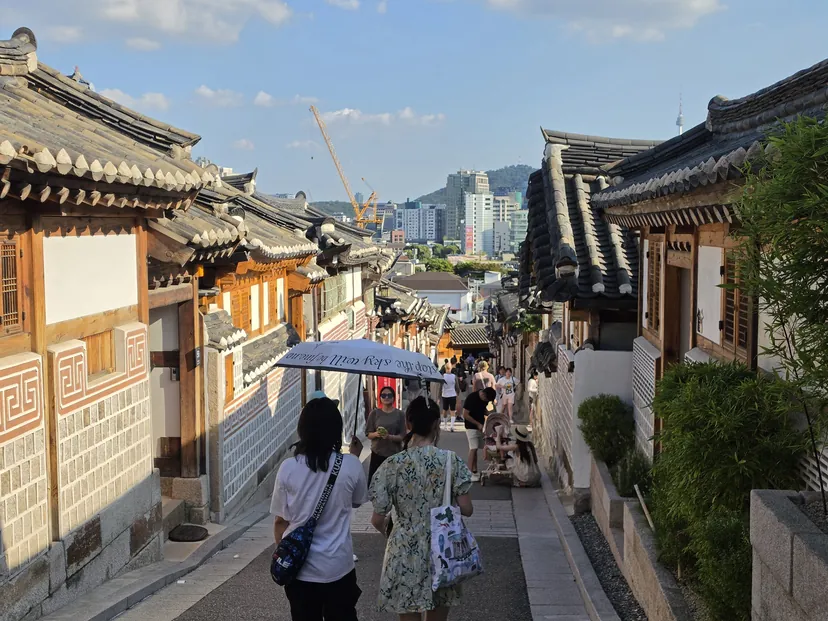
The Bukchon Hanok Village, visited on the 6th, was crowded with tourists despite the sweltering heat. Tourists cooled themselves with handheld fans while repeatedly posing for photos against the backdrop of traditional Hanok houses. On Bukchon-ro 11-gil, a famous photo spot, there was a steady stream of people stopping to pose as they walked through the alleyway. There were many foreign tourists dressed in Hanbok as well. Throughout the alleys, signs asking for quiet because it is a residential area, as well as signs indicating tourist visiting hours, were posted everywhere.
Although Bukchon is a residential area where people actually live, the influx of domestic and international tourists has led to persistent complaints from residents regarding noise and privacy infringement. Consequently, the Jongno-gu Office designated Bukchon as a "Special Management Area" on July 1, 2024, and has been managing it by dividing it into Red, Orange, and Yellow zones based on the level of inconvenience experienced by residents. After a 4-month trial period starting in November 2024, the system has been fully implemented since March 1, 2025.
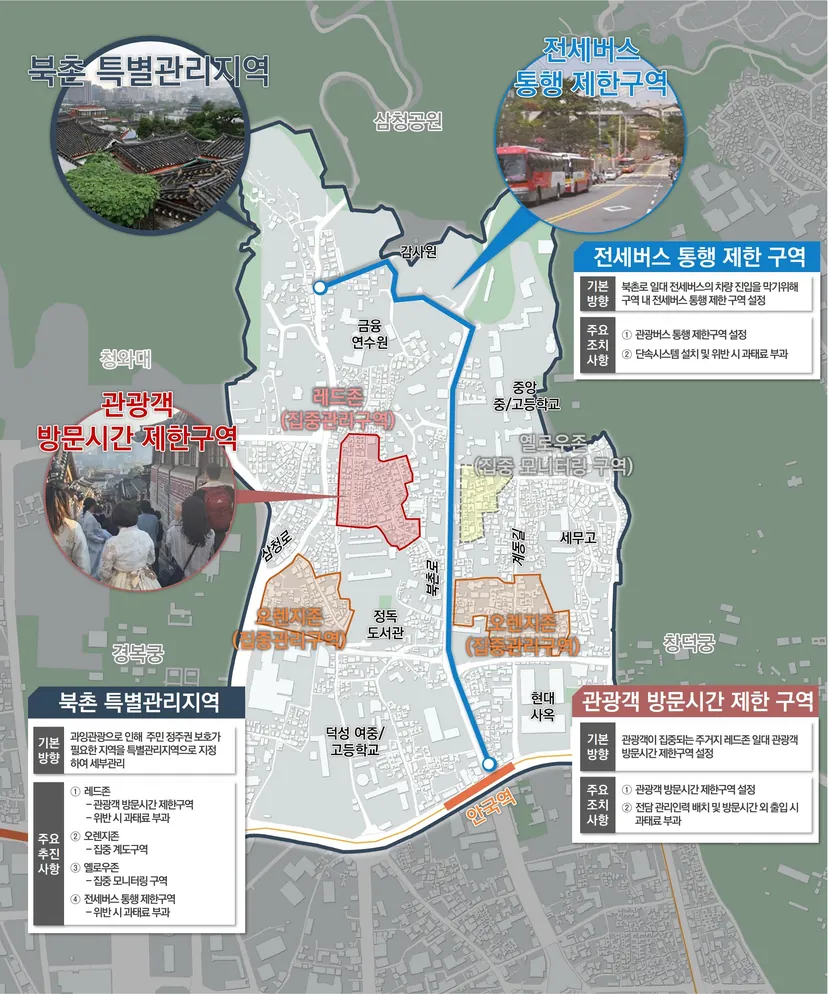
The area around Bukchon-ro 11-gil in Gahoe-dong is a Red Zone, which has the strictest regulations among the special management areas. Tourist visiting hours are restricted to between 10 AM and 5 PM. "Bukchon Sheriffs" are on duty at the site, providing information on visiting hours to tourists and managing traffic and guidance. Entering for tourism purposes outside of the restricted hours can result in a fine of 100,000 won.
The system appeared to have largely taken root on the ground. As it neared 5 PM, the Bukchon Sheriffs informed tourists that visiting hours were ending and guided them to move outside of the Red Zone. Tourists left the alleyway without much friction, and the once-bustling street became quiet quickly after 5 PM.
A Bukchon Sheriff who was guiding tourists that day said, "It feels like the system has settled down to some extent," adding, "Previously, we had difficulty distinguishing between residents and tourists, but as time passed, we got used to it, and such incidents have decreased." They continued, "Even those who were confused by the control generally understand when we explain the purpose of the policy, so there isn't much conflict."
Residents assessed that their living environment has become much better since the time restrictions were implemented. Resident A, who has lived in Bukchon for 35 years, said, "From a resident's perspective, it is definitely not bad," adding, "It is clearly quieter than before." Another resident who has lived in Bukchon for 13 years said, "In the past, it was often noisy with tourists late into the night, but it is much better now." Resident B, who lives and runs a gallery nearby, also stated, "I very much welcome the implementation of the system."
Conversely, the merchants did not look happy. While they generally agreed with the purpose of the policy to reduce resident inconvenience, they said the 5 PM curfew has a significant impact on their operations and sales.
A merchant who has been doing business in Bukchon for 7 years said, "I agree that some level of control is necessary for the residents, but from a merchant's perspective, it is essentially a semi-compulsory reduction in business hours," adding, "Since the sun sets late in the summer, I wish they would extend the time to 6 PM or 6:30 PM."
An operator of a nearby souvenir shop also said, "It is clear that there is an impact on sales as tourists leave after the restricted time," and suggested that operating hours should be extended by an hour or two during the summer season.
It was also pointed out that information regarding exceptions is lacking. Under the current system, the Red Zone restricts visits for tourism purposes such as photography or aimless wandering, but those with clear purposes—such as customers of shops or museums, visitors for commercial purposes, or lodging guests—can be admitted after verification.
A resident who runs a museum in Bukchon said, "Signs stating that tourist access is restricted after 5 PM can be seen everywhere, but the fact that museum or shop customers can still enter after that time does not seem well-known," adding, "People might think that visitors cannot enter at all after 5 PM."
Indeed, notices prohibiting access for tourism purposes after the restricted time were easily found throughout Bukchon that day. However, it was relatively difficult to find information that specifically explains the exceptions, such as shop/museum patrons and lodging guests, and how to gain access after the restricted hours.
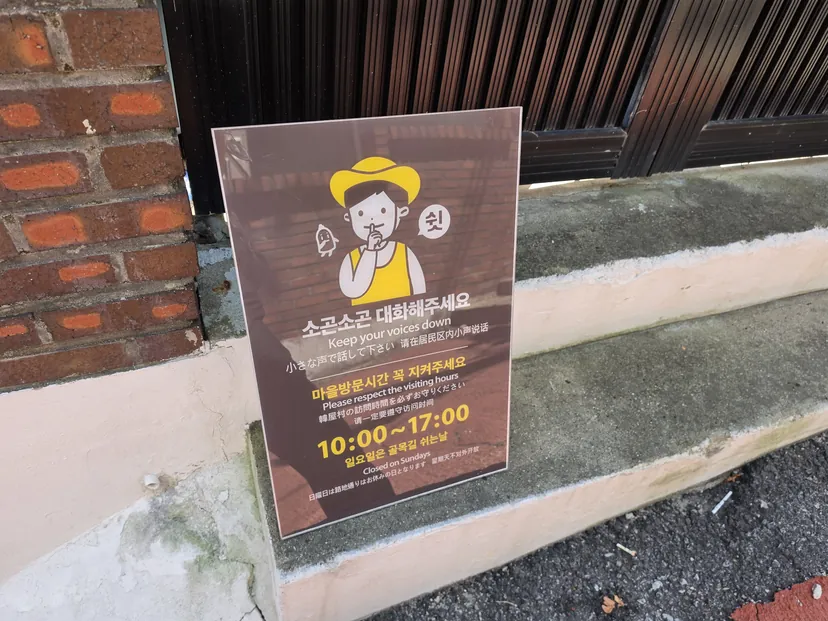
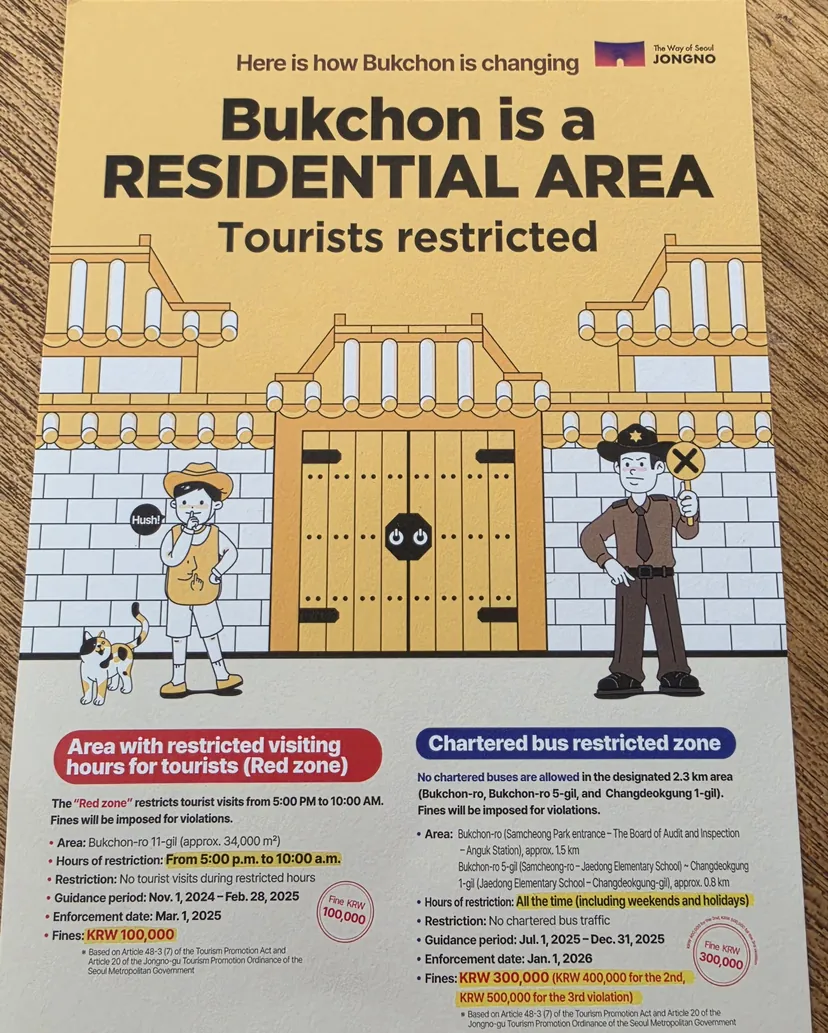
The Jongno-gu Office is currently monitoring the effectiveness of the special management area operations. They plan to analyze data related to visitors and local commercial districts and collect opinions from stakeholders such as residents and merchants to review whether to improve the system. Regarding the extension of visiting hours in summer requested by merchants, the office stated that it could consider flexible operational plans based on monitoring results and expert opinions.
In response to the criticism that information regarding exceptions is lacking, the Jongno-gu Office stated that Bukchon Sheriffs are distributing promotional materials and explaining exceptions on-site, and that relevant information is also being provided via QR codes. However, as some tourists do not check the QR codes, they plan to strengthen on-site explanations and expand promotional efforts.
The Jongno-gu Office stated, "We plan to objectively re-evaluate the overall policy based on the monitoring results," adding, "Our goal is to create a sustainable Bukchon where the community, residents, and merchants can coexist by improving areas that need supplementation while maintaining the positive aspects."