

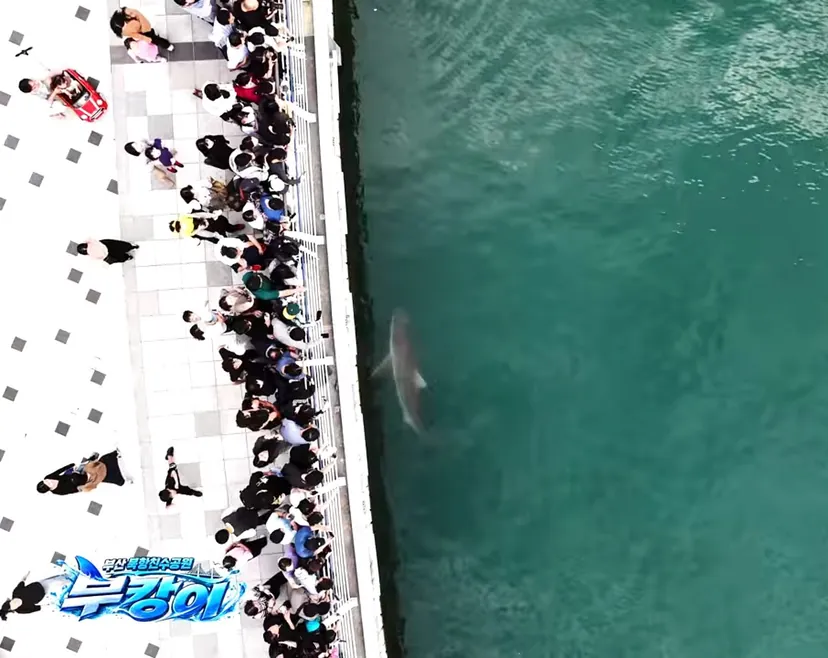
[비즈한국] The Chuseok holiday period left festival organizers feeling frustrated as the impact of a single shark was compared to that of a large-scale festival. Here, the "single shark" is "Bukang-i," which appeared in Busan, and the large-scale festival is the Yeosu World Island Expo. The Yeosu World Island Expo had direct project costs exceeding 70 billion won, leading to an admission fee of 15,000 won for adults. There was no admission fee to go see Bukang-i in the first place, though the cost of constructing the North Port is a separate matter. In any case, the number of people drawn to Bukang-i over ten days reached 600,000—three times the crowd mobilized by the Yeosu World Island Expo. The economic impact was also clearly visible, as it cleared out convenience store shelves nearby.
This is not to say that we should focus solely on criticizing planned events or festivals. The two cases cannot be compared in terms of accessibility. There is also a clear difference in scarcity. Let’s look at why Bukang-i gained such popularity overall.
First, let’s look at the statistics. These days, many foreigners are also visiting Busan. As of July, the number of foreign tourists visiting Busan reached 2,927,674, a 46.1% increase from the 2,003,466 recorded during the same period last year. This is more than double the national growth rate of 21.3%. 2025 was the first year that the number of foreigners visiting Busan exceeded 3 million annually. Having surpassed the 3 million mark in October 2025, it is expected that 2026 will easily surpass the initial target of 4 million. Interest in Busan was already growing before Bukang-i. Tourism that was once centered on Seoul is spreading to the regions, and Busan is the prime example.
So, what are Busan's strengths? The most representative one is the coexistence of the city and the sea. There are quite a few cities where the sea and the city coexist, such as Yeosu, Tongyeong, and Gangneung. However, the scale of the city, its population, and its accessibility are also important. There are not many places where beaches like Gwangalli and Haeundae are as close to the city center as they are in Busan. In the case of Gangneung, there is a distance between the city center and the beach. On top of this, Busan has been enhancing its waterfront spaces. The North Port, where the shark appeared this time, is also a waterfront space that marine creatures can actually access.
In addition, cultural preferences influenced by the social environment played a role. Some analyzed the enthusiasm for Bukang-i as an escape for modern people to relieve stress. This psychological aspect certainly exists, especially considering that this is one of the reasons people seek out the sea.
It also appears that a longing for the scarcity and authenticity of the "real thing" is at work. In South Korea, the urban population rate has reached 92%. More than nine out of ten people live in cities. Cities are increasingly being dominated by large apartment complexes and high-rise buildings. The environments one can experience and the landscapes one can see are similar. Most shops people use are franchises. The content enjoyed during leisure time is all planned, processed, or even manipulated. As AI services expand further, it has become difficult to even distinguish between the real and the fake. It is frequent that people see online images or videos and think it is a real shark, only to find it is fake.
On the other hand, Bukang-i is a real shark—a "natural" one, so to speak. Moreover, the fact that it is a predator shark heightened interest even further. If it had been sick or injured, people would have flocked less, and it would have immediately become a subject for rescue. The dynamism of living nature is transmitted to the viewers. It sparks a desire to visit the site to see Bukang-i in person and share proof shots. This act contains an intense longing for the authentic. People want to be recognized for having participated in the scene themselves; since the COVID-19 pandemic, such actual, in-person experiences have become very important.
This ties into tourism policy and festival event planning strategies. We need policies that activate waterfront spaces that citizens can enjoy, like the North Port. We need marine spatial design policies that allow marine life to naturally access these waterfront areas. To do so, it must go hand in hand with the restoration and preservation of the marine ecosystem, not just spatial design. This is not just a matter for Busan. People, including foreigners, cannot help but pay attention to places that harmonize with the city. Based on such spaces, tourism policies combined with cultural content must be implemented in parallel.
What about K-content? Recently, foreign media pointed out that music easily created by AI accounts for half of the tracks distributed on platforms, and that even playback rankings are being manipulated, harming original creators. However, Korea's K-pop industry is investing heavily in virtual idols or AI music, even though fans want real human artists. It is concerning that while the longing for the aura of the authentic is growing, K-content is heading in the opposite direction. Watching Bukang-i, I think again: people value natural authenticity over artificial processing.
The author, Kim Heon-sik, has walked through or hacked his way through the forest of pop culture phenomena since his 20s, with the expectation that there is a way to make the world a better place through culture. He continues on the same path in the 21st century, an era of AI and quantum computers, with the same belief.