

[BizHanKook] The Supreme Court has upheld a ruling that U.S. fabless (semiconductor design) company Broadcom violated fair trade laws by cutting off the supply of core components to Samsung Electronics, forcing the company to purchase $760 million (approximately 1.1 trillion won) worth of parts annually for three years. The ruling is seen as a move to curb actions where a company exploits its bargaining power—derived from reliance on hard-to-replace core components—to restrict a client's purchasing options and block the adoption of competitors' products.
Only 2–4 weeks of parts inventory, yet pressured by supply cuts
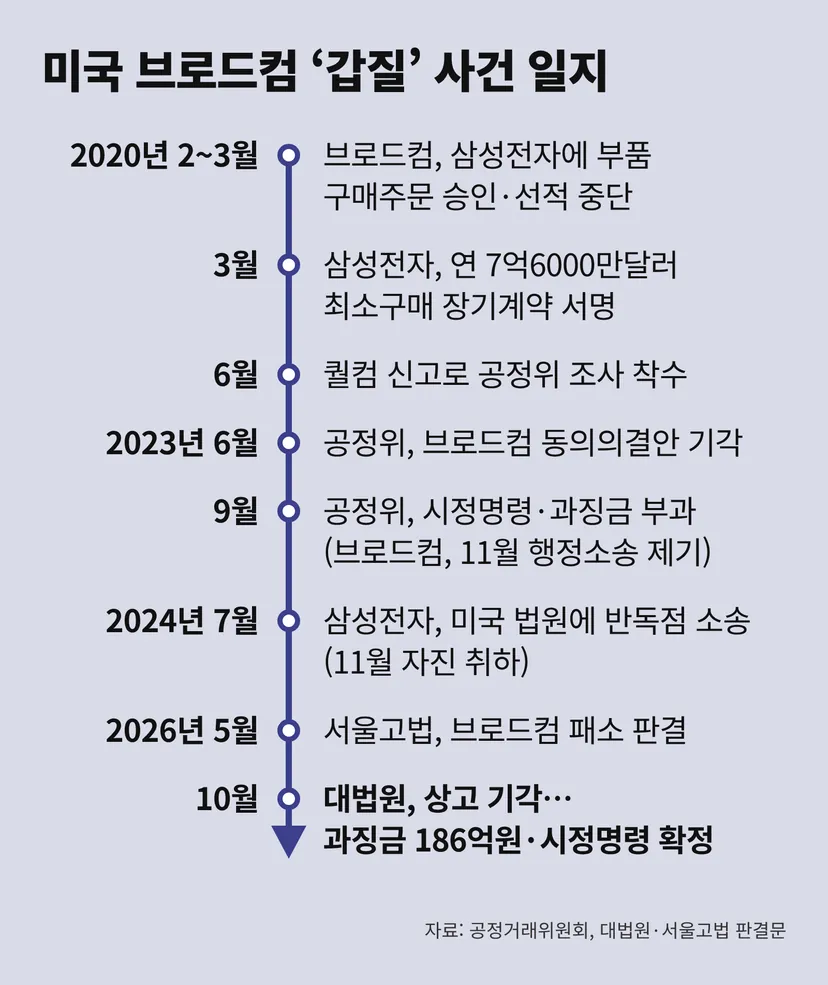
On the 27th of last month, the first division of the Supreme Court (Justice Cheon Dae-yeop presiding) unanimously dismissed the appeals filed by four Broadcom entities, including its U.S. headquarters and Korean subsidiary, against the Fair Trade Commission (FTC) in a lawsuit to cancel corrective orders and fines. Consequently, the 18.664 billion won fine and the corrective order imposed by the FTC were finalized. Although Broadcom filed an administrative lawsuit in November 2023 immediately after the FTC’s sanctions, it lost in both the second trial and the Supreme Court.
The parts involved in this case are Radio Frequency Front-End (RFFE) modules, which process wireless frequency signals for smartphones, and connectivity components for Wi-Fi and Bluetooth.
At the time, Samsung Electronics relied on Broadcom for nearly 90% of its related component purchases (as of 2019). Samsung typically held only 2 to 4 weeks' worth of inventory, and even with new orders, supply could take over 12 weeks. Furthermore, replacing parts that had already undergone product design and certification with those from other vendors was not an easy task. In particular, with the Galaxy S20 launch imminent, any disruption in supply would have inevitably caused setbacks in new product production and the operation of finished product lines.
In 2019, when Samsung Electronics began adopting some parts from competitors, Broadcom pushed for a Long-Term Agreement (LTA). Subsequently, on February 14, 2020, Broadcom stopped approving purchase orders from Samsung, and on March 5 of the same year, it halted shipments, production, and even some technical support.
Even after Samsung Electronics promised on March 13 to use only Broadcom parts for its flagship smartphones, it was found that Broadcom did not resume supply and instead demanded that foldable phones also be included in the agreement. Fearing production setbacks for the newly launched Galaxy S20 and other devices, Samsung signed the contract on March 27.
Under the contract, Samsung Electronics was required to purchase at least $760 million worth of Broadcom parts annually for three years starting in 2021. The agreement included a clause requiring compensation for the difference if the target volume was not met. To fulfill the contract, Samsung abandoned plans to adopt competitor components and purchased future inventory in advance. By the time the contract was terminated early in August 2021, the volume of parts purchased to fulfill the agreement had reached $780 million.

Internal documents secured by the FTC revealed that Broadcom staff internally acknowledged the issue, comparing the supply cut to a "nuclear bomb" or using phrases like "our strategy is against corporate ethics" and "extortion." Broadcom lifted the restrictions on purchase order approvals, shipments, and technical support on the day the long-term contract was signed.
Samsung is bigger, but?... “Abuse of trading position via supply cuts of hard-to-replace parts”
The Supreme Court agreed with the lower court's judgment that Broadcom forced the long-term contract on Samsung through the "highly unusual method of arbitrarily suspending parts supply." The fact that the minimum purchase and penalty clauses restricted Samsung's choice of parts, led to the cancellation or reduction of competitor adoption plans, and forced the advance purchase of future inventory also served as grounds for the decision. The Court confirmed the premise that to recognize an "act of providing disadvantages" constituting an abuse of trading position, it is not sufficient simply to show that the conditions were somewhat unfavorable to the other party.
Broadcom argued that the contract was signed voluntarily and mutually, and that it could not have held a superior position over Samsung Electronics, which has a much larger business scale. However, the court recognized Broadcom's trading position, citing the significant time and immense cost required to switch parts. The ruling implies that it is sufficient to prove that the company unfairly utilized its trading position to set disadvantageous conditions—effectively equating it to forced purchases—and that there was a risk of impeding fair trade in light of normal transaction practices.
The minimum $160 million in additional costs Samsung incurred by purchasing Broadcom products instead of cheaper competitor parts was also recognized as a disadvantage.
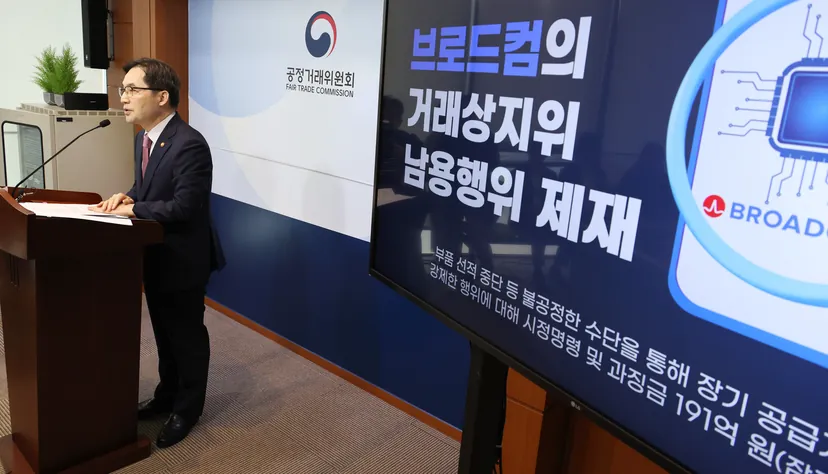
The court also ruled that it was appropriate for the lower court to include the revenue from the RFFE and connectivity parts actually purchased by Samsung under the contract in the relevant turnover for calculating the fine. The FTC applied a 2% rate, which is the ceiling for the imposition.
U.S. lawsuit ends in ‘quiet settlement’… ‘Exclusive contracts’ also under scrutiny in Europe
The FTC launched its investigation in June 2020 following a report by competitor Qualcomm. Although Broadcom requested a consent decree procedure, the FTC rejected it in June 2023, deeming the final proposal, which included a 20 billion won mutual growth fund, insufficient for victim relief. In September of that year, the FTC imposed corrective orders and fines on Broadcom. A consent decree is a system where a company offers voluntary corrective measures, and if the FTC accepts them, the case is closed without determining whether a violation occurred.
The civil lawsuit filed separately by Samsung Electronics in the U.S. ended in a settlement. Samsung filed a lawsuit in the U.S. District Court for the Northern District of California in July 2024, claiming that Broadcom's restrictions violated antitrust laws, but withdrew it in November of the same year. Both companies issued a joint statement saying all disputes had been resolved, but specific terms were not disclosed.
Controversy over Broadcom’s contracting practices has spread to other component markets. The European Commission and the U.S. Federal Trade Commission (FTC) confirmed corrective agreements and consent orders between 2020 and 2021 regarding Broadcom’s exclusive contracting practices that limited the adoption of competitor products in the semiconductor markets for set-top boxes and broadband equipment.
Domestically, the FTC confirmed a consent decree in September 2025 regarding a separate case where Broadcom required set-top box manufacturers to use only its System-on-Chip (SoC). Broadcom agreed to provide 13 billion won in mutual growth funds and promised not to disadvantage manufacturers for dealing with competitors or force them to purchase the majority of their part needs. However, unlike the Samsung case, where the illegality was confirmed, this case was settled through a consent decree.