

[비즈한국] Nowadays, everyone creates well. Case studies and methodologies of good brands are shared rapidly, and the standards for design and content have been leveled up. With the advent of artificial intelligence (AI), the barrier to entry for creating images, text, services, and experiences is also falling quickly. So, in an era where anyone can produce results of a similar quality, what can make a brand unique? The ‘BrandBiz Conference 2026’, taking place on Thursday, October 29 at the Four Seasons Hotel Seoul in Gwanghwamun, starts with this very question.
Marking its 10th anniversary this year, the theme of the BrandBiz Conference is ‘THE NEXT ORIGINAL – In an Era Where Everyone Creates Well, How Do Brands Become Unique?’ Having consistently covered the changes in the brand and design industries over the past decade, this year’s BrandBiz Conference goes beyond ‘how to create well’ and explores, from various perspectives, what to protect and what judgments to make so that a brand can maintain its own identity.
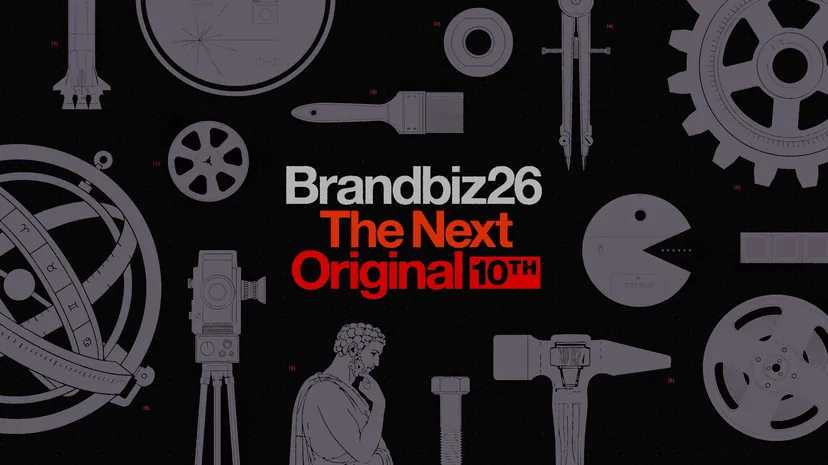
The BrandBiz Conference first began in 2017. At that time, the concept of branding was not as widely accepted as a fundamental of business as it is today. While there was a consensus on the importance of branding, it was not easy to find answers on what a good brand is or where to start. Over the past 10 years, the level of brand strategy, design, space, and content has risen significantly, and we have reached an era where even average companies can produce results above a certain level.
Paradoxically, this year's dilemma begins at that very point. As the gap in quality narrows, the appearances of different brands gradually grow to resemble one another. With proven strategies and design grammars easily referenced, and AI standardizing production capabilities, it has become difficult to create differences solely through the final output as in the past. This year's BrandBiz Conference asks what it is that ultimately makes a brand unique in such an environment.
The stage will feature eight speakers who have been active in different fields such as brand strategy, design, space, and industrial design.
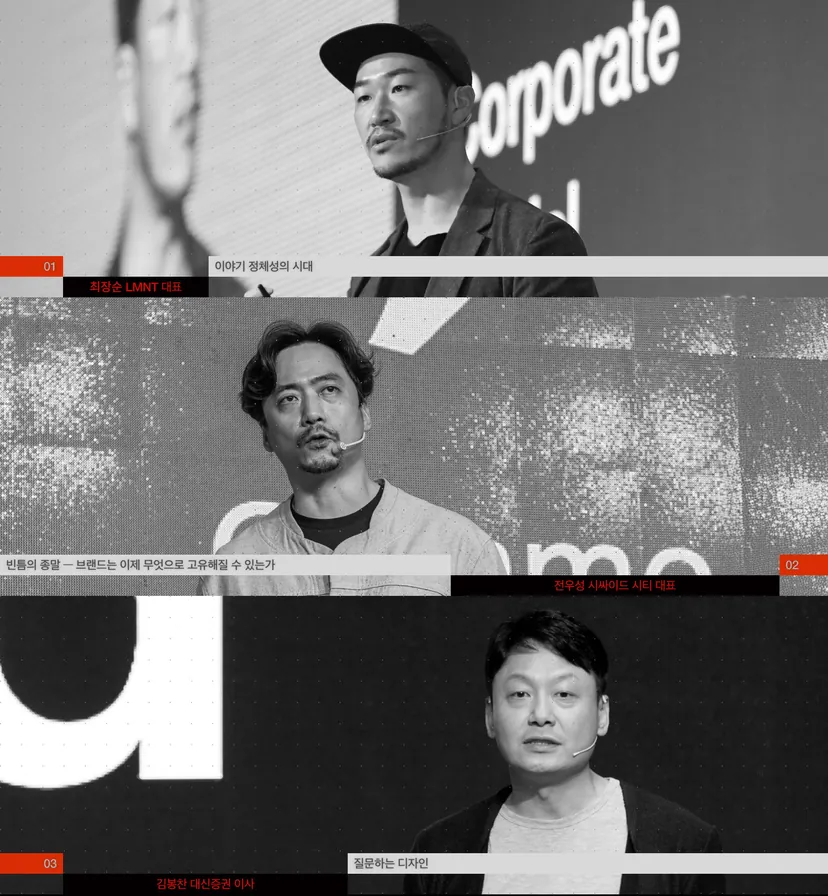
First, Choi Jang-soon, CEO of LMNT, will speak on ‘The Era of Narrative Identity’, highlighting why brands are now remembered for ‘what kind of story they possess’ rather than just their products and features. He discusses what stories brands should create in an era where people respond to worldviews, attitudes, and narratives rather than specifications when choosing a brand, and how to accumulate these into a consistent identity.
Jeon Woo-sung, CEO of Seaside City, through ‘The End of the Gap — What Can Brands Now Use to Become Unique?’, points out the reality that, now that the quality of design and marketing has been leveled up, it has become difficult to create uniqueness through small details or differentiated expressions as in the past. In an era overflowing with well-made brands, he examines the new conditions for differentiation—what ultimately makes a brand look different and be remembered for a long time.
Kim Bong-chan, Director at Daishin Securities, shares through ‘Designing with Questions’ that good design does not start from making a cool result, but from asking the right questions to properly view a problem. In an era where one can easily obtain countless answers and references, asking ‘why must we create this?’ has become more important than ‘what shall we create?’. Based on his experience dealing with brands and design within corporate organizations, he will share how questions change organizational judgment and determine the direction of design.
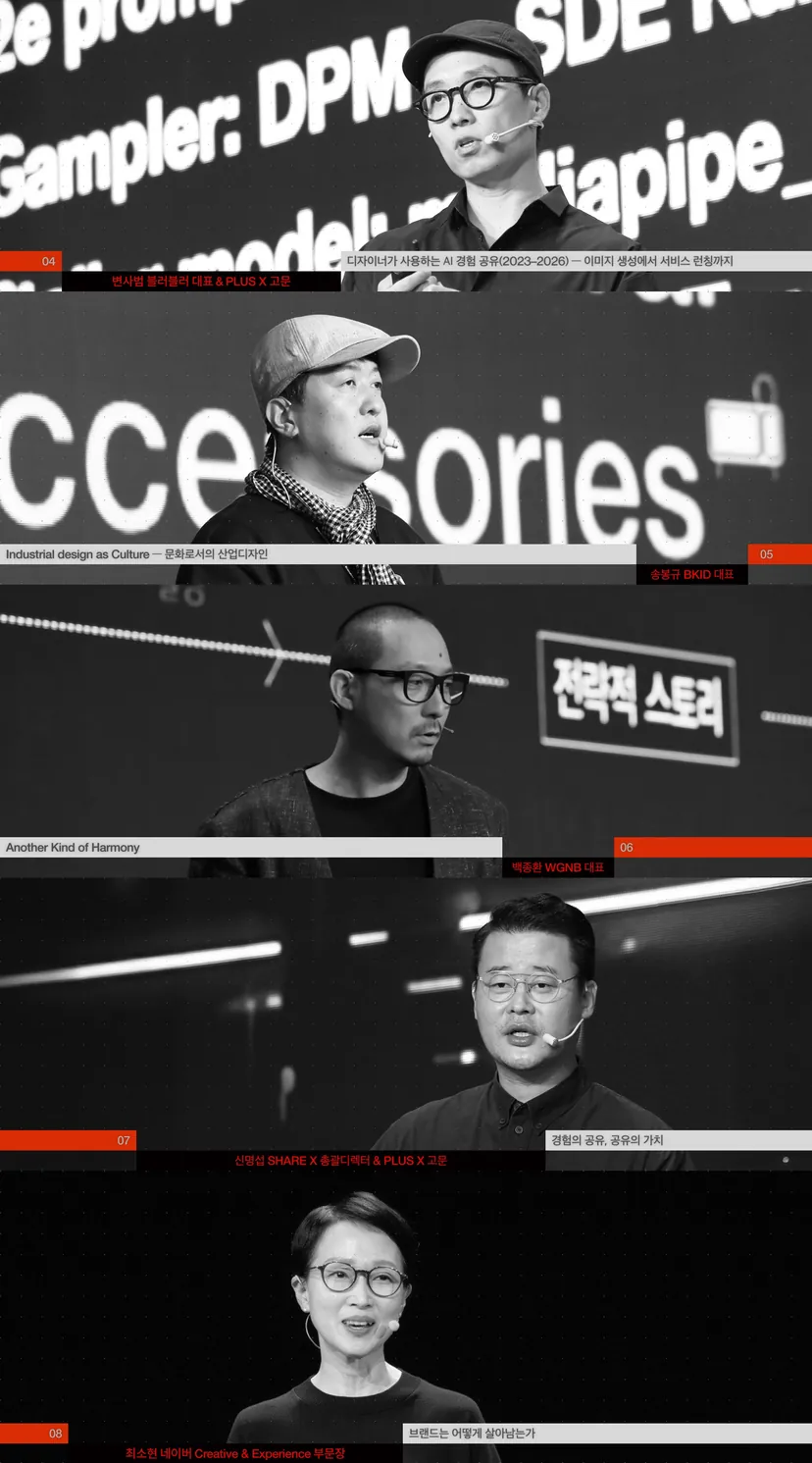
The conference will also address how AI is specifically changing design practice. Byun Sa-beom, CEO of Blur Blur and advisor at PLUS X, will share his trial-and-error experiences and changes from the time generative AI first appeared until now through ‘Sharing AI Experiences Used by Designers (2023–2026) - From Image Generation to Service Launch’. He will demonstrate the process of how AI, which started as a tool to create a single image, has expanded throughout the entire design process, from ideation and concept development to prototyping and actual service launch, and point out what should be left to AI and what designers must ultimately judge themselves.
Perspectives on space and industrial design will also follow. Baek Jong-hwan, CEO of WGNB, will talk about ‘Another Kind of Harmony’, explaining that space is not just about organizing things beautifully, but how different elements—such as brand, people, materials, light, and the surrounding environment—achieve harmony as a single experience. He plans to show through his actual work the process of creating new spatial impressions not through familiar harmony, but through unexpected collisions and tensions.
Song Bong-kyu, CEO of BKID, under the theme of ‘Industrial Design as Culture’, views industrial design beyond the act of determining the form and function of a product, seeing it as an act of creating culture. Through various projects, he will explain how the objects we use every day reflect the tastes and lifestyles of the era, and in turn, change people's behavior and culture.
Shin Myung-sup, General Director of SHARE X and advisor at PLUS X, through ‘Sharing Experience, the Value of Sharing’, discusses what kind of power accumulated experience holds when it is passed on to other people and organizations rather than remaining with an individual. He examines how to articulate and share the know-how and judgment criteria gained through numerous brand and design projects, and what the process of passing on experience is that leads to further creation and growth. It is also a story about how to transform the experience of ‘skilled individuals’ into the assets of a ‘skilled organization’ in an era where collective organizational judgment becomes more important than individual ability.
The final stage will be led by Choi So-hyun, Head of Creative & Experience at Naver. Under the theme of ‘How Do Brands Survive?’, she talks not about how to build a good brand, but how a built brand survives amidst change. Having experienced the rise and fall of new platforms firsthand, and after founding a brand consulting firm to help the birth and transformation of numerous companies, she is now responsible for the overall experience encompassing brand, design, marketing, and space within the massive platform of Naver.
Over the past 20 years, her core question has shifted from ‘How to create a good brand?’ to ‘How can an organization ensure it repeatedly makes good choices?’. As AI levels out even the ability to create, she will conclude this year’s conference by addressing what brands should never easily change, what they must boldly change whenever the environment shifts, and what judgments humans must ultimately be responsible for until the end.
BrandBiz Conference 2026 will begin with opening remarks from Kim Won-yang, CEO of Ilyo Shinmun, followed by eight lectures across the morning and afternoon. Speakers who have been active in different fields and generations will look at the single question of ‘uniqueness’ based on their respective experiences.
The BrandBiz Conference has made the questions faced by the brand industry at the time its theme every year. If ‘how to create a good brand’ was the important question 10 years ago, the situation has now changed. This is because we have moved past an era where good output itself was rare, into an era where anyone can create well.
Ultimately, this year's question is not ‘how to create better’. The focus has shifted to what to choose, what to discard, and what to protect until the end even in a changing environment. The BrandBiz Conference 2026 will be an occasion to look back on the past 10 years while simultaneously contemplating where the uniqueness of a brand will be created in the next 10 years.
The BrandBiz Conference 2026 is a paid event, and participant registration and detailed information can be found on the official website.