

[Biz Hankook] ‘The road now hangs on the long mountain ridge. Perhaps because it is past midnight, in the stillness that seems dead, one can almost feel the beast-like breathing of the moon, and the soybean plants and corn leaves are dampened even more blue by the moonlight. The mountain ridge is entirely a buckwheat field, and the flowers that have just begun to bloom are so breathtakingly beautiful in the moonlight, as if salt had been sprinkled over them.’
Most Koreans are likely familiar with this paragraph. It is a scene from the short story ‘When Buckwheat Flowers Bloom,’ published by author Lee Hyo-seok in 1936, as the story has been a popular fixture in textbooks. Reading this work makes one inevitably curious about the scenery of the buckwheat fields in Bongpyeong, where the sight of ‘flowers that have just begun to bloom, appearing as if sprinkled with salt in the soft moonlight, is enough to take one's breath away.’ This is why Bongpyeong-myeon, Pyeongchang-gun, Gangwon-do, becomes bustling from late August to September when the buckwheat flowers begin to bloom.
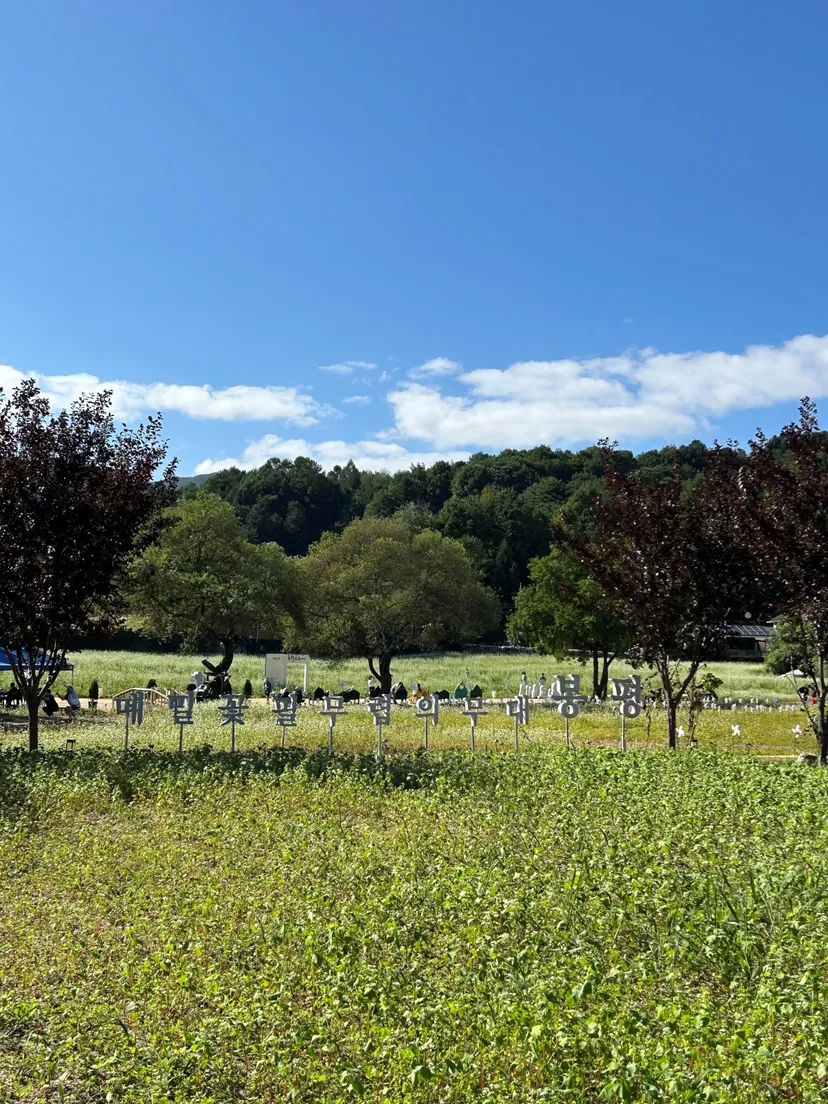
Bongpyeong-myeon, Pyeongchang-gun, is the background of ‘When Buckwheat Flowers Bloom’ and the hometown of author Lee Hyo-seok. Since 1999, Bongpyeong-myeon has hosted the ‘Pyeongchang Hyoseok Cultural Festival’ to honor Lee Hyo-seok's literary achievements. This year’s schedule runs from September 4 to September 13. The festival, operated directly by local residents, has a modest charm. Visitors can cross the stepping stones of the Heungjeongcheon Stream to reach the buckwheat fields, take a ride on a ‘tin train’ to tour the fields, enjoy searching for ‘golden buckwheat’ hidden in a pool of buckwheat hulls, and then explore the author’s life at the Lee Hyo-seok Literary Museum and the Hyoseok Moonlight Hill.
The most common activity for those visiting Bongpyeong during this period is to get lost in the sprawling buckwheat fields and capture the ‘photo of a lifetime.’ Since the visitor demographic here is quite mature, if you are on the younger side, you may frequently be asked to take group photos for others. Of course, seeing the joyful expressions of the seniors, you will undoubtedly find yourself bending over and taking photos from various angles. And as you do, you’ll ponder again: Let’s not forget that today is the youngest day of my life.
Perhaps because author Lee Hyo-seok passed away at the young age of 35, the scale of the Lee Hyo-seok Literary Museum isn't massive, but it is a must-visit once you are in Bongpyeong. There is an admission fee, but it is free during the festival period. You can trace his footsteps through his handwritten manuscripts, photos, and other materials. Located on a hillside, it also offers a great vantage point to view the entirety of Bongpyeong-myeon. Be sure to also visit the nearby Hyoseok Moonlight Hill. Opened as part of the 2018 Pyeongchang Winter Olympics Art and Culture Special Zone project, it is designed as a space for various art experiences based on the symbolism of the moonlight that appears in ‘When Buckwheat Flowers Bloom.’
While there are various events during the festival, such as literary walks with commentators and book concerts with winners of the Lee Hyo-seok Literary Award, I recommend visiting on September 12, when the five-day market is held. This traditional market, held on days with a ‘2’ or ‘7,’ sells various local specialties including buckwheat, potatoes, mushrooms, and wild deodeok. You’ll find yourself debating whether to buy the fresh-looking wild deodeok. It was also at this Bongpyeong marketplace where the protagonist of ‘When Buckwheat Flowers Bloom,’ the traveling merchant Heo Saeng-won, met Dong-i, who is presumed to be his son. You can watch buckwheat pancakes and buckwheat crepes being made, and the fun of sitting down for a bowl of makgeolli (rice wine) is unmissable. In particular, be sure to try ‘Bongpyeong Buckwheat Makgeolli’ (Hans Farm), which has won awards at the Korea Liquor Awards in 2021, 2023, and 2026. There is also ‘Pyeongchang Potato Makgeolli’ in the same lineup, but personally, I give a vote to the buckwheat makgeolli for its clean taste and smooth finish.
You can see murals depicting scenes from ‘When Buckwheat Flowers Bloom’ and donkey statues at the entrance of the village, which makes you truly realize that this is the home of Lee Hyo-seok and buckwheat flowers. While it may not be huge or filled with grand spectacles, once you’ve had a buckwheat crepe with a glass of makgeolli, bought a drink, and sat on a bench overlooking the fields to enjoy the peaceful autumn day while gazing at the flowers, you will find the world looks quite beautiful. It’s okay if you don’t have a lover by your side (the flowers are famously associated with the drama ‘Guardian: The Lonely and Great God,’ and the flower language of buckwheat is ‘lover’).
If you have plenty of time, you can stay until the evening to admire the flowers swaying under the moonlight as so eloquently described in the novel, or you could visit Woljeongsa Temple, a thousand-year-old temple located on Mt. Odaesan in Pyeongchang, before heading to Bongpyeong. How about a day trip where you walk through the fir tree forest path at Woljeongsa—one of the three great fir tree paths in Korea—in the early morning, enjoy buckwheat noodles and pancakes in Bongpyeong, and finish by admiring the buckwheat flowers? It sounds like a perfect day filled with sentiment, blending nature and literature.