

[비즈한국] As a tectonic shift is expected in the domestic virtual asset market due to mergers and acquisitions (M&A), the moves of Bithumb, the second-largest KRW-based exchange, are drawing attention. Currently, Bithumb is the only one among the five domestic KRW exchanges (Upbit, Bithumb, Coinone, Korbit, and Gopax) that has not undergone M&A involving a traditional financial firm or a large overseas exchange. Bithumb recently announced plans for an initial public offering (IPO) and has begun preparations such as improving corporate governance and strengthening internal controls, but market conditions remain difficult.
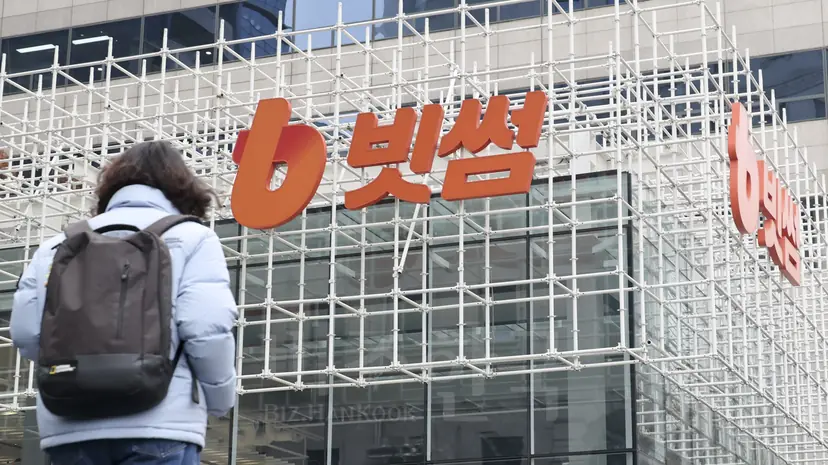
In early August, Bithumb announced its IPO plan targeting 2028. The plan is to complete the strengthening of its internal control system and the transition to Korea International Financial Reporting Standards (K-IFRS) by 2026, file for a preliminary listing review in 2027, and complete the IPO in 2028. Bithumb explained that it is switching from Korea Generally Accepted Accounting Principles (K-GAAP) to K-IFRS to meet the accounting standards required for global publicly traded companies. It also announced plans to strengthen employee compliance monitoring and internal control processes in collaboration with securities firms and law firms.
The company is also diversifying its business to reduce the impact of virtual asset market volatility. The goal is to supplement its fee-centered revenue structure and secure liquid assets to maintain corporate value even after going public. In fact, as virtual asset trading has decreased, Bithumb's performance this year has also plummeted. Revenue for the first half of 2026 was 168.8 billion KRW, a 49% decrease compared to the same period last year (329.2 billion KRW). Notably, net profit shifted from 55 billion KRW in the first half of 2025 to a deficit of 108.7 billion KRW in the first half of this year.
Looking at Bithumb’s revenue composition, trading commission income is overwhelming. At the end of 2025, virtual asset trading commissions accounted for 97% of revenue, while other income, such as price inquiry services, accounted for 2.3%. However, in the first half of this year, other income dropped to the 8 million KRW level, causing its share to fall to near 0%. With commission income reaching 100%, diversifying revenue is essential.
Bithumb also emphasized that it is improving the transparency of its corporate governance. Bithumb reorganized its business structure in 2025 by spinning off 'Bithumb Asset' (formerly Bithumb A). Under this structure, Bithumb focuses on its core exchange and blockchain business, while Bithumb Asset handles new businesses such as investments. Bithumb explained, "By separating the exchange business from new businesses, we have simplified our business structure and established a governance system that clarifies the roles and responsibilities of each sector while preemptively blocking the possibility of conflicts of interest."
Unlike Bithumb, Bithumb Asset recorded a surplus in the first half of this year. In the first half of 2026, it achieved 6.6 billion KRW in revenue, 1.5 billion KRW in operating profit, and 16.9 billion KRW in net profit. Bithumb Asset was able to generate profit while the main exchange business faltered because it earned income through short-term investments in securities such as bonds.
However, Bithumb still has a long way to go to resolve its complex corporate governance controversies. For starters, the sale of stakes held by Bucket Studio and Vidente is being delayed. Bithumb's governance is largely divided between the side of Lee Jung-hoon, the founder and representative of Bithumb Asset, and the side represented by Vidente. Vidente, which was previously at the center of controversies over actual ownership, is part of a circular shareholding structure: Initial No. 1 Investment Association → Bucket Studio → Inbiogen → Vidente, with Vidente holding shares in Bucket Studio. Vidente currently holds stakes in Bithumb Holdings (30.0%), Bithumb (10.22%), and Bithumb Asset (10.22%).
KOSDAQ-listed companies Vidente and Bucket Studio are on the verge of delisting due to embezzlement and breach of trust by Kang Jong-hyun, who was called the actual owner of Bithumb, and related executives. Although delisting was prevented on the condition of improving governance through the sale of Bucket Studio shares and management rights, the sale fell through in June when a consortium led by Switchwon failed to make the payment.
However, they have recently been given a chance for a re-sale as a new potential buyer has emerged. On July 28, Bucket Studio signed an agreement to sell its stake to the U.S. financial firm NMSI, Inc. The deal is expected to proceed after NMSI, Inc. conducts due diligence and eligibility reviews for up to six weeks. Accordingly, the KOSDAQ Market Committee decided on August 24 to grant Bucket Studio a four-month improvement period during its deliberation on whether to delist. Vidente was also granted a five-month improvement period in July of this year.
Perhaps due to these governance issues, the company is unable to secure investment from financial firms. It was reported in late June that Kiwoom Securities was considering acquiring new shares of Bithumb, but nothing has been finalized. Since then, Kakao Pay was also reported to be considering an investment in Bithumb, but discussions appear to be sluggish due to issues such as investment structure and acquisition terms.
Meanwhile, while Bithumb struggles to find strategic partners like financial firms or large overseas exchanges, the offensive from competitors who have gained support is intensifying. Korbit (now DigitalX), which was acquired by Mirae Asset Consulting and became a subsidiary of the Mirae Asset Group, announced that it would offer zero trading fees for all members for one year starting August 24.
Subsequently, on the 26th, Coinone announced that it would switch to 0% trading fees for all items starting at 11 a.m. that day until further notice. In May, Coinone received investment from Korea Investment & Securities and the global exchange OKX, making them joint third-largest shareholders. Although the current market share of Korbit and Coinone is only around 1-2%, they can aggressively expand their business now that they have funded partners.
The fact that Dunamu, the number one virtual asset operator in Korea, has announced IPO plans is another variable. Dunamu recently stated through the media that it would pursue a listing once its stock swap with Naver Financial is completed. The market considers it highly likely that Dunamu will list on the U.S. stock market rather than in Korea, but if the IPO timing overlaps with Dunamu's, it is difficult to guarantee a successful offering.
To go public, the company must resolve internal control controversies, but legal risks remain. Bithumb is facing sanctions from financial authorities following a large-scale Bitcoin misallocation accident that occurred last February. The Financial Supervisory Service (FSS) plans to deliver an inspection opinion letter containing the level of sanctions to Bithumb in early August and decide on final sanctions after deliberation. Bithumb is also engaged in a lawsuit to cancel the disposition by the Korea Financial Intelligence Unit (FIU) regarding violations of the Act on Reporting and Using Specified Financial Transaction Information. The pleading date for the lawsuit has been delayed twice and is now set for October 22.