

[비즈한국] The formula that a pharmaceutical or biotech company's stock price will soar once it successfully develops a new drug and receives product approval from the Ministry of Food and Drug Safety is wavering. Even after years—sometimes over a decade—of research, development, and clinical trials have culminated in drug approval, cases are piling up where stock prices fail to meet expectations or even drop significantly after the announcement.
On the 8th, the Ministry of Food and Drug Safety approved "Latica Ophthalmic Solution 5% (Recoflavone Hydrate)," a dry eye treatment co-developed by GL PharmTech and Ajou Pharm, as the 44th domestically developed new drug. It is the first dry eye treatment independently developed by a domestic pharmaceutical company.
However, the stock price of KOSDAQ-listed GL PharmTech moved in the opposite direction. While the closing price rose to 5,780 won on the 8th just before the announcement due to expectations for the drug's approval, the stock showed weakness afterward. From the 9th to the 14th, GL PharmTech's stock price fell for four consecutive trading days, dropping more than 21% from its closing price on the 8th, and has shown slight fluctuations since the 15th.
As only a few trading days have passed since the approval, it is too early to conclude the future trajectory of Latica's stock. However, since the anticipation for approval was already partially reflected in the stock price, market interest is likely to shift toward how much market share and revenue growth the drug can secure in competition with existing dry eye treatments after its actual launch. GL PharmTech and Ajou Pharm aim to complete the initial production of Latica in the third quarter of next year, with plans for price listing and a commercial launch in the fourth quarter.
Onapra Injection sales have begun, but financial burdens remain even after a 32.5 billion won capital increase
Vivozon Pharmaceutical illustrates more clearly what the market looks for after a new drug approval. Its non-narcotic analgesic, "Onapra Injection," was approved as the 38th domestic new drug in December 2024. Although its stock price rose to as high as 12,924 won afterward, it had fallen to 2,910 won by the close of trading on the 16th. The market's new benchmark for evaluation is not just the achievement of approval, but how much revenue and cash flow the new drug can actually generate.
Onapra Injection recorded 600 million won in sales in the first quarter of this year and 2 billion won in the second, showing a quarterly growth trend. However, considering it generated 2.87 billion won in roughly two months following its launch last November, it is difficult to say it has entered a clear growth trajectory based solely on first-half performance. Since there is a possibility that initial supply to hospitals and distribution networks was reflected in the sales, further observation is needed to see if actual prescription growth continues.
Furthermore, it is hard to say that Onapra Injection has improved the company's overall performance. While it is now the company's second-highest selling product after the hypertension treatment J-Vica, Vivozon Pharmaceutical's consolidated revenue for the first half of this year was 27.4 billion won, a 24.7% decrease from 36.4 billion won during the same period last year.
The company also conducted a capital increase to secure operating funds and repay debt, but the burden of debt repayment remains.
Vivozon Pharmaceutical decided on a paid-in capital increase through a general public offering of unsubscribed shares after a rights offering on October 13 of last year. While it initially planned to raise about 50 billion won, the final amount collected was reduced to approximately 32.5 billion won due to subsequent stock price declines and adjustments to the issuance price, with payment completed in March of this year.
Vivozon Pharmaceutical originally planned to use 13.1 billion won of the capital increase funds to partially repay the principal and interest on the 15th private convertible bond worth 20 billion won, issued in January 2020. As the capital increase schedule was delayed, the company reached an agreement with the creditor, its affiliate Vivozon, to extend the maturity to January 2028 and decided to repay the debt in quarterly installments of 2.5 billion won starting from the first quarter of this year.
Additionally, there is an operating loan from Woori Bank that matures this December. As of the end of June, Vivozon Pharmaceutical’s cash and cash equivalents stood at 8.7 billion won, with 2 billion won in short-term financial instruments.
Curocell: Insurance coverage is the key, despite being the first domestic CAR-T approval
Curocell also succeeded in getting its CAR-T therapy "AnverCarty" approved as the 42nd domestic new drug on April 29 for the treatment of relapsed/refractory diffuse large B-cell lymphoma (DLBCL). The achievement is significant in that it is the first domestic company to bring a CAR-T therapy to the commercialization stage.
However, the stock price plummeted immediately after the approval was confirmed. The stock, which had risen to the 60,000-won range on anticipation of approval, fell over 10% on the trading day following the market's full reflection of the news, and by the 16th, the closing price had dropped to 21,450 won. It appears that since the expectation of approval was already largely factored into the price, the company failed to find a new catalyst for growth after the actual approval.
In Curocell's case, the stock movement is difficult to explain solely by the dissipation of anticipation. Because CAR-T therapy is a high-cost treatment requiring hundreds of millions of won per administration, whether health insurance coverage is applied and the set drug price are the key variables determining patient accessibility and market size. However, AnverCarty has not yet been covered by health insurance, meaning it has not been fully introduced to the market.
AnverCarty is currently undergoing the health insurance listing process. In July, it was judged appropriate for coverage by the Health Insurance Review and Assessment Service's (HIRA) Severe Disease Review Committee, and on the 3rd of this month, the Pharmaceutical Benefits Evaluation Committee also recognized its cost-effectiveness, provided the company accepts a price at or below the evaluation amount proposed by HIRA. Subsequent procedures, such as price negotiations with the National Health Insurance Service and the deliberation of the Health Insurance Policy Deliberation Committee, remain. Curocell is aiming for insurance listing within this year.
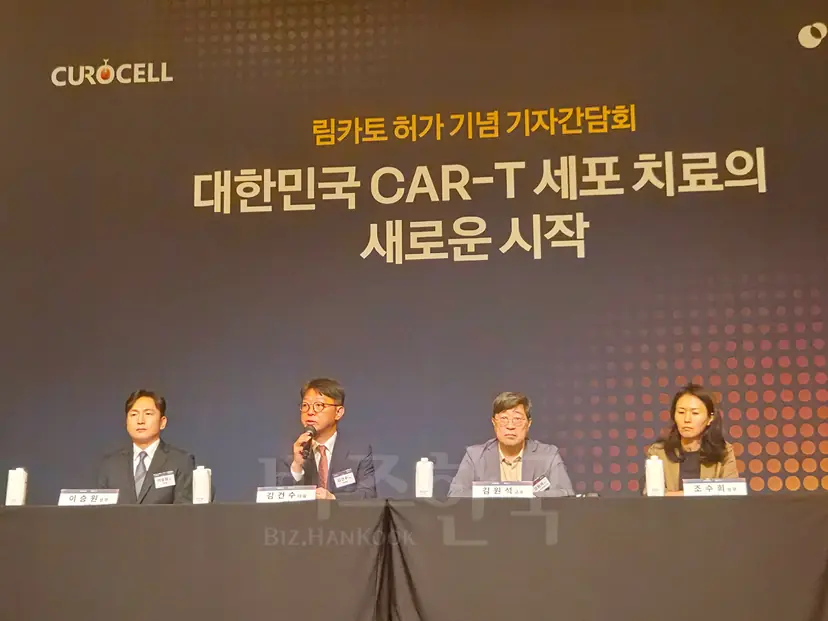
FutureChem’s capital increase one month after ProstaView approval leads to shareholder alienation
FutureChem’s situation is similar. "ProstaView," a radiopharmaceutical for prostate cancer diagnosis developed by the company, was approved as the 43rd domestic new drug on April 30.
However, product approval for ProstaView did not immediately translate into sales. ProstaView was only sold for the first time last month on the 20th, following processes such as HIRA notifications and registration of medical institution codes. It took about four months from the new drug approval to actual sales.
The capital-raising process also influenced market evaluation. One month after ProstaView’s approval, at the end of May, FutureChem decided on a rights offering to raise approximately 40 billion won. However, as the final issuance price dropped to 5,910 won due to the subsequent decline in stock price, the actual amount collected was reduced to about 20 billion won. In effect, the post-approval stock price trend impacted the company's capital-raising scale.
FutureChem plans to use the funds for global clinical trials of its prostate cancer treatment, FC705, and for the research and development of subsequent radiopharmaceuticals. While the nature of this capital raise is different from Vivozon Pharmaceutical's as it is intended for growth investment, existing shareholders are inevitably forced to consider the dilution of their equity value due to the issuance of new shares.
Vivozon Pharmaceutical, Curocell, and FutureChem differ in the new drugs they have developed and their business structures. GL PharmTech’s situation also differs from the aforementioned companies in that it focuses on a dry eye treatment with a relatively larger market size. However, looking at the stock price trends following new drug approvals, they share the commonality that the mere fact of receiving MFDS approval does not drive up corporate value.
If the Ministry of Food and Drug Safety evaluates whether a drug can be sold on the market based on its safety, efficacy, and quality, investors are evaluating corporate value by predicting the future cash flow that the new drug will generate.
For drug development companies, product approval is the fruit of long-term R&D, but in the capital market, it is actually the starting point for new verification. Now, biotech investors are taking a step beyond "Is this a company that can develop a new drug?" to ask "Is this a company that can actually make money with that new drug?"
Jo Heon-je, Executive Director of the Korea New Drug Development Association, advised, "When an achievement like new drug approval emerges, anticipation is already priced in, which may lead investors to realize their gains. However, this should not be interpreted simply as the company’s value reaching its peak." He added, "A company that has successfully completed the new drug development process once accumulates core technology, development capabilities, and experience in responding to regulations, which may increase the likelihood of success for subsequent pipelines."
He further noted, "Since there is 'next value' in developing additional indications for approved new drugs, the market also needs to evaluate these possibilities alongside current results."