

[BizHanKook] The government has announced plans to expand support for artificial intelligence (AI) transformation and commercialization to enhance the manufacturing competitiveness of the domestic biotech industry. However, concerns are emerging from within the industry that as investment funds become concentrated in a handful of companies, early-stage biotech ventures are facing deepening financial difficulties. Critics point to a gap between the industry-fostering policies emphasized by the government and the investment environment experienced by companies.
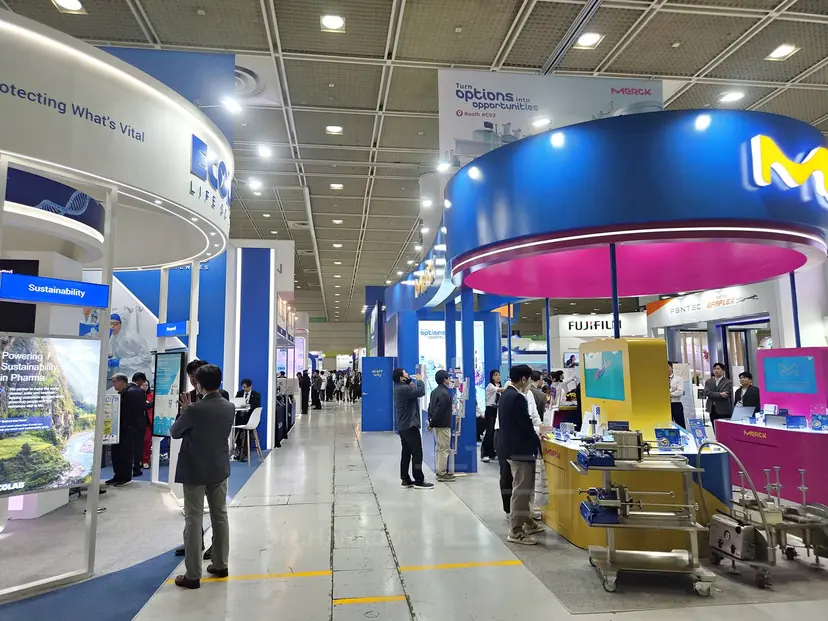
The differing perspectives between the government and the industry were evident at ‘BIO PLUS-INTERPHEX KOREA 2026 (BIX 2026),’ which kicked off at COEX in Gangnam-gu, Seoul, on the 28th.
Lee Min-woo, Director General of Industrial Growth at the Ministry of Trade, Industry and Energy (MOTIE), attended the opening ceremony and toured exhibition booths, including those of Samsung Bioepis, Kyungbo Pharmaceutical, the AI Bio M.AX Pavilion, and global bio-materials, parts, and equipment (Sobu-jang) firm Cytiva. The schedule was designed to observe the manufacturing technologies and current status of the industry as introduced by various companies and research institutions.
After concluding his booth tour, Director General Lee told Bizhankook, “It is very encouraging to see many Korean and global companies participating, and to witness that many countries, including Canada, China, and India, are taking note of Korea’s manufacturing capabilities in the biotech industry and seeking cooperation.”
He added, “The Korean biotech industry must be cultivated as a high-tech strategic industry, and the government also plans to significantly expand support for research and development (R&D), verification, commercialization, and infrastructure.”
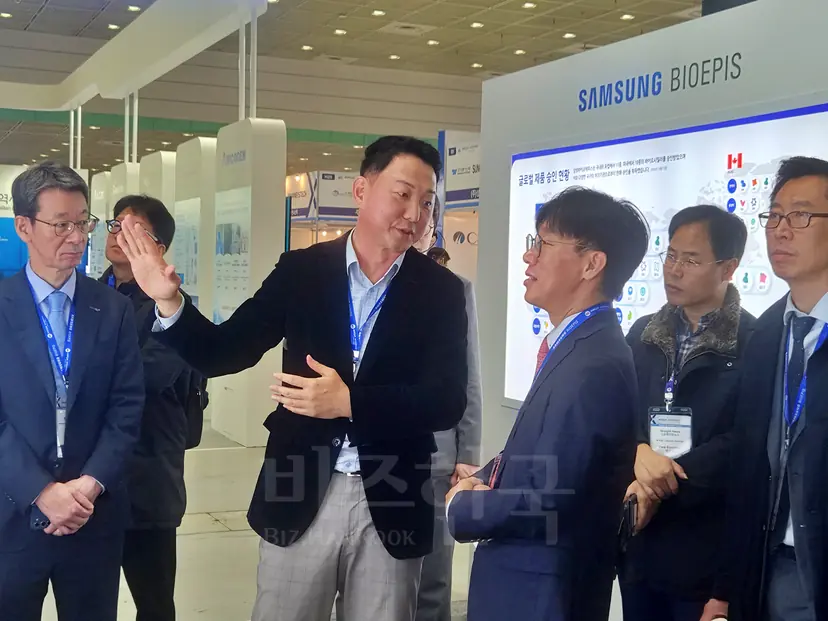
Ministry of Trade, Industry and Energy Observes AI Manufacturing Innovation; Emphasizes Use of Regulatory Sandboxes
During Director General Lee’s booth tour, AI-driven biotech manufacturing innovation and the strengthening of production competitiveness were key points of interest.
Kyungbo Pharmaceutical, which Lee visited, is expanding its business domain from its existing Active Pharmaceutical Ingredient (API) business to the field of Antibody-Drug Conjugates (ADCs). While building a research center in Yongin and pushing for the expansion of its Asan plant, the company is also working to establish an autonomous manufacturing system that combines AI and robotic technology.
A representative from Kyungbo Pharmaceutical explained, “We are pursuing a project to build an AI-based autonomous manufacturing lab by 2029 in cooperation with the Korea Institute of Machinery and Materials and Korea University.”
The concept is to build a manufacturing environment that operates autonomously 24 hours a day by integrating robots and AI control technology into the synthesis and purification processes of ADC linkers and payloads. The goal is to reduce labor costs and secure cost competitiveness to counter low-priced APIs from China and India.
Technologies for the automation and digital transformation of manufacturing processes were also introduced at the AI Bio M.AX Pavilion, promoted by the Ministry of Trade, Industry and Energy. The AI Bio M.AX Pavilion is an exhibition space showcasing technologies that incorporate AI and automation into everything from biopharmaceutical development to production and quality control; ‘M.AX’ stands for Manufacturing AI Transformation.
According to a representative from the Korea Research Institute of Bioscience and Biotechnology (KRIBB), the project involves a research consortium developing seven core element technologies, including AI-based drug candidate discovery, cell state analysis, robotic automated culture, continuous production and autonomous manufacturing control, and digital twin-based quality verification.
The KRIBB representative explained, “There is currently no case worldwide where the entire manufacturing process has been perfectly automated, and the Republic of Korea intends to lead global AI bio-manufacturing standards by connecting these element technologies.”
Director General Lee stated that to increase the competitiveness of such manufacturing technologies, the government would provide support even for stages beyond the R&D phase.
Regarding questions about regulatory improvement, he specifically emphasized the use of regulatory sandboxes. Director General Lee stated, “The biotech industry is a key future strategic industry for Korea. The Ministry of Trade, Industry and Energy will accelerate policy support so that biotech ventures and global companies can grow together, focusing not just on technology development but also on commercialization, regulatory sandboxes, bold verification support, and nurturing companies.”
In his congratulatory speech at the opening ceremony, he also presented biotech manufacturing process innovation through AI convergence and the stabilization of the supply chain for materials, parts, and equipment as major policy directions. The Ministry of Trade, Industry and Energy plans to invest 400 billion won by 2033 to expand the development and verification infrastructure for core biotech materials, parts, and equipment technologies.
Industry: “Investment Funds Concentrated on a Few Listed Companies; Early-Stage Firm Survival at Risk”
On the other hand, voices from the biotech industry argued that the government’s industry-fostering policies should lead to the resolution of financial difficulties for early-stage companies.
Ko Han-sung, Chairman of the Korea Biotechnology Industry Organization (KoreaBIO), emphasized the need for government support and regulatory improvement during the opening ceremony.
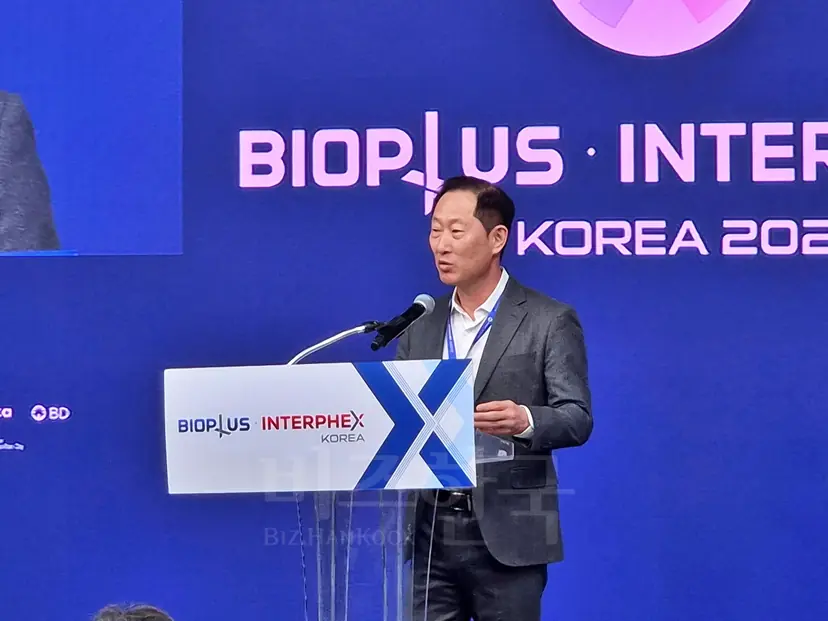
Chairman Ko said, “The government talks about many things, but it is not easy for companies to move forward in the actual field. I hope that government officials will take a deep look at the specific situation on the ground regarding regulatory innovation and reform and carefully consider what the practical difficulties are.”
He also pointed out that the perception of expanded government budget support differs in the field. “They say the budget has increased compared to other sectors, but it is not an increase felt on the ground,” he said, calling for expanded support for the biotech industry.
Later, meeting separately with Bizhankook at the exhibition hall, Chairman Ko specifically mentioned the recent polarization in the biotech investment market. He stated, “There is a severe phenomenon where funds are concentrated only in places where government support is already flowing well. In the past, 2 billion won was invested evenly across many ventures, but now, 10 to 20 billion won is being poured only into specific listed companies.”
He pointed out that rather than funds disappearing from the market entirely, they are becoming concentrated in a few companies, making it difficult for early-stage R&D firms to raise capital. Chairman Ko expressed concern that this concentration of investment is causing severe financial distress for early-stage biotech companies and Contract Research Organizations (CROs).
Chairman Ko also emphasized the need for a long-term perspective regarding the recently spotlighted convergence of AI and biotechnology. He said, “The convergence of AI and biotechnology also requires an absolute amount of time for data to be accumulated and verified. The government and the market must provide support with a long-term sense of balance.”