

[BizHanKook] Baedal Minjok (Baemin) has envisioned a future where it predicts customer demand and prepares for deliveries even before an order is placed. The plan is to use artificial intelligence (AI) to analyze customer preferences and ordering patterns, while coordinating everything from kitchen preparation to rider dispatch in real-time to minimize waiting times in the delivery process.
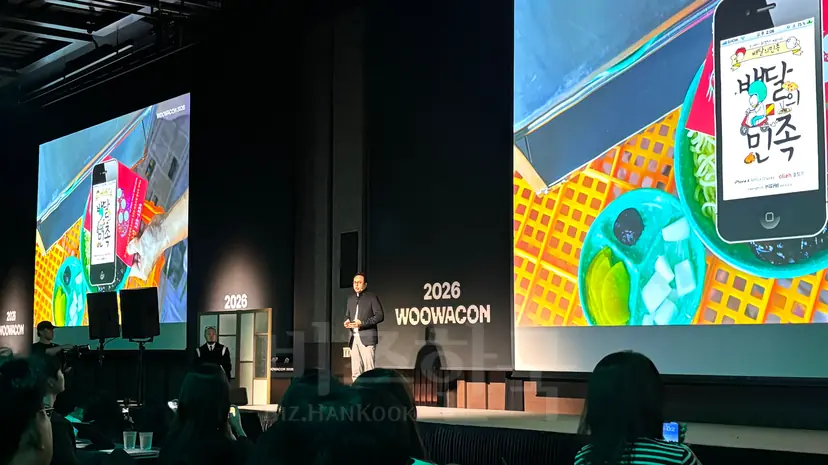
The ‘Woowa Tech Conference 2026’ was held at the Grand InterContinental Seoul Parnas in Gangnam-gu, Seoul, on the 28th. This year’s theme is ‘Technology that Creates a City That Never Stops.’ On this day, Woowa Brothers unveiled its ‘Seamless City’ blueprint, aimed at minimizing wait times in the delivery process.
A Seamless City refers to a city that moves away from the traditional model where delivery begins only after a customer places an order, instead predicting and preparing for demand before the order even occurs. When AI analyzes a customer’s consumption habits and preferences to recommend necessary items, stores prepare to cook in line with predicted demand. In this scenario, riders are dispatched to areas with high potential for orders to pick up food exactly when it is finished, with the goal of reducing customer wait times.
Woowa Brothers defined the technological system that connects customers, stores, and riders into a single network to coordinate demand prediction, cooking, dispatch, and delivery in real-time as a ‘Real-time Physical Network.’
Kim Beom-seok, CEO of Woowa Brothers, said, “We are reducing unnecessary wait times for customers to near zero, not just for food but for many other products as well,” adding, “AI will understand customer intentions and automatically handle browsing, selection, and even recurring orders within the scope allowed by the customer.”
Ko Myung-suk, CTO of Woowa Brothers, explained, “Services until now have mainly played a role in displaying information, but with the advancement of AI, humans no longer need to make every judgment or execution,” adding, “The system is changing so that agents have the autonomy to understand human intent, make decisions, execute tasks directly, and even improve themselves.”
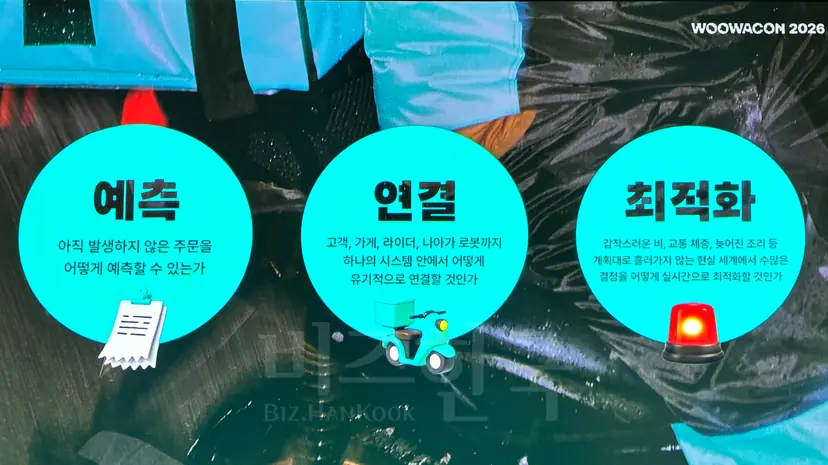
Predicting Delivery Demand with AI on Rainy Days to Reduce Delays
On this day, members of Woowa Brothers gave lectures on their respective areas of expertise. In the session titled ‘How Does Baemin Gather Riders on Rainy Days?’, Data Scientist Shin Sung-chan and Data Analyst Joo Ga-ram unveiled rider supply and demand management technology using AI.
Data Scientist Shin introduced ‘KAIROS,’ an AI-based automated rider supply and demand platform developed and operated to resolve delivery delays caused by weather. KAIROS is a system that calculates required driving hours by predicting order volume and rider supply by region, and supports securing riders to cover any shortages. It utilizes over 20 machine learning models to predict supply and demand across all regions nationwide.
If it is predicted that rider driving hours will be insufficient, the system analyzes individual riders’ availability to select recruitment targets. It calculates the time a rider is expected to work voluntarily without separate incentives and determines the gap from the target operating hours. Afterward, it determines which additional riders to secure by analyzing the probability of them responding to a dispatch request and their estimated operating time.
Woowa Brothers considers delivery quality to have deteriorated if the delivery time exceeds one hour. To prevent this, KAIROS predicts the expected order volume and rider supply for the next hour, starting 30 minutes ahead, every 10 minutes to respond to supply and demand gaps.
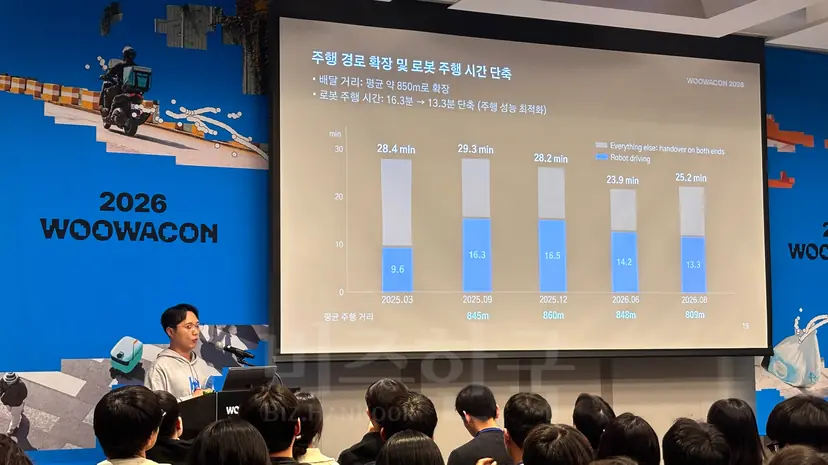
Delivery Robots: Enhancing Operational Efficiency through Simplified Structure
Woowa Brothers also revealed the technological advancements of the B-Mart robot delivery service introduced last year. Kim Byung-oh, Head of the Robotics Lab at Woowa Brothers, introduced the improvement process and future development direction of the delivery robot ‘Dilly.’
This year, Woowa Brothers focused on increasing the stability and operational efficiency of the robots. Previously, if a problem occurred, the entire system had to be rebuilt, but they improved the operating system to allow for rebuilding only the necessary parts. This is a method of upgrading the operational pipeline while maintaining some manual tasks.
For the third-generation delivery robot model ‘Dilly X3-R 1.4,’ introduced last August, the focus was on minimizing driving components and simplifying the structure. Rather than blindly expanding functions, they focused on performing deliveries reliably. Previously, there was a problem where shocks accumulated on the steering axle when driving on uneven roads, damaging parts, but they improved durability by removing the separate steering arm structure used for in-place rotation.
They also removed the automatic motor for the cargo compartment and introduced an electronic lock that customers open and close themselves. Instead, they added a sensor that detects whether items are loaded to verify if the customer has received them. This reduced the possibility of mechanical failure and increased convenience and accuracy in the product receipt process.
Moving forward, they are upgrading their technology to expand the delivery robot’s driving range from outdoors to indoors. Currently, robots have limitations in indoor settings as they rely heavily on maps for positioning because GPS signals are difficult to use. In particular, it is difficult to determine the robot’s vertical position, such as when floor numbers differ but flat coordinates repeat in the same way.
Accordingly, they are envisioning a ‘Door-to-Door’ delivery system that connects outdoor driving paths with building interiors and links with elevators. They also plan to build an ecosystem that supports integration with third-party robots and shares delivery maps. Furthermore, they are reviewing an autonomously evolving data ecosystem that automatically updates maps by utilizing information collected by robots in real-time.
Head Kim Byung-oh explained, “The technical parts have been solved, but actual adoption is slowing down due to issues like cooperation from apartment complexes and the fact that access passwords vary,” adding, “We are currently in the stage of resolving these issues.”