

[BizHanKook] What should a brand infuse into its space to express its own unique essence? Baek Jong-hwan, CEO of WGNB, emphasized that the essence of spatial design goes beyond merely crafting aesthetically pleasing forms; it is about establishing 'relationships' where different elements meet to create new value and planting the 'ideology' of the brand.
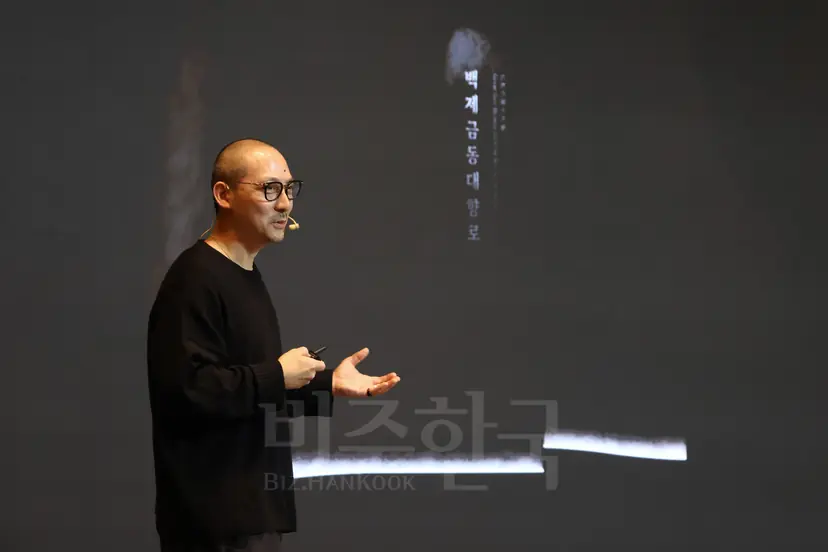
On October 29, WGNB CEO Baek Jong-hwan delivered a lecture titled ‘Another Kind of Harmony’ at the ‘Brand Biz Conference 2026’ held at the Four Seasons Hotel Seoul in Jongno-gu, Seoul. Baek began his talk by pointing out the visual phenomenon where a single dot on a blank screen creates negative space, and a second dot introduces relationships and emotions, such as distance and tension. He explained, “Spatial design is not the process of adding A to another A, but a process where different A and B fuse to create a completely new C,” adding, “Building relationships that allow us to view objects from new perspectives when heterogeneous things meet is the starting point of creativity.”
The Superposition of Past and Present... The ‘Baekje Incense Burner Hall’ and the ‘Room of Beauty’
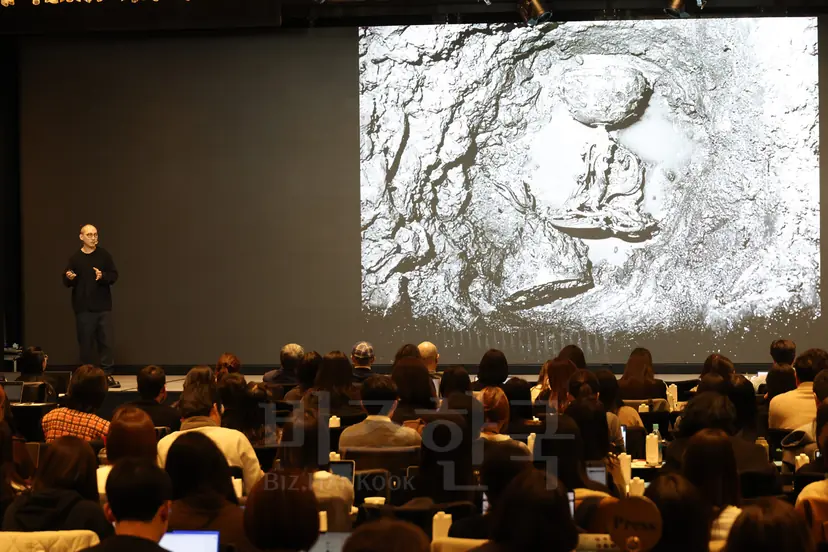
Baek introduced projects where historical artifacts became city icons and brands within modern spaces: the ‘Baekje Incense Burner Hall’ at the Buyeo National Museum and the ‘Room of Beauty (Mi-in-do Room)’ at the Daegu Kansong Art Museum.
When designing the exhibition for the Baekje Gilt-Bronze Incense Burner at the Buyeo National Museum, Baek focused on the site where the burner was excavated (Neungsan-ri temple site) and the geometric order of the Geumdang (main hall) presumed to be its original location. He shared, “As modern people are viewing a ritual object (incense burner) used in the Baekje era, I sought to superimpose the order of the past with modern architecture.”
To achieve this, he applied the concept of an ‘ellipsoid,’ positioned between geometry and natural lines, to the space, and constructed a separate box surrounding the incense burner in the center of the 80-pyeong space using multiple layers of square structures. He installed sloped walls and integrated benches to allow visitors to linger and appreciate the exhibit. Inside the exhibition hall, soft metal finishes and precision framing lighting with reduced reflection were applied, allowing the metallic quality of ancient Baekje and modernity to harmonize across time and space.
The subsequently introduced ‘Room of Beauty’ at the Daegu Kansong Art Museum is a case that proposes a new way to view Shin Yun-bok’s narrow, long painting, ‘Mi-in-do’ (Portrait of a Beauty). After discussions with curators, Baek drew inspiration from the sense of place of a private room where a member of the nobility might have privately enjoyed a painting in the past. He explained, “I wanted to move away from the conventional way of hanging pictures on walls.” He finished the inner room with pure Hanji (traditional Korean paper), while the outer wall was finished with hand-gathered, numbered, lacquered Hanji, placing the ‘Mi-in-do’ on the ‘boundary’ between a metaphorical private room and a public viewing space.
A Manual Embracing Both Existing and New Construction... Olive Young’s ‘Reverse-borrowed Scenery’ and Layering
As a final case, Baek cited the store planning for the commercial retail space ‘Olive Young.’ To resolve information asymmetry within the achromatic store packed with countless beauty products, he established a clear traffic flow and signage system (visual structures for information delivery) by utilizing the structure of columns and beams.
In particular, Baek revealed that he introduced the concept of ‘Reverse-borrowed Scenery’ to spatial design, which flips the traditional landscaping concept of ‘borrowed scenery’ (bringing the outside landscape in through a window). Just as an Apple Store uses a transparent front facade to imprint its brand image on people in the street, he planned the facade so that the inside of the store is perceived as the brand’s ideology from external perspectives.
To do this, he created a window structure applying the slope of the Olive Young logo (13 degrees) and placed a ‘window palette’ that conveys messages solely through the brand’s unique colors rather than text information. Furthermore, to resolve the limitations of newly built curtain-wall buildings surrounded by glass without walls, he devised a ‘layered’ method by placing an additional wall inside the facade. By utilizing the back of the newly installed wall as storage for store fixtures, he completed a consistent manual that is flexibly applied to both the remodeling of existing buildings and newly constructed ones.
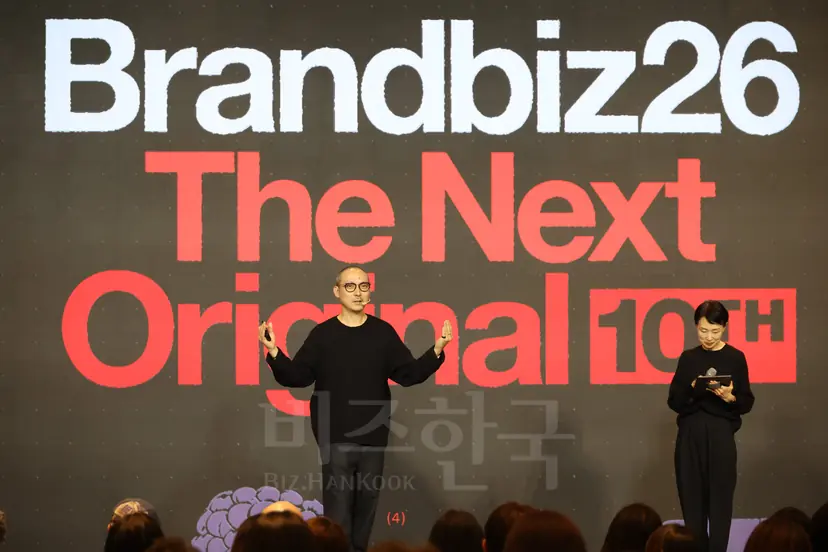
Baek defined design by saying, “Design is not just the work of crafting physical forms, but a process where different things meet to build relationships and create new value,” adding, “A new worldview created through the combination of heterogeneous elements settles in people’s minds as the brand’s ideology and identity.”
During the Q&A session that followed the lecture, when asked about the value of ‘high-end’ in relation to commercial and residential spaces, Baek provided the philosophy of ‘minus (subtraction)’ as his answer. He added, “The more you go toward ‘minus,’ the more high-end it becomes. It means there is no one left who can own it. You end up doing craft work for that space alone, such as using materials found only in that house. Securing irreplaceable ‘scarcity’ and ‘uniqueness’ is the true essence of high-end.”