

[비즈한국] While the rollout of robotaxis for urban passenger transport is being tempered by complex regulations and safety concerns, the practical commercial stage for autonomous driving technology is shifting rapidly toward heavy freight transport on highways. On Interstate 45, a key logistics artery in the south-central United States, Texas has already entered a phase where large trucks are regularly hauling actual cargo for shippers with empty driver’s seats or only safety monitors on board. This is interpreted as a signal that the era of commercialization based on paid transport contracts has begun in earnest, moving beyond simple technical demonstrations.
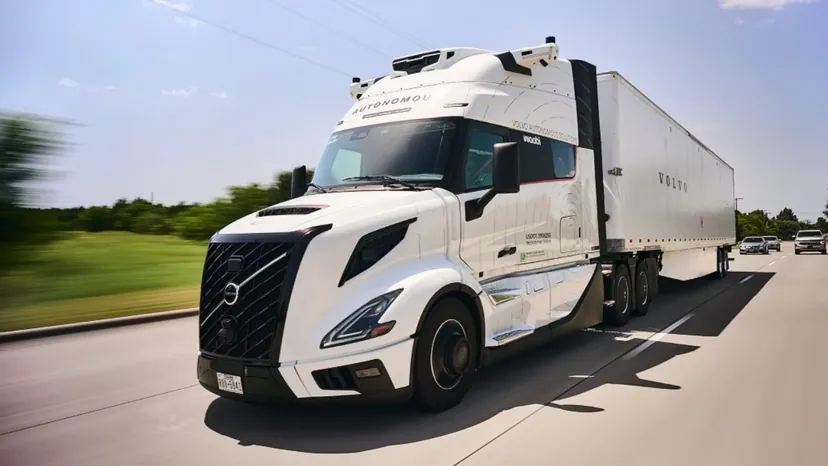
Tech companies hit the road for real-world freight—moving toward full autonomy
The transition toward driverless operations in the Texas logistics corridor is accelerating as collaborations between automakers and autonomous software firms materialize. On October 5, Volvo Autonomous Solutions and the AI autonomous driving company Waabi officially announced that, in partnership with open logistics network provider Warp, they had begun transporting actual client freight between Dallas and Houston. The method involves using Waabi’s system on Volvo’s heavy-duty autonomous trucks, which feature redundant safety designs for critical systems like braking and steering, to deliver cargo directly to external logistics facilities.
This operation is considered notable because it goes beyond transporting fixed-route bulk cargo, incorporating small-package mixed-load networks that consolidate shipments from multiple clients, thus applying the technology to challenging real-world logistics scenarios. While a safety observer is currently in the driver's seat, both companies plan to transition to fully driverless operations after completing a series of phased tests.
Cases of fully unmanned transport with no safety driver on board are also following suit. On April 30, BotAuto, a startup specializing in autonomous truck-based transport services, announced that it had successfully completed a fully unmanned commercial freight delivery on a 230-mile (370 km) nighttime route from northeast Houston to Hutchins, south of Dallas, with no on-board safety personnel or real-time remote intervention.
Prior to this, autonomous technology firm Aurora announced on May 1 of last year that it had officially launched the first regular commercial driverless freight service in the U.S. on the Dallas-Houston route after completing safety validations. Aurora has been dedicated to handling actual loads for Uber Freight and cold-chain carrier Hirschbach, recording over 1,200 miles (1,931 km) of cumulative driving without a human driver.
Kodiak Robotics is also gaining momentum. On September 25, Kodiak announced it would finalize the transition to driverless transport for all segments, including both general roads and highways, on its 219-mile (352 km) route between Dallas and Houston by the end of the year. Subsequently, on October 8, the company announced that it had partnered with carrier Charger USA to deploy autonomous trucks on a 435-mile (700 km) route to Laredo, Texas—the largest land trade gateway between the U.S. and Mexico—to begin paid delivery of refrigerated and dry cargo, rapidly expanding its service range.
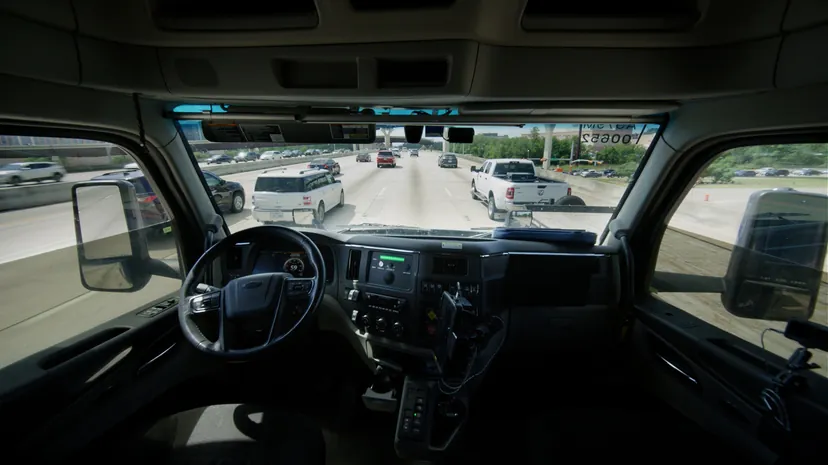
Highways and regulatory innovation: Why Texas is the optimal hub
The fact that autonomous tech companies found a path to monetization in heavy freight trucks before passenger transport is due to a combination of road environments and industrial structures. Unlike urban centers filled with unpredictable variables, highways have limited access points and consistent traffic flow, making it relatively easier for AI to ensure safety.
Structural challenges in the U.S. logistics industry have also expedited this adoption. Long-haul heavy trucking has suffered from a chronic labor shortage due to an aging workforce and high turnover rates. Regulations limiting legal driving time to 11 hours per day to prevent fatigue are also a factor. In contrast, autonomous trucks do not experience fatigue, allowing for punctual operations even at night and continuous long-distance movement without needing to swap drivers, thereby lowering transportation costs per mile.
This is combined with the geographical and institutional advantages of Texas. Dallas-Fort Worth and Houston serve as major freight hubs connecting vast manufacturing and consumption bases with ports in the south-central U.S. The mild climate year-round lowers the risk of sensor malfunctions, and the Texas state government has proactively authorized the operation of driverless autonomous trucks on public roads, removing institutional uncertainty and attracting global companies.
Challenges posed by automation: Liability standards and the future of labor
As driverless transport becomes a reality, the institutional and social challenges that must be addressed have become clear. The most urgent task is determining liability in the event of a major accident. There is currently no clear legal standard as to whether the responsibility in a collision involving a driverless vehicle should fall on the automaker, the software developer, or the transport company managing the fleet.
Changes in the employment of long-haul freight workers are also a key point of contention. Regarding concerns that the introduction of unmanned trucks could threaten the livelihoods of drivers, the industry expects a division-of-labor model to take hold: autonomous vehicles will handle simple long-haul highway driving, while human drivers will focus on complex "last-mile" urban deliveries, cargo inspection, and loading/unloading tasks.
Ultimately, the commercial sustainability of autonomous technology is more likely to be determined by highway freight transport than by passenger cars in cities. The introduction of driverless trucks, starting on Texas highways, has maximized logistical efficiency while simultaneously posing new legal and social challenges that require consensus.