

[비즈한국] On August 20, the Lowell Observatory in Arizona, USA, spotted something suspicious. It was a small light moving across the night sky. Shortly after, two other observatories detected the same light. It was reported as a newly discovered asteroid. Analysis of its orbit showed that the object seemed to be temporarily captured by the gravity of the Earth and the Moon, loitering in our vicinity. It was identified as a candidate for a "mini-moon," a temporary natural satellite of Earth. It was given the temporary serial number Sar2901.
However, recent shocking analysis suggests that Sar2901 might not be a natural celestial body at all. It may actually be an "artificial object" rather than an ordinary asteroid.
This claim stems from backtracking the orbit of Sar2901. Following its path in reverse leads to a position very close to Earth in mid-April 1970. This period coincides exactly with the Apollo 13 mission, the most famous accident in human space history.
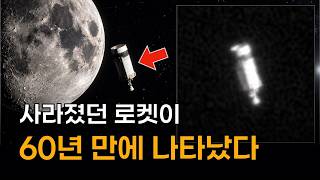
Apollo 13 was launched on April 11, 1970. Three days later, on April 14, the oxygen tank in the service module of the spacecraft, which was headed to the Moon, exploded. At that moment, a large portion of the spacecraft's outer wall was blown off. The oxygen levels plummeted, and the astronauts eventually retreated to the lunar module, Aquarius. After enduring all sorts of hardships, the three astronauts, including James Lovell, returned safely to Earth.
Some astronomers speculate that Sar2901 could be an aluminum or insulation panel from the spacecraft that was ejected into space during the accident. It might have drifted through space, escaping Earth's gravity for a time, only to be discovered recently as it returned to our vicinity. Others suggest that it might not be debris from the explosion, but rather a protective panel that separated normally during the launch of Apollo 13.
While this is a very intriguing hypothesis, data is still quite scarce. Shortly after its discovery, Sar2901 moved away from Earth and dimmed, and it is currently invisible even through telescopes. It was observed only eight times before it vanished from view. With such limited observations, calculating a 56-year-old orbit with perfect accuracy is extremely difficult.
If it is indeed spacecraft debris, it would be significantly affected not only by the gravity of the Earth and Moon but also by the radiation pressure of sunlight. Radiation pressure is nearly impossible to predict because the effect varies greatly depending on the angle and distance of the sunlight hitting the panel. Therefore, many astronomers remain cautious about linking Sar2901 to the Apollo 13 accident. Sar2901 is expected to approach Earth again in mid-November. If we can analyze its orbit more precisely then, its identity should become clearer.
But is it really possible to mistake old spacecraft debris for an asteroid? As embarrassing as it may sound, surprisingly, such things have happened in reality. And not just once, but multiple times.
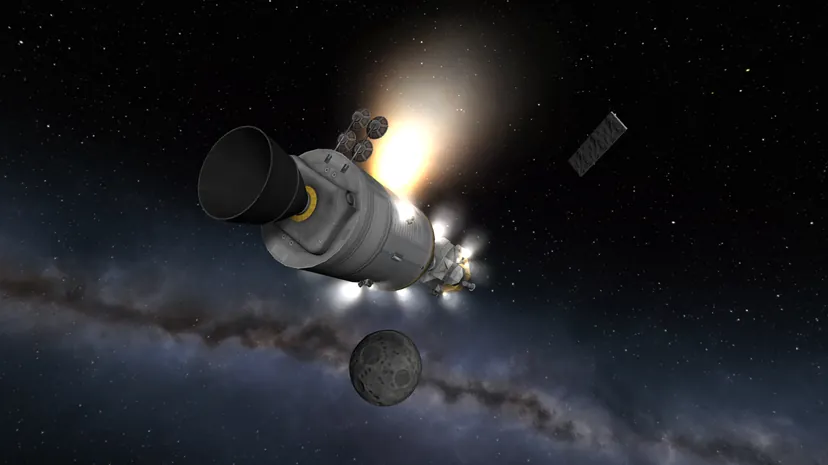
J002E3, once suspected of being another mini-moon staying near Earth, is a prime example. When it was first discovered in 2002, it was thought to be an asteroid that orbited the Sun every year, only to stay near Earth for a few months every 40 years. However, the spectrum observed when it approached Earth was strange. For one, it was too bright for an asteroid. It looked more like a smooth piece of metal than a dark, rocky stone. Furthermore, the spectrum detected traces of white rocket paint. The identity of J002E3 was the third-stage rocket body of Apollo 12, launched long ago.
There was a minor problem with Apollo 12, which was launched toward the Moon on November 14, 1969. NASA originally intended to jettison the third-stage rocket far away from the Moon after separating the command module where the astronauts were, to avoid interfering with subsequent lunar missions. However, during the ignition of the third stage, the engine burned for too long, meaning even after the fuel was spent, it could not completely escape Earth's gravity. Consequently, the rocket failed to enter an orbit looping around the Sun; instead, it became trapped in an unstable orbit that looped widely around the Earth after passing the Moon.
Then, two years after its launch in 1971, it passed a point where the gravitational influences of the Earth, Moon, and Sun subtly offset each other, finally allowing it to break free from Earth's orbit and enter a wider orbit around the Sun. However, it did not move entirely away from Earth. It began loitering near Earth, following an orbit almost identical to Earth's but slightly further inward. It was then spotted by humans, mistaken for an asteroid, and even assigned a serial number.
In 2020, an asteroid heading toward Earth was discovered and named 2020 SO. However, its orbit showed it being easily pushed by solar radiation pressure, which is uncharacteristic for an asteroid. It turned out to be the upper stage of the Atlas rocket that launched the US lunar probe Surveyor 2 in 1966. In October 2015, another mysterious asteroid suddenly appeared. Its density was extremely low, and it looked hollow inside. Astronomers believe it to be a discarded fuel tank from a rocket launched during the Apollo era. It entered the Earth's atmosphere over the Indian Ocean south of Sri Lanka on November 13, 2015, and burned up. It was an event where debris from a rocket launched by humans long ago drifted through space as an artificial asteroid before crashing back into Earth's atmosphere.
The presence of man-made objects drifting around the Earth and Moon is becoming increasingly common. Most recently, on August 5, the upper stage of a SpaceX Falcon 9 rocket impacted the lunar surface. After leaving Earth with a private lunar lander in 2025, the rocket's upper stage, its fuel exhausted, drifted through space for nearly a year before falling to the Moon. The roughly 4-ton rocket debris struck near the Einstein Crater on the far side of the Moon at a speed of 8,000 km/h, creating an artificial crater 18 meters in diameter.
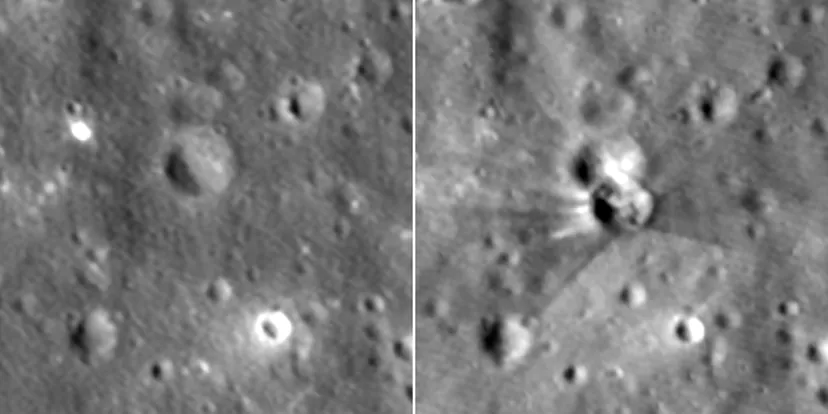
An interesting point is that while it was initially expected that a crater 30 meters in diameter would remain after the impact, the actual size was only half that. Unlike a solid asteroid, the hollow rocket debris crumpled like scrap metal upon impact, absorbing a significant portion of the energy. Additionally, the debris struck at an oblique angle rather than hitting the lunar surface vertically, further reducing the energy.
An empty, mission-spent rocket crashing into the Moon is not merely a curious collision; it serves as a scientific tool for probing the Moon's interior. In fact, during the Apollo missions, starting with Apollo 13, NASA intentionally crashed the spent third-stage boosters of the Saturn V rockets into the Moon—a total of five times from Apollo 13 to 17. They intentionally caused "moonquakes" to study the Moon's interior. By detecting the vibrations with seismometers left on the Moon, they gathered data to explore the size of the Moon's core and mantle. While we cannot predict when or where a stray asteroid might strike, the location, timing, and scale of these human-induced tremors are precisely known, helping to more accurately understand the Moon's internal structure.
During Apollo 12, the lunar module's ascent stage was also intentionally crashed into the Moon. Vibrations were detected on the surface that lasted for hours. This led to the famous anecdote that "the Moon rang like a bell," which fueled conspiracy theories claiming the Moon is hollow or even an alien artificial object like the Death Star. In reality, unlike Earth, the Moon has almost no water and consists of a dry, hard rocky structure, so once it receives an impact, the energy is not easily dampened and echoes for a long time.
While these artificial impacts provide important experimental opportunities to learn about the lunar surface and interior, becoming too frequent could lead to another problem. It could become a new threat to the lunar bases that will soon be built in earnest.
Unlike Earth, the Moon has no atmosphere to shield it by burning up falling debris. All lunar missions leave behind spent, empty rockets in space. How should we dispose of them? We could designate a suitable crater as a space junk landfill and dump everything there. A better method would be to carefully use fuel until the very end to push them completely out of Earth's and the Moon's gravity. However, throwing trash further away requires more fuel and higher costs. Alternatively, we could irresponsibly leave them drifting in space around Earth and the Moon and leave it to luck.
Humans have now begun dumping trash beyond Earth and onto the Moon. Before long, artificial craters left by humans may one day hide the natural craters already existing on the lunar surface. Even if humanity were to perish and vanish someday, should anyone ever return to Earth and the Moon, they might be able to reminisce about our legacy through these metal scraps drifting in the surrounding space. Even today, we are leaving hand-axes in outer space for future space archaeologists.
Reference
https://www.minorplanetcenter.net/mpec/K26/K26R09.html
About the author, Ji Ung-bae: Loves cats and space. Since watching ‘Galaxy Express 999’ as a child, he dreamed of sharing the beauty of the cosmos. He is currently an assistant professor in the College of Interdisciplinary Studies at Sejong University, engaging in various science communication activities including lectures and writing. He has authored books such as ‘On the Uselessness of Astronomers’, ‘We Are All Born Astronomers’, and ‘Strange Questions That Pop Up When Looking at the Universe’, and has translated titles including ‘How I Killed Pluto’, ‘Quantum Life’, and ‘UFO’ (original titles may vary).