

[BizHanKook] Recently, Korea Aerospace Industries (KAI) has been emphasizing the MAH-1, the Marine Attack Helicopter (MAH), as much as it does the KF-21 fighter jet. At the Sacheon Airshow held from October 22 to 25, the MAH-1 made its first public appearance, performing high-maneuverability flights in a fully armed configuration. On October 28, a ceremony marking the completion of the MAH system development was held at KAI's factory in Sacheon, Gyeongnam.
KAI’s “all-out promotional effort” for the MAH reached its climax at 11 a.m. on November 16 at the plaza of the ROK Marine Corps Headquarters in Hwaseong, Gyeonggi-do. A gray helicopter, flying low from the southern sky, landed in the narrow plaza. It was an MAH-1 prototype. The person who stepped out of the helicopter was KAI CEO Kim Jong-chul, wearing sunglasses. CEO Kim had personally piloted the aircraft, intended for delivery to the Marine Corps, from Sacheon to the Marine Corps Headquarters.
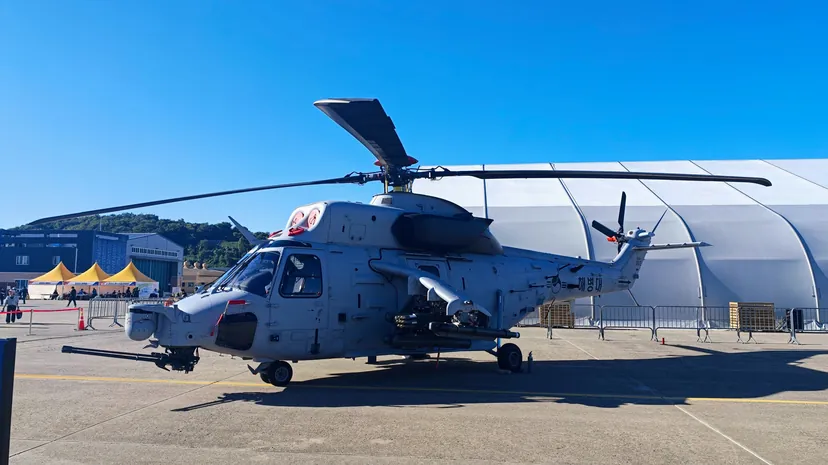
KAI’s intense effort to promote the MAH-1 seems to be driven by both emotional and business motives. First, it appears the company felt some of the criticism surrounding the MAH-1 was unfair. The Marine Attack Helicopter project faced many difficulties as it had to meet the Marine Corps’ requirements within a limited budget. Foreign companies offered high prices or pressured the ROK to purchase their aircraft by claiming their production lines were closing. The decision to pursue domestic research and development was made after KAI proposed that they could meet the Marine Corps' requirements within the fixed budget by modifying an existing airframe. In the process, there was even criticism based on comparisons with specific foreign models, with some claiming that the “Marine Corps bought a useless helicopter.”
However, some of the criticism was based on inaccurate comparisons of performance metrics like rate of climb, range, and armor, or on the biased perception that attack helicopter cockpits must be in a tandem (front-rear) layout, and that a side-by-side layout is unsuitable. Despite such criticism, the Defense Acquisition Program Administration (DAPA) decided to push ahead with the MAH-1 development. The system development, which began in October 2022, was completed in four years. 450 billion KRW was invested in the development, and mass production will begin next year. A total of 24 units will be deployed to the Marine Corps Aviation Group by 2031.
KAI’s extensive publicity of the MAH’s operational readiness also seems to stem from expectations that it could open new markets beyond the Marine Corps, as the MAH’s performance, price, and delivery speed are highly competitive.
The MAH is an airframe that combines the armament and avionics systems of the Army’s Light Armed Helicopter (LAH-1) with the platform of the Marineon (MUH-1) amphibious transport helicopter. It has a maximum takeoff weight of 8.7 tons, a maximum speed of 265 km/h, and an operational endurance of 3 to 4 hours. It is equipped with a 20mm turreted machine gun, 70mm guided/unguided rockets, the domestic "Cheongeom" air-to-ground guided missile with an 8km range, and Mistral air-to-air missiles. The parts commonality with the Marineon reaches 96%.
The MAH outperforms competing models in several areas. First, it has stronger firepower than the LAH-1 Mirion, which is also produced by KAI. The performance of its Target Acquisition and Designation System (TADS) is also superior. Its armor protection is equal to or better than the LAH, capable of withstanding 12.7mm heavy machine gun fire. Its range is longer than the LAH’s, and its weapon payload capacity is more than double. Notably, the fact that it carries guided rockets (APKWS) and air-to-air missiles—capabilities the LAH does not yet possess—hints at its potential as a "drone hunter."
Like the KF-21 and FA-50, the MAH is worth considering for international export due to its price competitiveness. According to statements by a high-ranking KAI official reported in the media, the MAH has a weapon payload capacity similar to the Apache but costs only half as much. With the price of the Apache having risen significantly, the ability to carry eight long-range anti-tank missiles and perform both air-to-air and air-to-ground missions is the basis for KAI’s confidence in its price competitiveness.
Recently, variables have emerged regarding the ROK military’s attack helicopter force. KAI’s LAH faced engine problems starting early this year. Although it has since normalized, questions regarding the engine supply capacity of France’s Safran remain. Recently, the 622 Apaches operated by the U.S. military and 242 units operated abroad were grounded for nearly a month due to concerns over transmission defects. The issue has since been resolved. For KAI, this situation provides grounds to propose the MAH as an alternative to both the LAH and the Apache. It is reported that there are no issues with the current supply of the GE T700 engines used in the MAH. Furthermore, the Surion, the platform upon which the MAH is based, has proven its operational stability.
There has not been an official proposal for an Army version of the Marine Corps' attack helicopter. However, it has been confirmed through reporting that the second large-scale attack helicopter project—the additional introduction of the AH-64E Apache Guardian—is effectively under review. KAI could potentially propose supplying 50 to 60 MAH units to the Army for the same cost as introducing 36 Apaches.
If the domestic Surion transmission, for which development was completed this year, is installed in the MAH, and equipment specific to the Marine Corps—such as salt-corrosion protection gear, rotor-folding mechanisms, specialized radio equipment, and emergency floats—is removed, there is room to increase the weapon payload and extend the operational range. If developed for the Army, it has the potential to evolve into a "drone aircraft carrier" capable of carrying over a dozen long-range attack drones, or a "drone hunter" equipped with an Active Electronically Scanned Array (AESA) radar for intercepting drones.
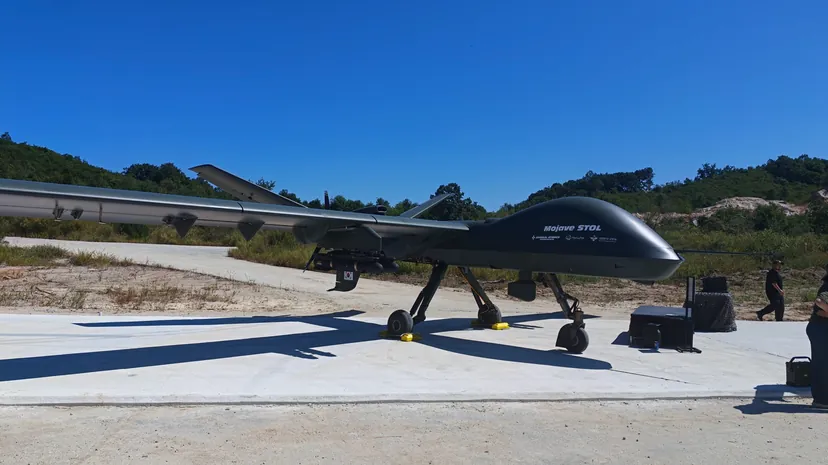
However, it remains uncertain whether such a concept will actually be implemented. Reporting indicates that in the process of reviewing alternatives to the additional Apache acquisition, opinions are being exchanged on both the option of securing attack helicopters domestically and the option of restructuring the force to center around unmanned aerial vehicles (UAVs). If attack helicopters are to be replaced by UAVs, the Mojave, jointly produced by Hanwha Aerospace and the U.S.-based General Atomics (GA), is considered a strong candidate.
It is true that the Ukraine war exposed the vulnerabilities of helicopters and highlighted the importance of drones for both Russia and Ukraine. However, UAVs can be at a disadvantage in terms of survivability because it is difficult to equip them with self-defense systems depending on the airframe. While larger Reaper-class drones can carry self-defense equipment like missile warning systems, doing so reduces the payload capacity available for weaponry.
The capabilities of UAVs are also advancing rapidly. Tests are underway to equip the Mojave with machine guns and air-to-air armaments so that it can perform the drone-countering missions once handled by manned attack helicopters. Someday, UAVs might fully replace attack helicopters. However, I believe that for the next 30 years, Manned-Unmanned Teaming (MUM-T), where manned helicopters and UAVs operate together, will be necessary.
I believe that the military, the Ministry of National Defense, and the Korea Institute for Defense Analyses (KIDA) need to review a plan to appropriately balance domestic attack helicopters and UAV assets while standardizing the armaments and equipment across both platforms. For example, they could upgrade the Cheongeom anti-tank missiles used on attack helicopters for use on UAVs, or standardize the use of AESA radar for drone detection and long-range attack drones across both helicopters and UAVs. I hope our military makes the best possible choice regarding the future of the Army's aviation force.