
[BizHanKook] The center of gravity in the artificial intelligence (AI) competition is shifting from large language model (LLM) training and securing graphics processing units (GPUs) to inference and cost efficiency in operating actual services. In a landscape where not only semiconductor performance but also software, networks, and storage must be optimized, AMD is embarking on a project to verify infrastructure that combines heterogeneous computing semiconductors with South Korean AI firms. The plan is to integrate the semiconductor and software technologies of Korean companies into the AMD ecosystem and expand these domestically verified systems into the global market.
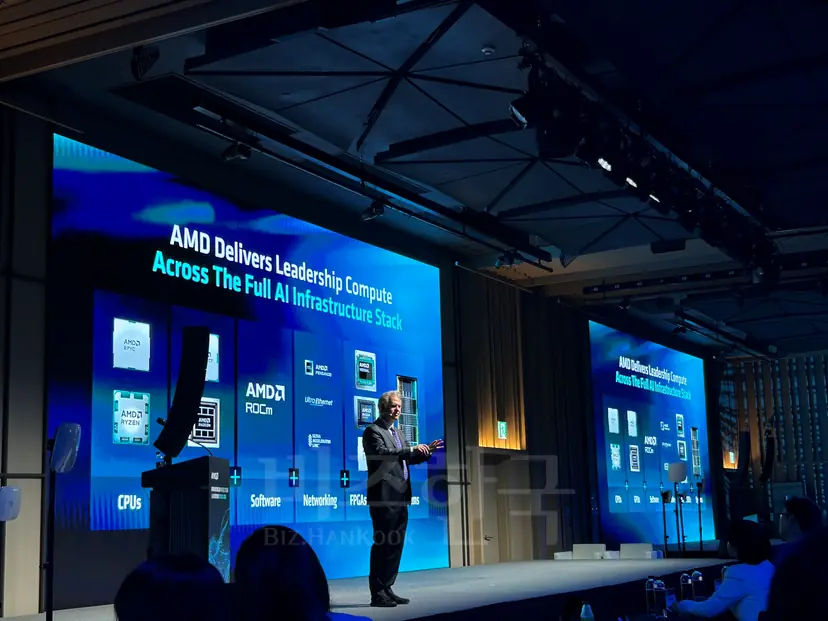
AMD hosted ‘Advancing AI World Tour Seoul 2026’ on the 4th at the Westin Josun Seoul, where it shared its global AI strategy and direction for domestic cooperation. This marks the first time the company has held its annual technical event, which has traditionally been held in the U.S., in South Korea. Domestic AI semiconductor and infrastructure firms including FuriosaAI, MangoBoost, and More, along with partner companies like Naver Cloud, also participated to showcase their technologies and use cases.
Heterogeneous Infrastructure with Domestic NPUs: Becoming a ‘Verification Hub’ for Korea
In his keynote address, Keith Strier, Senior Vice President of Worldwide AI Market at AMD, announced plans to build the first reference cluster in Seoul by the spring of 2027 in collaboration with FuriosaAI and MangoBoost. The approach involves combining AMD's CPUs and GPUs with neural processing units (NPUs) from Korean AI semiconductor firm FuriosaAI and data processing units (DPUs) from data center infrastructure semiconductor and system firm MangoBoost. The three companies also signed a Memorandum of Understanding (MOU) on the same day. Each semiconductor leverages its strengths: CPUs coordinate tasks, GPUs handle large-scale calculations, NPUs take care of AI inference, and DPUs manage network and data movement.
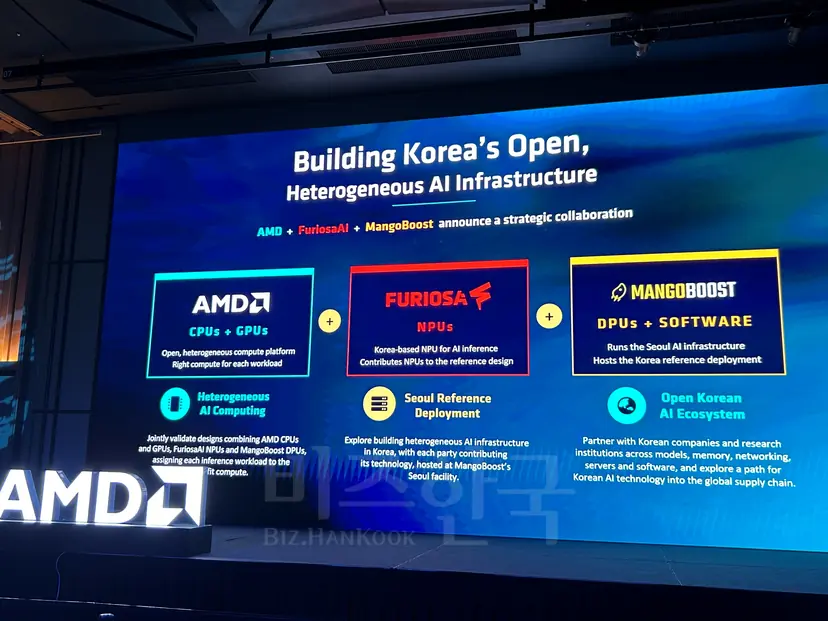
A reference cluster is a system that verifies whether various semiconductors and software work together in an actual data center environment, serving as a standard reference for other companies to adopt. Senior Vice President Strier stated, "When we signed the MOU in July, we promised not only to bring AMD technology to Korea but also to integrate Korean technology into the AMD ecosystem," adding, "This will be the first example that demonstrates what a heterogeneous AI infrastructure looks like while fulfilling our promise to our Korean partners."
Strier emphasized, "There is no single chip that satisfies every workload, and no single configuration or rack can meet all demands." The rack-scale system ‘Helios,’ which clusters 72 GPUs, is scheduled to be introduced to major data centers and clouds worldwide by 2027. As AI agents proliferate, the role of the CPU in task orchestration has grown once again. Strier projected, "The quantity of CPUs we will sell over the next year will exceed the combined sales of the last several years."
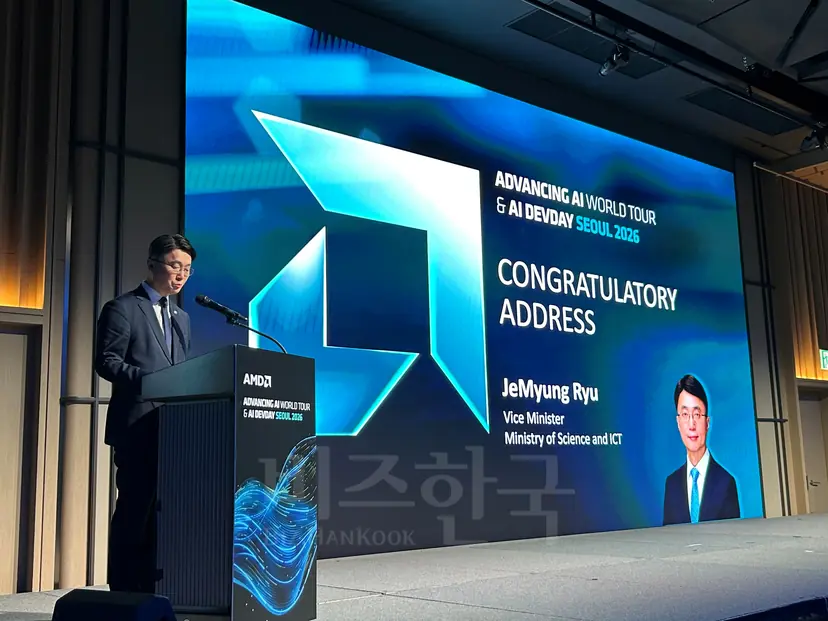
Cooperation between the Ministry of Science and ICT (MSIT) and AMD is also becoming more concrete. Previously in July, the two sides signed an MOU covering AI computing infrastructure construction, the establishment of an AMD AI research center, and talent training. In October, AMD also announced plans to establish a domestic AI research center with a research staff of several hundred. Lee Do-kyu, Director of Information and Communications Policy at the MSIT, said during a panel discussion that day, "The (MOU) includes content about cooperating with Korea's domestic NPUs," adding, "This is highly unusual."
He explained that while MOUs are usually comprehensive, they specifically pinpointed the collaboration between AMD's CPUs/GPUs and Korean NPUs, and that cooperation is currently underway on the ground based on this. The government plans to support adoption by public and private sectors as well as overseas clients by building large-scale verification references that combine various configurations, such as AMD CPUs/GPUs with domestic NPUs, next year.
The ‘Challenge’ of Proving Cost Competitiveness
The role of domestic companies goes beyond mere semiconductor supply. Ramin Roane, Vice President of AI Product Management at AMD, stated, "We are building a Korean software stack based on ROCm together with our partners in the Korean ecosystem." To provide AI model services, calculations must be optimized for the hardware, and software must be updated repeatedly as new models emerge. Additionally, multiple pieces of equipment must operate as a single system.
AI infrastructure software company More diagnosed that data centers are evolving from simply renting out GPU computing resources to becoming ‘token factories’ that operate models directly and provide tokens. More CEO Cho Kang-won explained that they are combining optimization software at the chip and cluster level on top of AMD ROCm to support the latest models rapidly and are developing a structure that can use not only different GPUs like AMD and NVIDIA but also domestic NPUs in the future. More claimed that its own measurements showed the inference throughput of the GLM model was approximately twice as high compared to a combination of typical NVIDIA GPUs and standard open-source software. According to the company, businesses building their own data centers can cut operating costs by about half compared to using external token services.
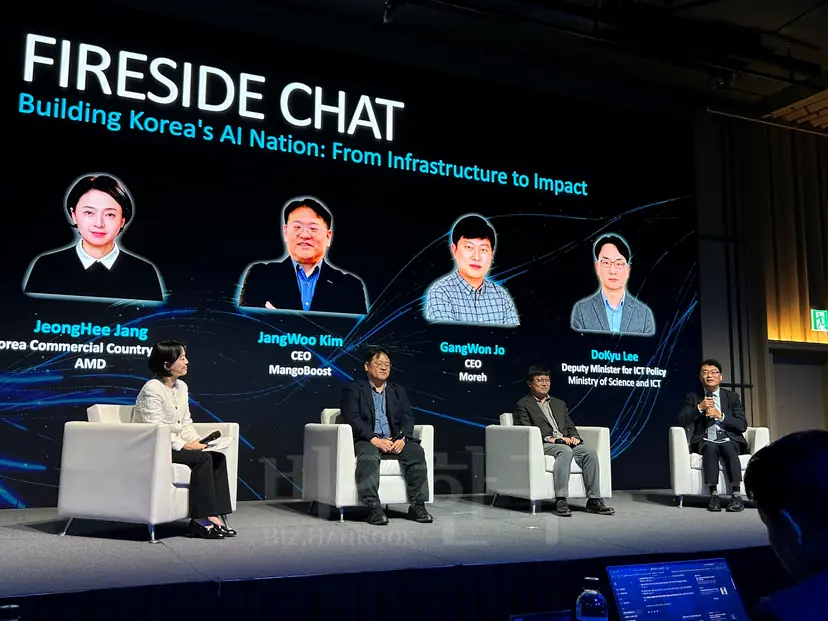
MangoBoost emphasized its system capability to optimize networks, storage, accelerators, and software together. MangoBoost CEO Kim Jang-woo said, "Data sovereignty is important, but what is even more important is that AI is currently too expensive," and introduced a case where they improved performance-per-cost by more than two times by increasing GPU efficiency for a major domestic conglomerate and combining it with their own hardware.
Park Young-hee, Center Lead of Cloud Technology Group at Naver Cloud, revealed that they are operating approximately 35,000 servers equipped with AMD's server CPU, ‘EPYC.’ She explained that this reduced rack space by 20–25% compared to Intel-based systems, and the adoption was expanded after considering the Total Cost of Ownership (TCO), including power and cooling.
However, for heterogeneous infrastructure to take root in the market, different semiconductors must be reliably compatible, and performance and costs must be objectively proven. CEO Cho pointed out, "If a specific vendor decides not to supply GPUs to Korea for a year, it is currently an environment where it's impossible to build a data center." This means that beyond simply introducing different semiconductors, software and system capabilities that allow data centers to operate regardless of the supplier are necessary.
Director Lee stated, "The government will support our companies to play their proper roles as partners in the global open ecosystem, and we are working to build an environment where important sensitive information can be processed domestically."