

[비즈한국] “Investors won’t listen to you unless you start by talking about AI.” This is a sentiment currently circulating openly among startup founders in Europe.
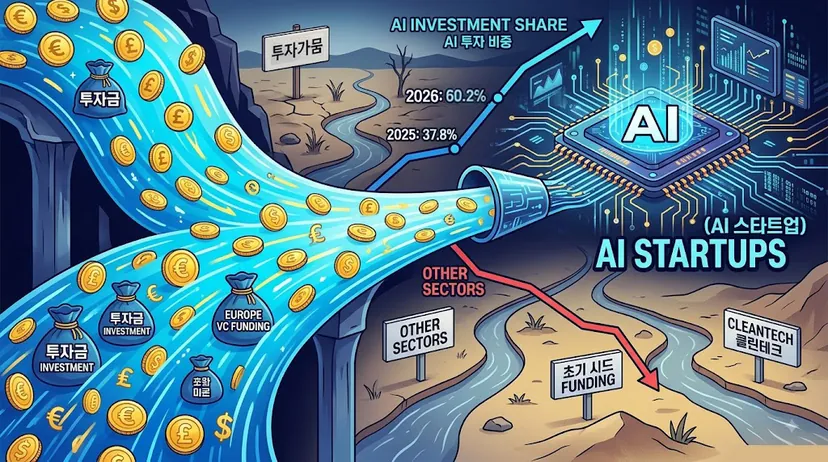
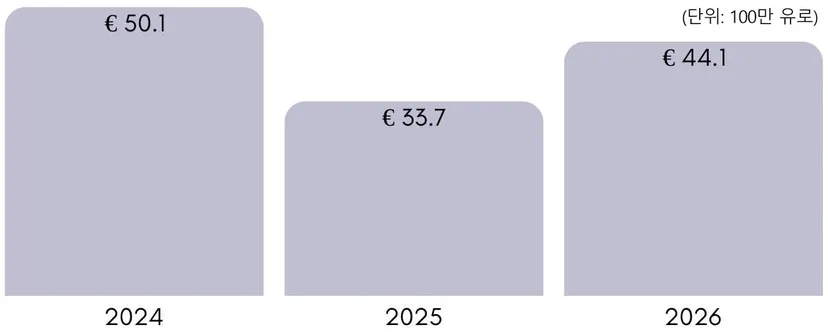
Looking at the data, one can see this is no exaggeration. According to tech.eu, a media outlet specializing in European tech, a total of 44.1 billion euros (approximately 72 trillion won) flowed into the European startup market in the first half of 2026, a 31% increase from the same period the previous year. However, the number of startups that received investment was 1,740, the lowest in six years. More money is flowing through a narrower gate to fewer companies. The name of that gate is AI.
AI Accounts for 60%: “Deepening Concentration”
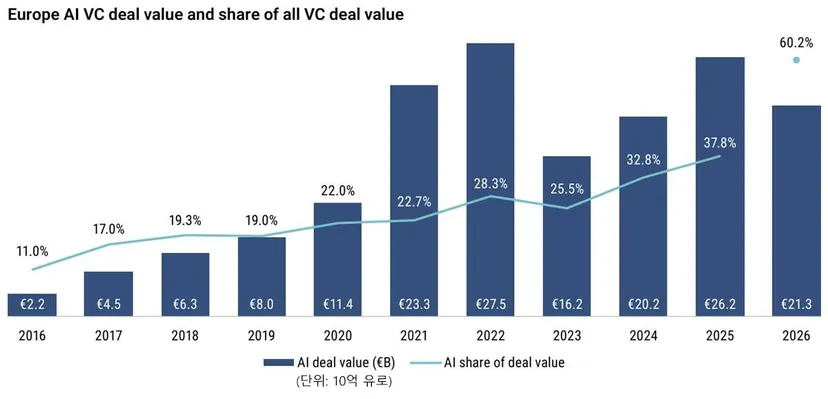
The ‘2026 Q2 European Venture Report,’ published last month by PitchBook, a startup and VC investment data analysis firm, illustrates this concentration with figures. In the first half of this year, 60.2% of European VC investment went to AI-related companies. This is a jump of more than 22 percentage points in just one year, up from 37.8% in 2025.
The largest deals in the second quarter symbolically highlight this trend. Isomorphic Labs, a UK-based drug discovery AI startup spun out of Google DeepMind, raised 1.7887 billion euros (approximately 2.9 trillion won). Autonomous driving AI firm Wayve secured 1.0873 billion euros (approximately 1.77 trillion won). Ineffable Intelligence, an AI startup focused on reinforcement learning, raised 943.1 million euros (approximately 1.53 trillion won) in its seed round alone. The company was founded by David Silver, a former DeepMind researcher who helped create AlphaGo, and is developing an AI that learns on its own without human-generated data. It is rare for an early-stage startup to raise over 1 trillion won at the seed stage.
Beyond AI, the cleantech (clean energy/green industry) sector is also worth noting. In the first half of the year, cleantech was the third-largest sector with 7.4 billion euros (approximately 12 trillion won), growing 59.1% compared to the same period last year.
The point to note is the number of deals rather than the amount. PitchBook analyzes that the number of AI startups themselves has increased, with AI deals accounting for about 40% of all investment deals. This is a signal that not only money but the entire ecosystem is shifting toward AI.
The Drying Up of Early Seed Investment
Where money gathers, other areas dry up. In the first quarter of this year, the number of seed-stage investments in Europe fell by 44% compared to the same period last year. The total number of deals hit a six-year low. Seed funding is the stage where early-stage startups receive external capital for the first time. This gateway has effectively narrowed by nearly half.
Ironically, during this same period, the aforementioned Ineffable Intelligence raised over 1 trillion won in a single seed round. This means that a handful of companies are monopolizing massive, record-breaking rounds, while the threshold for other founders to even meet with investors has become much higher.
There are also structural reasons. As the average size of European VC funds has grown from 50 million euros to 60 million euros, the screening costs associated with small-scale early-stage investments of several million euros have become relatively burdensome. This is because, for larger funds, it is more efficient to focus on large-scale rounds rather than small ones. Experts worry that the current pipeline gap could lead to an investment drought in the growth stage by 2027–2028.
UK Dominates in Europe, US Bets on European AI
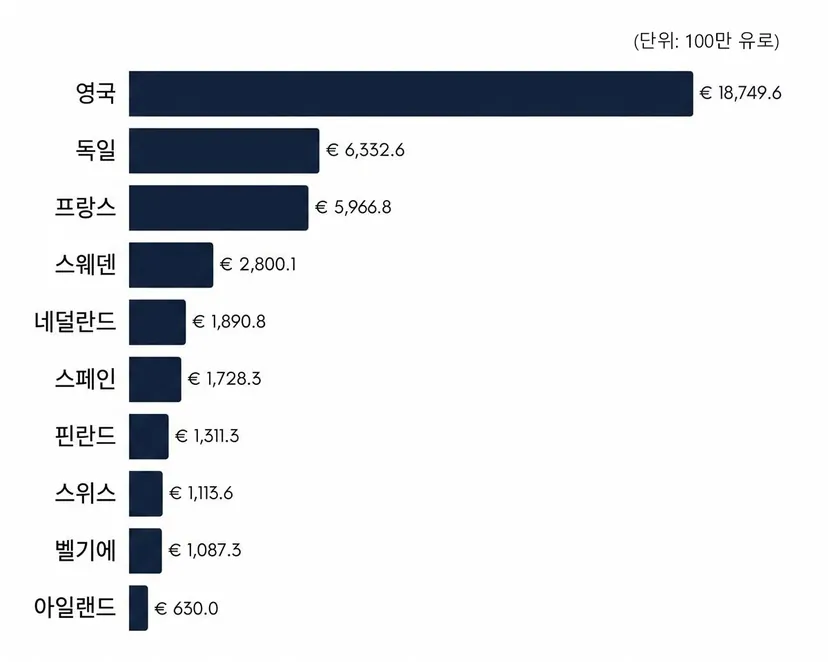
Geographic concentration has also intensified. In the first half of the year, the UK single-handedly attracted 18.7 billion euros (approximately 30.5 trillion won), or 42% of all European investment. This is triple that of Germany (6.3 billion euros) and France (6.0 billion euros). Contrary to predictions that investment would shrink following Brexit, the UK has leveraged its ties to US capital to become the biggest beneficiary of the AI rally. The aforementioned companies—Isomorphic Labs, Wayve, and Ineffable Intelligence—are all based in London.
Germany, the “manufacturing powerhouse,” and France, which prioritizes “AI sovereignty,” have failed to narrow the gap with the UK. Neither France, which declared its independence in European AI with Mistral AI, nor Germany, which doubled its government startup fostering fund to 2.5 billion euros (approximately 4 trillion won), can stem the flow of private capital moving toward the UK.
The origin of the funds is also interesting. The number of US investors participating in European VC deals has equaled that of UK investors, with each group numbering around 1,600. Silicon Valley capital has started crossing the Atlantic to place direct bets on the European AI ecosystem. For US investors, the price of European AI startups is attractive. According to PitchBook data, the average valuation (median pre-money valuation) of European AI startups is just 8.3 million euros (approximately 13.5 billion won). By the same metric, US AI startups are valued at 64.2 million euros (approximately 104.7 billion won). This means they can buy significantly more equity in Europe than in the US for the same amount of money.
“No Funding Unless You Are AI-Native”
The AI that investors demand is not simply a product with an AI feature added on. Companies must be “designed as AI from birth.” The industry calls this being “AI-native.”
On the ground, there are voices saying that even when existing software or service companies pitch by adding AI features, investor reaction is not what it used to be. Conversely, companies that have redesigned their entire business model around AI are seeing larger rounds. Ineffable Intelligence’s seed round of over 1 trillion won is an extreme example of this.
Investor screening criteria have also changed. While they used to ask, “How do you use AI?”, they now ask, “Can this business exist without AI?” They prefer companies where AI is the backbone of the business, rather than companies that just added AI features to an existing service. Whether a company possesses proprietary AI technology or data assets that competitors cannot easily replicate has become the key checkpoint. A higher standard means higher barriers to entry.
PitchBook interprets the fact that Europe’s AI investment share (60.2%) is still lower than that of the US (87.7%) as an opportunity. While the US is nearing a saturation point where almost all VC money is flooding into AI, Europe hasn’t reached that level yet, suggesting there is still room for growth.
Korea Also Experiences AI Concentration
South Korea is not unfamiliar with this phenomenon. According to the startup data platform THE VC, domestic startup investment in the first quarter of 2026 reached 2.18 trillion won, a 55.4% increase compared to the same period last year. However, the number of investments decreased by 17.4%. This is the same pattern as in Europe, where the total amount increased while the number of deals decreased.
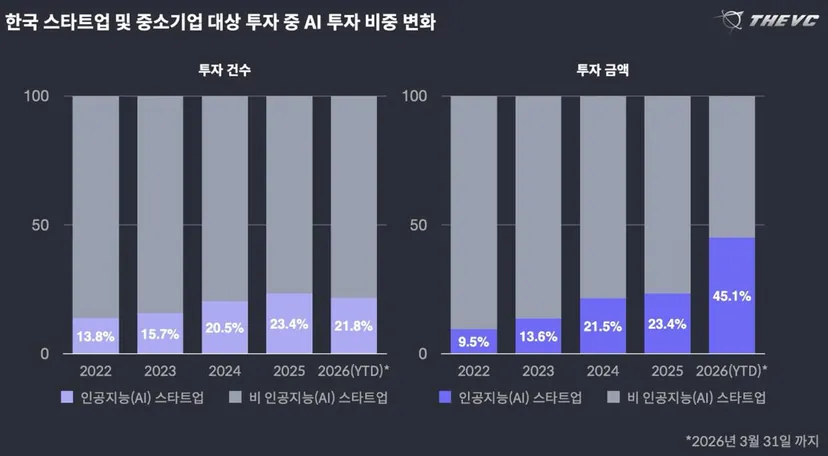
The AI concentration phenomenon is also similar. In Korea, it is estimated that AI-related startups receive more than 45% of total investment. Conversely, the share of early-stage investments, combining seed and Series A, stood at only 21.5%. The fact that the share going to early-stage founders is shrinking rapidly is the same in Korea.
The government’s policy stance also supports this direction. The government has identified the fostering of AI startups as a key task, expanding AI-specialized funds and AI scale-up support programs. Private VCs have also been launching funds focused on the AI sector in succession.
AI concentration is not a temporary trend but closer to a structural reorganization of the investment ecosystem. For startups that do not place AI at the core, this market is becoming increasingly narrow. Both Europe and South Korea are facing the same current.
The author, Lee Jung-woo, spent 17 years as a journalist covering major industries such as automobiles, secondary batteries, and heavy industry, as well as various fields including national defense, diplomacy, environment, education, and health and welfare. He has specifically reported on industrial structure changes centered on mobility, energy transition, and sustainability from the field. He currently resides in Berlin, Germany, and works as a partner at the startup accelerator ‘123 Factory.’