

[BizHanKook] Artificial Intelligence (AI) and robots are gaining attention as alternatives to solve the problems faced by the construction industry, such as labor shortages, safety accidents, and poor apartment construction. From AI cameras that detect worker proximity to warn of danger, to quadrupedal robots that inspect construction progress, and robots that weld faster than humans, these technologies are emerging. The construction industry is accelerating technological development to improve safety, construction quality, and productivity.
These changes in the construction industry were on full display at the ‘2026 Smart Construction, Safety, and AI Expo’ held at KINTEX in Goyang, Gyeonggi Province, on the 27th. Hosted by the Ministry of Land, Infrastructure and Transport, the three-day event, which began on the 25th, featured 258 companies across 818 booths. From large construction firms to tech startups, participants showcased technologies developed to enhance safety and productivity at construction sites.
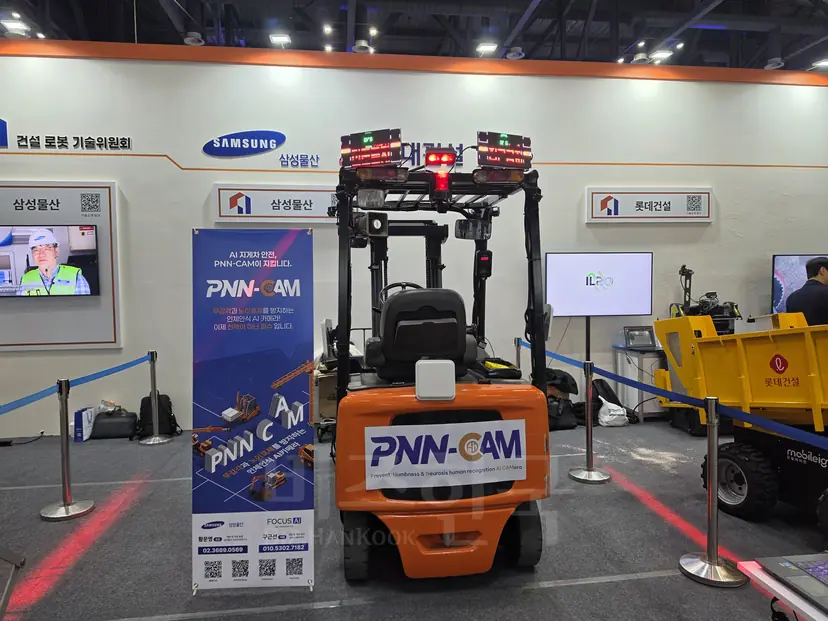
In the field of safety management, technologies that consider worker behavioral characteristics stood out. A prime example is the ‘PNN-CAM,’ a human-recognition AI camera system developed by Samsung C&T and Focus AI. Using six cameras mounted on a forklift, it identifies the locations of nearby workers and adjusts the volume of warning sounds based on the level of risk. To prevent workers from becoming desensitized or fatigued by repetitive alarms, the warning messages and audio alerts can be customized.
Smart construction tech company ConTI Lab showcased a safety management solution where a second AI re-verifies the dangerous situations detected by the first AI. ConTI Lab, which received an innovation award in the safety management category at this year's Smart Construction Challenge, combined Vision Language Models (VLM) with existing video recognition AI to increase judgment accuracy. In a 30-day trial conducted at six Kolon Global construction sites, the system successfully categorized 462 out of 4,967 AI-detected danger situations as false alarms.
A ConTI Lab official explained, "We continuously train the AI model with re-verified data so it adapts quickly to the site, reducing unnecessary alarms. This technology is also being used at the Kolon Global headquarters to monitor approximately 300 cameras."
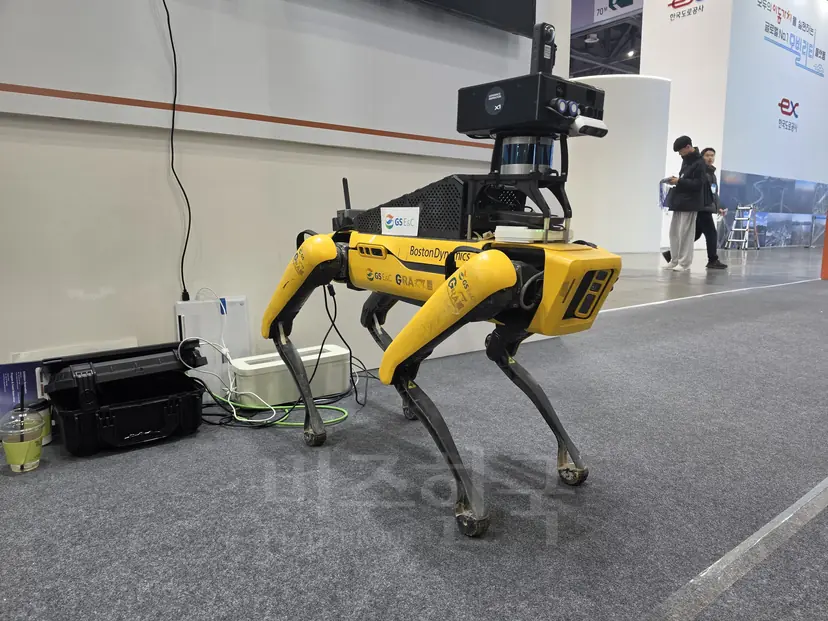
Technologies for monitoring construction progress and managing construction quality are also advancing. GS E&C introduced ‘G.RAI,’ a construction robot operation platform that integrates its own technology into a quadrupedal robot. As the robot autonomously navigates based on blueprints and collects video and other data, the AI determines the completion rate. It can even collect data in areas where communication is disconnected. According to GS E&C, the accuracy of the process assessment is around 95%, and it takes approximately 3 minutes to analyze per household unit.
GS E&C plans to expand the scope of robot usage to include defect inspection during the construction process. Unlike human inspections that focus on the day's work, the robot can collect data throughout the site along a set route. GS E&C tested this robot at apartment construction sites such as Maple Jai. The company is currently securing AI training data with the goal of developing a defect detection function by next year.
A GS E&C official stated, "Defects like missing insulation cannot be verified unless they are inspected during the construction process. We intend to use the robot to periodically patrol the site to check for such issues."
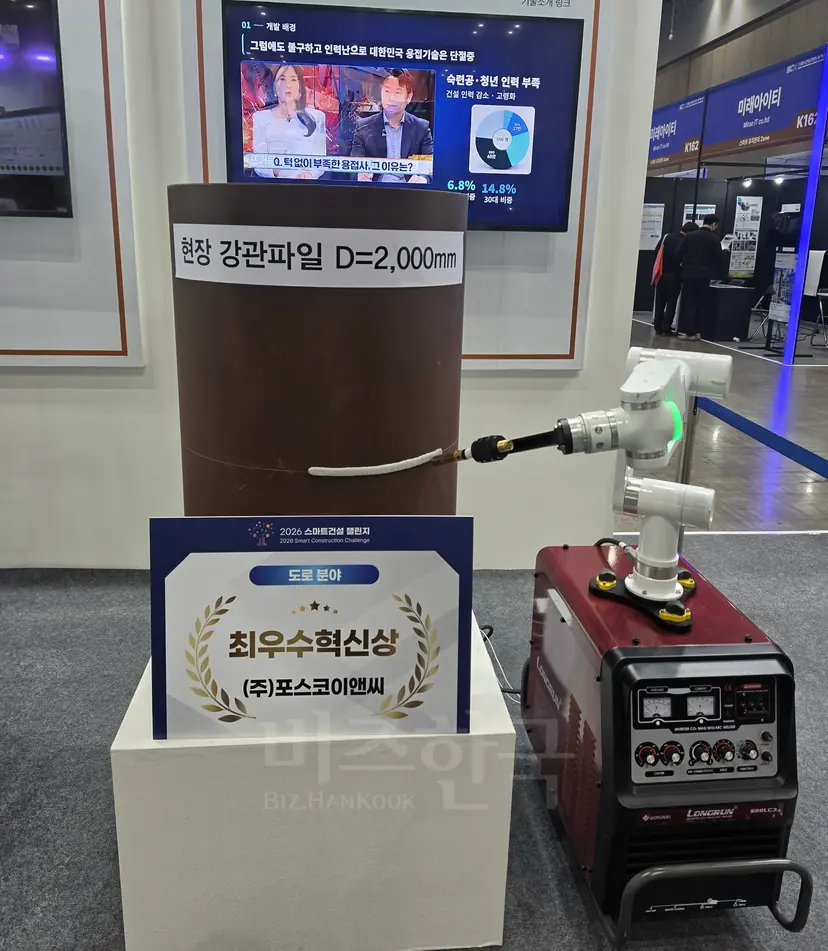
Moving beyond on-site management and supervision, robots that directly perform construction work have also emerged. POSCO E&C, which received the Minister of Land, Infrastructure and Transport Award in the road sector at this year's Smart Construction Challenge, showcased a mobile collaborative welding robot. Once a worker designates the welding point, the robot follows the path to perform the weld. It weighs around 10kg, making it portable for use in different locations. It is currently being used for bridge steel pipe pile welding at the Saemangeum connecting road construction site.
A POSCO E&C official explained, "Once a worker designates the welding spot, the robot can weld three times faster than a human. It ensures uniform quality regardless of the welder's skill level and helps resolve the shortage of skilled welders."
Building materials companies are also entering the field of construction automation. KCC received the Minister of Land, Infrastructure and Transport Award in the complex/housing sector at this year's Smart Construction Challenge for its autonomous painting robot, ‘SMART CANVAS.’ It is a robot that paints the floors of designated areas by recognizing the surrounding environment without requiring direct human control. It reduces the physical burden on workers and ensures a uniform paint film thickness, thereby improving construction quality.
The government is also preparing measures to support the introduction of AI and robots into construction sites. The Ministry of Land, Infrastructure and Transport plans to promote a project for the introduction and diffusion of physical AI construction machinery from next year through 2030. The project will support the verification and field implementation costs for technologies that integrate AI into physical equipment like construction machinery and robots, and assist with relevant regulatory improvements, technology verification, and certification. The ministry recently conducted a survey of the construction industry to develop the project plan.
Achieving economic feasibility is key to the full-scale diffusion of smart construction technology. Even if technology advances, it is difficult to replace existing work methods if equipment introduction and operating costs are too high. A construction industry official met at the event remarked, "There is a significant difference between being technically possible and being commercially viable. The price of robots must go down, and specialized companies for their management and operation must emerge."