

[비즈한국] Companies sometimes make decisions that are difficult to explain by money alone. Understanding the underlying laws and systems can help explain the reasons behind them. "Useful Business Law" introduces clues to help understand business trends.
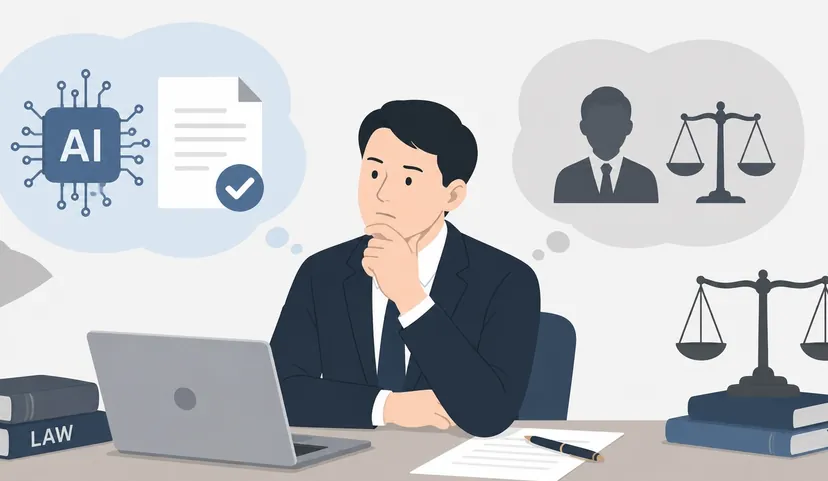
Now that the use of AI has become mainstream, how have legal practices changed? The content that follows may not be a universal story of the entire industry. However, I have summarized the changes based on what I have personally experienced in the field recently.
First, let’s talk about the old days. When I first started working as a lawyer, I would agonize for a long time over a single email. If an associate lawyer wrote a draft and reported it to a partner, the partner would review it for several days before sending it. While this method of working was sometimes frustrating and time-consuming to outsiders, no one doubted its legitimacy, as the quality improved through thorough deliberation and review. In fact, it inspired a sense of respect, much like watching the "old man whittling a bat."
However, this method has almost disappeared today. Even where it remains, I am not sure it is desirable. This is because AI has emerged that is better at writing than humans. At the very least, humans cannot beat AI in terms of "speed" and "completeness of drafts." The same goes for legal documents.
So, what kind of changes are emerging in the industry now that AI is popular? First, legal document battles unfold at an astonishing speed. It often happens that a rebuttal document is prepared within an hour of receiving the opposing party’s filing. Originally, civil litigation had a somewhat customary and standardized rhythm for written exchanges. A complaint is filed, an answer is submitted, and once the issues are narrowed down, supplementary briefs are exchanged. Since even simple documents take hours for a human to write, it was common to refrain from unnecessary filings and keep the battle at a level acceptable to both the client and the representative. In the AI era, however, there are cases where an overwhelming, almost excessive volume of documents is poured out within an unimaginably short time.
Furthermore, tasks that do not leave much room for human creativity seem to have been replaced by AI. Proofreading—catching typos and formal errors—was never easy. If a document exceeded 30 pages, it was inevitable to lose focus and miss a typo. But if you leave it to AI, it proofreads instantly and accurately.
Research, which involves organizing general information such as precedents, legal principles, practices, and regulations before starting a full-scale task, is also being replaced by AI. In the past, there was a perception that it was difficult to guarantee a problem-free process without checking the "Court Practice Guide" before handling tasks related to litigation procedures or practical work. Now, on the contrary, it even looks unprofessional if you handle a task without even organizing the relevant information using AI.
The same goes for taking meeting minutes. In the past, this was the task on which junior lawyers spent the most time. Since it serves as basic data for the case, it was surprisingly labor-intensive. But now, if you record the meeting, transcribe it, and organize it with AI, you can secure high-quality data in a short time.
Lastly, there is the repetitive task of filling out standardized forms. Construction site administration requires drafting and sending numerous official letters confirming standardized facts such as payments. Franchise headquarters managers often write official letters to explain policies or demand corrective actions from store owners. In the past, even one such letter took a considerable amount of time, but now it is easily written with AI.
Looking at this, the tasks immediately replaced by AI are generally those handled by junior staff. Therefore, AI looks like a "tool for team leads." At the same time, concerns are raised that juniors may lose the opportunity to master the work because of AI. Indeed, basic skills such as proofreading, research, and meeting minutes were processes that juniors learned through repetition, and those processes can now be skipped entirely.
Unexpectedly, tasks considered high value-added can also be replaced by AI. It is very difficult to write applications and opinions that persuade regulatory agencies by synthesizing market structure, current status, and the client's economic situation in regulatory matters. In the past, very few people could write such documents, and they were recognized for their value as so-called "expert lawyers." Lawyers searched for examples left by these experts and envied the templates stored deep in the systems of large law firms. However, using AI, these documents can also be created without much difficulty. This is another irony I feel in the AI era.
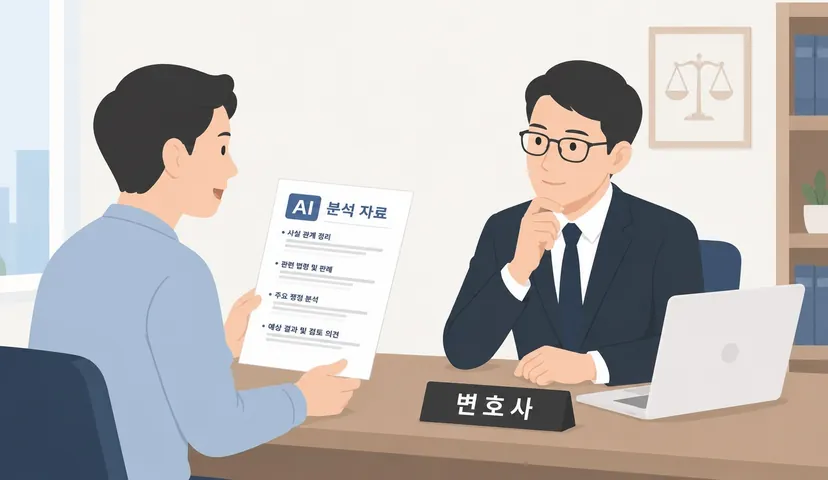
There is another, major reason why I use AI even if I don't want to. It is because clients come with data that they have already organized and reviewed with AI, and ask questions or request consultations based on it. However, such AI data is generally not very helpful. This is because the prompts themselves are inaccurate, and the biases and hallucinations peculiar to AI have not been corrected. To get an accurate answer, a process of correction through repeated questions is necessary, but that process is mostly skipped.
Nevertheless, the way we work has clearly changed. In the past, a lawyer would start a consultation by creating and delivering meeting materials, but now clients bring AI-generated data, and the consultation starts by distinguishing what is right, wrong, or needs supplementation in that data.
As observed while handling cases, those who make good use of people in the right places also use AI well. People with leadership who don't trust humans 100% but correct what needs correcting, don't micromanage, give appropriate discretion, and know what to give up on, showed tremendous productivity with AI.
Also, in legal work, AI fundamentally cannot exceed the expertise of the user. As mentioned earlier, AI is better than humans at proofreading, research, meeting minutes, and data organization. However, establishing case response strategies, adjusting the strength of arguments, and developing logic to persuade the opponent were entirely dependent on human ability. At this very point, AI is merely a means and a tool.
Some say that the development of AI will cause lawyers' work to disappear. However, I see it quite the opposite. In fact, the work of lawyers will skyrocket. This is because, thanks to AI, the data and evidence that form the basis of litigation have exploded. Things that were previously ignored because they were cumbersome are now becoming legal disputes with the help of AI. Things that would have ended in verbal discussions are now being exchanged as official letters neatly organized by AI. There was a non-legal custom in Korea of lending hundreds of millions of won without even writing a promissory note, or writing only a one-page contract when trading multi-billion won forest land. Because of that, there were many cases where one could not sue even if they wanted to due to a lack of evidence, but now it has become easier to prepare data with the help of AI.
From another perspective, the popularization of AI also causes unnecessary disputes and litigation. Data and information are flooding in, but those not trained in legal work are overwhelmed by the volume or blindly trust the unilateral and biased conclusions provided by AI.
AI generally provides answers that cater to the user's preferences. So it often answers that "you can win this lawsuit" as the user wants. However, actual litigation is not like that at all. You never know who will win until you go through the process. Since there are limits to advance prediction, litigation is often compared to a living organism. In this respect, leaving legal judgment to AI is quite dangerous.
Nevertheless, there are not a few cases in the neighborhood where people file lawsuits believing only in AI's unilateral and biased answers. Courts and investigative agencies that have to handle this will likely face a significant burden, but as a result, legal disputes will increase, and the work of lawyers will increase accordingly.
Looking back, the "old man whittling a bat" of those days who pondered over a single email for days is hard to find now. However, no matter who or what writes the draft, the role of taking final responsibility and judging whether that draft is right or wrong still remains with the human. The value of a lawyer in the AI era will be determined precisely in that position.