

[BizHanKook] Opening even a small shop comes with a multitude of regulations to check, yet these are scattered across various ministerial statutes and institutional websites. The government has begun the process of selecting an operator to build a system by next January that uses generative AI to search for and provide guidance on such regulatory information, and even assist in regulatory review and streamlining. This marks the first instance of a public AI service built on a pan-governmental common AI infrastructure preparing for the operational phase.

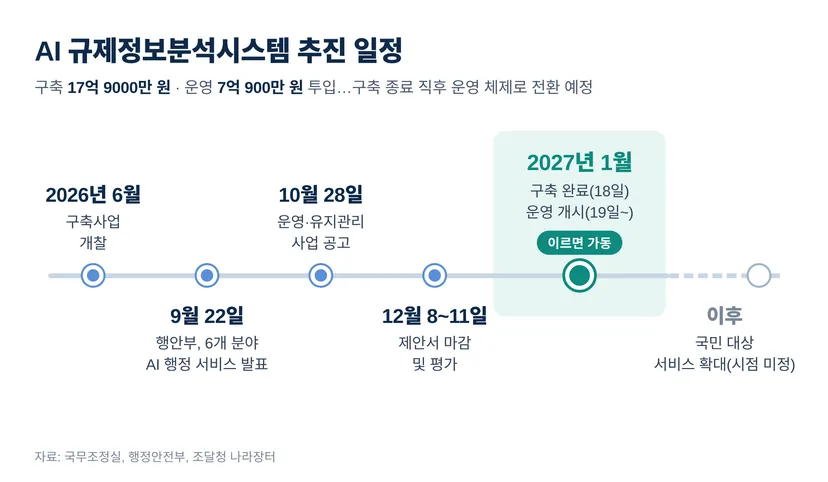
According to the Office for Government Policy Coordination and the Public Procurement Service on the 20th, the Office for Government Policy Coordination has announced the ‘2027 AI Regulatory Information Analysis System Operation and Maintenance Project’ and is accepting proposals until the 8th of next month. The project budget is 709 million won. According to industry sources, the VTW (VTW) consortium, a public information technology consulting and systems company that was the second runner-up after Saltlux, has taken on this project. This project, which costs 1.79 billion won just for development, is one of the 12 tasks under the 18 billion won ‘Public Sector AI Service Support Project’ promoted by the Ministry of the Interior and Safety and the National Information Society Agency (NIA).
The system is expected to be operational as early as next January. An official from the Office for Government Policy Coordination explained, “The maintenance service was prepared in line with the currently anticipated timeline, but the exact service launch date and other details have not yet been finalized.”
While the construction work is underway and details are being refined, the currently conceived AI Regulatory Information Analysis System has four main functions. The AI will identify overlapping or similar regulations and recommend them as candidates for streamlining, and will display similar legal clauses and past review cases when new regulations are created or existing ones are strengthened. It also includes providing guidance on regulatory sandbox approval cases and integrated searches for regulatory information. The plan is to start by supporting civil servants in their duties and eventually expand the service to allow the public to check regulatory information directly.
The system runs on the pan-governmental common AI infrastructure built on the public-private partnership cloud at the Daegu Center of the National Information Resources Service. It is a shared infrastructure provided by the government to allow each agency to utilize Large Language Model (LLM) and Retrieval-Augmented Generation (RAG) capabilities in administrative networks where commercial AI is difficult to use due to security concerns. RAG is a technology that allows AI to first find relevant documents to use as a basis before answering; the Request for Proposal specified that OpenAI’s open model ‘GPT-OSS 120B’ is scheduled to be implemented.
The scope of data that will determine the quality of responses is not yet finalized, and the government is in the process of narrowing down the subjects to be utilized. The Office for Government Policy Coordination has requested the operating company to regularly (monthly) measure and improve the hit rate of search results and the MRR index. MRR is an indicator showing how well data relevant to a query appears at the top of search results. Checking guardrails to filter out groundless answers and monitoring for hallucinations are also the responsibility of the operating company.
The Office for Government Policy Coordination’s ‘Regulatory Informatization’ budget proposal for next year has been set at 1.831 billion won, double this year’s (899 million won), and is currently under review by the National Assembly. The operating company will be selected following an evaluation of proposals on the 11th of next month.
Previously, the Office for Government Policy Coordination introduced this system in September, stating that it would help responsible civil servants quickly and accurately find and provide regulatory information, and would be used to consistently streamline related regulations by analyzing regulatory suggestions and existing cases. An official from the Office for Government Policy Coordination stated, “While more data is generally better, some of it isn’t used effectively when you look closely, so we are reviewing it comprehensively,” adding, “Since data is the most important element, we are striving to utilize it to the fullest extent.”