

[BizHanKook] The explosive rise of AI in corporate and industrial settings is transforming everything from hiring practices to corporate culture. Externally, the global economic order faces uncertainty due to events such as the Trump administration's loss in the U.S. midterm elections and ongoing localized conflicts in places like Israel and Ukraine. How should companies and individuals survive in this rapidly changing economic landscape? We introduce some new books that can provide guidance.
In the Age of Generative AI, 'Who is the Master of Work?': AI Owner

'AI Owner' sheds light on the unique competitive edge that individuals and organizations must secure in an era where AI democratization allows anyone to easily create drafts. The author points out that as AI usage increases, decision-making processes become blurred, leading to a surge in 'workslop'—tasks that look professional on the surface but fail to drive real progress. To overcome this challenge, the book suggests going beyond simply increasing AI tools by proposing 'herbal medicine drawer' style data design to systematize data networks and 'AI OKR,' a framework for setting practical goals. Furthermore, it emphasizes the role of an 'AI Owner'—someone who is not a passive user led by technology, but rather someone who clearly defines the purpose and scope of delegation while taking responsibility for the final result. It serves as a reminder that as AI becomes commoditized, the key to performance is not the technology itself, but human agency in controlling the context and boundaries of work.
The author, who has worked in the software industry for over 10 years, reconsidered the utility of his experience after observing AI, eventually finding answers by building his own work tools and managing an AI agent team. Based on his field experience, this book teaches readers what to delegate to AI and where humans must exercise their own judgment.
Build a Moat with an 'AI Compounding Engine': Companies Growing More vs. Disappearing Through AI
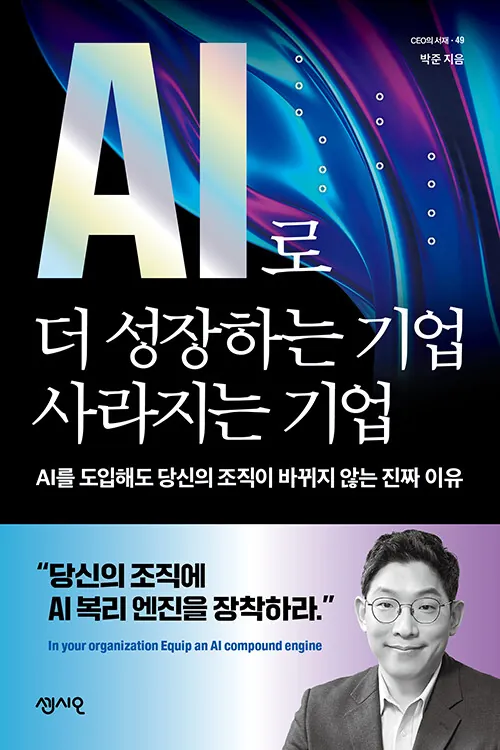
The author has led AI innovation and commercialization in the field as a vice president at SK Telecom. He observed that many companies repeatedly fail to turn technology adoption and high investment into actual performance. The author identified the root cause not in the technology itself, but in the corporate structure that accepts and executes it.
The author asserts that simple time-saving or the use of external AI tools cannot constitute a sustainable competitive advantage. The core lies in combining internal tacit knowledge, on-site know-how, and loyal customer data with AI to strengthen unique strategic assets. Based on the 'Strategic Asset Quadrant' framework for analyzing corporate assets, the book clearly presents where to concentrate resources. When a 'closed loop' is built where produced results flow back into the organization's data and databases, a company evolves from a mere payer of costs into an owner of an 'AI compounding engine' that accumulates performance. It clearly demonstrates the need to fundamentally reorganize an organization's strategy and execution structure beyond the tactic of technology adoption.
The Reshaping of Monetary Hegemony, The Future of Global Finance: The Next Dollar

As U.S. debt and macroeconomic uncertainty intensify, cracks are forming in the traditional dollar-centered financial order. The author, known for 'The Story of the Jews' and 'Economic History of the Jews,' tracks the seismic shift in monetary hegemony—from rising gold prices and the rise of Bitcoin to the emergence of stablecoins and Central Bank Digital Currencies (CBDC)—in a multi-dimensional way. Avoiding the simplistic, provocative frame of "dollar collapse," the book provides a detailed diagnosis of the coming global financial order by combining the historical evolution of currency with hegemonic competition among major powers. If both companies and individuals cannot read the macro patterns of capital movement, they cannot ensure the stability of their assets and management. The book guides readers on how the value of money we have been obsessed with is being redefined during this paradigm shift in monetary systems, and what insights we should draw from the global macroeconomy.
After joining KOTRA and working in the world's economic hotspots for 32 years, the author learned that money is not just a means of exchange, but a symbol that drives world trade, accumulates wealth, and sets the rules of the international order. Based on this experience, he explains complex and dry global economic and financial history in an easy and entertaining way.
The 'Inconvenient Truth' That Determines Corporate Survival: What Long-Lasting Companies Confront

The average duration of S&P 500 companies staying in the index was over 30 years just a generation ago, but now it is only half that. In an era where corporate lifespans are rapidly shortening, the secret to long-lasting companies does not lie in simple financial performance or the blind adoption of trendy management fads. The author, who has spent over 20 years contemplating and advising on corporate management and sustainability, leads the familiar discussion surrounding ESG to a deeper level of questioning in this book.
The author argues that for ESG and management innovation to be more than just slogans, companies must recover 'Parrhesia'—the sincerity to speak honestly about the inconvenient truths within. Companies that cannot maintain their 'social license' obtained through social relationships, even if it conflicts with short-term results, will inevitably be weeded out of the market. The book emphasizes the necessity of structural mechanisms that allow sensitive information and risks that organizations prefer to ignore to be delivered to decision-makers without distortion. Beyond superficial goodness or flashy indicators, it reminds us that a firm honesty—objectively confronting one's own weaknesses and limits and connecting them to actual organizational change—is the true condition for the survival of long-lasting companies.