

[비즈한국] President Lee Jae-myung has recently announced and is actively promoting three mega-projects aimed at strengthening industrial competitiveness in the era of Artificial Intelligence (AI). These three projects—semiconductors, physical AI, and AI data centers—are considered essential not only for the nation's future industries but also for balanced regional development, a policy President Lee has consistently emphasized. To accelerate these initiatives, the President even invited the leaders of the nation’s two major labor unions to the Blue House for meetings.
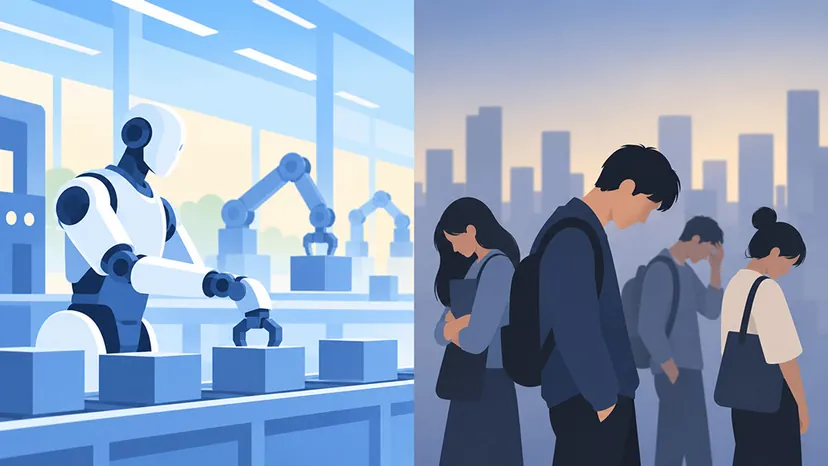
However, as AI spreads across society, it has become increasingly difficult for young people to find jobs. Furthermore, research indicates that industries with higher exposure to AI are seeing a widening wage gap, raising concerns that even if young people succeed in finding employment, they may face financial hardship due to low wages. Consequently, experts warn that labor unions may stiffen their resistance, despite the President's appeals.
On September 3, President Lee met with Kim Dong-myung, chair of the Federation of Korean Trade Unions (FKTU), and Yang Kyung-soo, chair of the Korean Confederation of Trade Unions (KCTU), at the Blue House to discuss issues surrounding the three mega-projects. During the meeting, President Lee underscored the national importance of these projects, noting that their successful implementation is essential for the benefit of future generations and the strengthening of national competitiveness.
In response, the leaders of the two labor unions suggested that successful implementation of the mega-projects would require not only close communication but also the active participation of the labor sector. President Lee’s decision to meet with the union leaders was driven by the urgent need for labor cooperation, such as easing the 52-hour workweek within special economic zones, to ensure the success of these projects. The government is fully committed, having allocated 5.8 trillion won specifically to these three mega-projects in next year's budget.
However, for the labor sector, it is difficult to welcome these initiatives wholeheartedly, as employment conditions have deteriorated since AI began to be used in earnest by companies. The labor sector is particularly wary because the youth, who represent the pool of new union members, are the ones most affected by AI-related job losses. According to the Korean Statistical Information Service and microdata analysis, the number of employed individuals in their 20s from January to August of this year averaged 3.279 million per month, a decrease of 193,000 compared to the same period last year (3.472 million). This stands in contrast to the overall number of employed individuals in the country, which increased by 117,000 to an average of 28.84 million per month during the same period.
This decline in employment among those in their 20s is concentrated in the information and communications, and professional, scientific, and technical services sectors—industries that are both preferred by young workers and traditionally sought after by companies looking for young talent. From January to August this year, the number of employed 20-somethings in the information and communications sector averaged 189,030 per month, a decrease of 60,134 compared to the same period last year (249,164).
Similarly, the number of employed 20-somethings in professional, scientific, and technical services fell to a monthly average of 215,178 through August of this year, down 25,393 from the same period last year (240,571). The information and communications sector, which includes computer programming, postal services, and telecommunications, is categorized as a sector with high AI exposure. Professional, scientific, and technical services, which encompass R&D, legal, accounting, tax, and consulting firms, are also highly susceptible to AI integration.
The combined number of employed individuals in these two sectors, which are heavily influenced by AI, averaged 404,208 per month this year—a decrease of 85,527 compared to the same period last year (489,735). This accounts for 44.3% of the total decline in the number of employed 20-somethings this year. In effect, as related companies increase their use of AI, they are refraining from new hiring.
Since these high-AI-exposure sectors are seeing both a reduction in new hires and a widening wage gap, there are concerns that those in their 20s may find themselves in increasingly precarious positions even after securing employment. According to a recent report titled “AI Exposure and Wage Inequality” published by the Korea Information Society Development Institute (KISDI), an industry with 0.1 points higher AI exposure showed an 8.13 percentage point greater increase in the P90/P10 ratio, which measures the wage gap between the top 10% and bottom 10% of workers. This indicates that the higher the industry's exposure to AI, the greater the inequality among workers within that sector.