

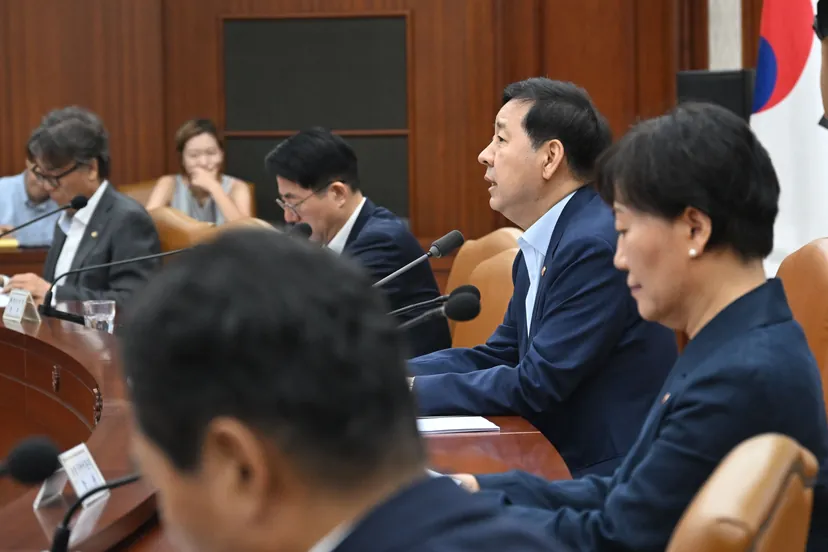
[비즈한국] Moving beyond a growth structure overly reliant on semiconductors, the government is embarking on a major industrial transformation to integrate artificial intelligence (AI) across key industries, including steel, petrochemicals, shipbuilding, automotive, and bio. Koo Yun-cheol, Deputy Prime Minister and Minister of Finance and Economy, presided over a joint meeting of the Emergency Economic Headquarters and the Ministerial Meeting on Economic and Structural Innovation at the Government Complex Seoul on the 6th, where he announced the 'Direction for Economic Structural Innovation' containing these plans. The government stated that it intends to operate the Economic Ministers' Meeting as a 'Structural Innovation Ministers' Meeting' moving forward, with plans to discuss and announce related measures on a monthly basis.
A Sense of Crisis Over Falling Potential Growth… Breakthrough via Physical AI
The government’s push for comprehensive industrial structural innovation is rooted in a sense of crisis regarding declining potential growth rates. The government believes that the Korean economy is facing persistent downward pressure on growth due to the overlap of a shrinking working-age population, stagnant investment, and plateauing productivity. It was also noted as a problem that recent economic achievements have not been evenly distributed across the lives of the people. In fact, the income quintile ratio worsened from 5.72 in 2023 to 5.78 in 2024, and the net asset Gini coefficient deteriorated from 0.612 in 2024 to 0.625 in 2025.
At the meeting, the government stated, "Now is the golden time for structural transformation to leap forward into an 'irreplaceable Republic of Korea,'" and announced that it would concentrate national policy capabilities on current issue management and economic structural innovation. The policy goals were set on two axes: securing "super-gap" competitiveness through industrial structural innovation, and achieving "growth for all" by narrowing gaps in assets, income, labor, generations, and regions.
The core axis of the industrial structural innovation proposed by the government is 'Physical AI.' In line with the trend where the AI paradigm is expanding beyond calculation and inference into the realm of physical action, such as robotics, the plan is to integrate AI into all industries beyond just semiconductors. The steel industry is set to develop a basic plan within the fourth quarter of this year, focusing on AI-based manufacturing process innovation alongside the development of high-value, eco-friendly technologies such as hydrogen reduction steelmaking and special carbon steel. For the petrochemical industry, the government plans to release a comprehensive support package during the same period that encompasses business restructuring and the introduction of alternative raw materials. Furthermore, the government plans to announce a comprehensive roadmap for AI-based drug development for the bio sector and the development of specialized humanoid robots for the home appliance sector around the fourth quarter.
In particular, the shipbuilding industry will see the parallel development of specialized humanoid robots for tasks like welding, alongside core technologies for fully autonomous navigation. The automotive sector is slated to develop a common AI platform for electric vehicle manufacturing and autonomous driving AI models. To support this, the government has decided to throw its weight behind the cultivation of the robot industry. A robot foundry and parts cluster will be established in Saemangeum, while a robot demonstration test field will be created in the Daegu-Gyeongbuk region.
What are the 1-year results of the ‘Manufacturing AI Transformation’?
Ahead of this announcement, the Ministry of Trade, Industry and Energy disclosed the one-year results of its manufacturing AI transformation policy, dubbed ‘M.AX (Manufacturing AI Transformation),’ during a work report on the 4th. The M.AX Alliance, launched last September, currently has about 1,500 participating companies and organizations and features an 11-division system including AI factories, AI robots, and autonomous ships.
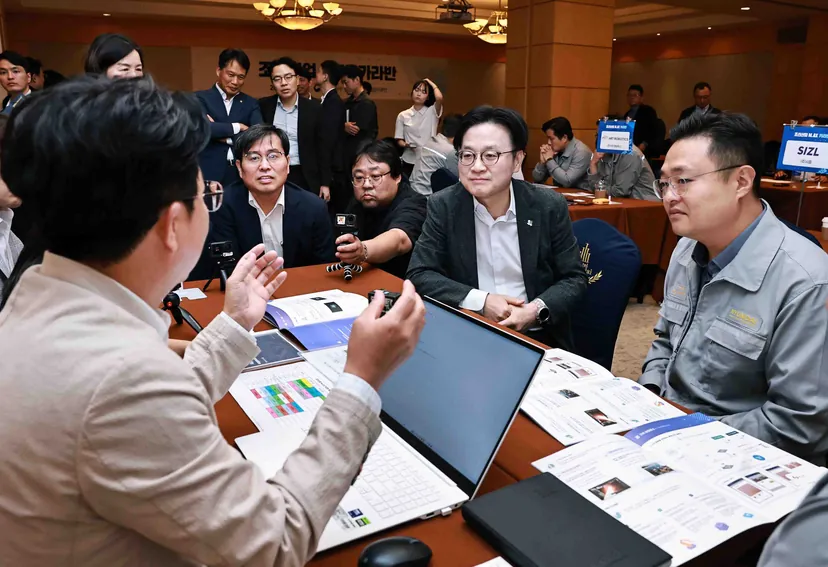
According to the Ministry of Industry, an inspection of 42 out of approximately 170 workplaces that received support for AI factory projects—those that started relatively early and showed visible results—revealed that productivity increased by an average of 30.1% while the defect rate dropped by an average of 15.5%. Looking at individual cases, in the semiconductor sector, Shinhan Diamond reduced the inspection time for wafer polishing process consumables by 33%, and Surplus Global boosted productivity by 66.7% by applying AI to the semiconductor equipment resource recovery process. In the automotive sector, Asan Sungwoo Hitech reduced quality inspection time by 90% through the introduction of an unmanned autonomous manufacturing system for EV batteries, and Hwashin reduced the defect rate by 20% by applying a facility predictive maintenance system to its battery case production process. In the shipbuilding sector, HD Hyundai Samho improved productivity by 50% by introducing AI-based autonomous welding and inspection solutions for rudder trunk welding and production processes, while ENK reduced high-pressure cylinder inspection time by 22% with an AI vision inspection system.
Based on these achievements, the Ministry of Industry has set a goal to convert 220 additional manufacturing processes into AI factories by the end of this year and to build 500 by 2030. In addition, the ministry is promoting the development of core technologies for so-called 'full-stack AI factories,' where AI autonomously operates the entire manufacturing process without human intervention.
Minister of Trade, Industry and Energy Kim Jung-kwan stated, "As the results of increased productivity and lower defect rates have been verified in the field, we will ensure that these proven models spread rapidly to small and medium-sized enterprises and regional industrial complexes. We will actively support Korea in leaping to become the world's strongest M.AX nation by 2030 by accumulating and utilizing manufacturing data and expert know-how, and by realizing full-stack AI factories operated by AI and robots."
The Remaining Challenges: Parts and Models, Who Holds the Reins?
Behind the achievements, there are still gaps that have yet to be addressed. In this announcement, the government disclosed the domestic technology gap compared to the top-tier nation in specific figures: 2.51 years behind in next-generation semiconductors, 1.79 years in intelligent robots, and 1.64 years in autonomous vehicles. The government's decision to launch a new dedicated R&D program for the "three core parts"—actuators, sensors, and robot hands—as part of its robot industry cultivation task, and to separately pursue the development of a domestic Robot Foundation Model (RFM), can be interpreted as measures to narrow these gaps. It is essentially an admission by the government that a significant portion of the core parts and software for the robot industry has not yet been localized. It remains to be seen to what degree the core technologies driving these systems are truly self-reliant behind the facade of impressive on-site performance indicators.
The government's plan for building production bases for the robot industry is also specific. Infrastructure for a robot foundry and parts cluster will be established in Saemangeum, while a robot demonstration test field will be created in the Daegu-Gyeongbuk region. These two locations are expected to be the twin pillars of robot mass production. The government plans to quickly establish a production base for the robot industry through these efforts. The key will ultimately be how quickly these two hubs can establish themselves so that the aforementioned localization of the three core parts and the development of humanoids specialized for the 10 major industries can lead to actual mass production.
Deputy Prime Minister Koo Yun-cheol said at the meeting, "The government will do its utmost for 'economic structural innovation' to rebound potential growth and achieve growth for all. We must create changes that the public can truly feel by innovating the structures of existing key industries like steel, fostering new industries, and narrowing the gaps in assets, income, labor, generations, and regions." Starting with this announcement, the government plans to hold a 'Structural Innovation Ministers' Meeting' every month to sequentially release follow-up measures for each sector, including steel and petrochemicals.