

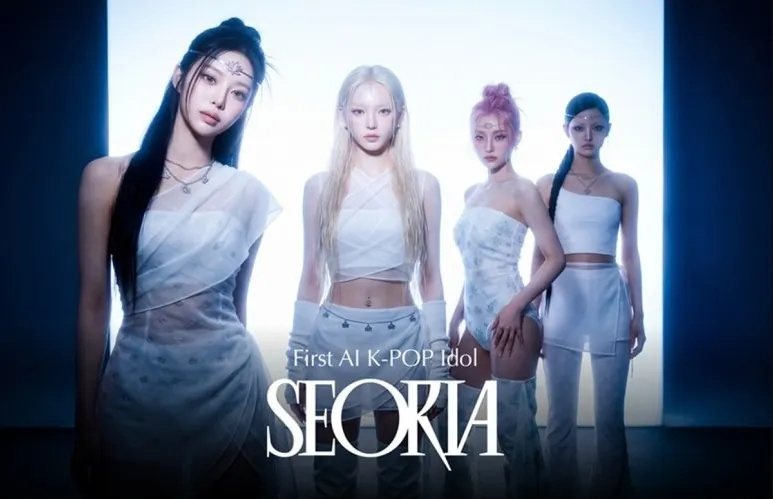
[BizHanKook] At the end of the century, "Adam," the nation’s first cyber singer created with 3D graphic technology, brought an unfamiliar virtual entity into the realm of popular music. 25 years later, the virtual idol "PLAVE" emerged, building a strong fandom by sharing daily life with fans through 2D avatars. Now, an idol group created entirely by artificial intelligence (AI)—from their appearance and voices to their music—has arrived. They are the four-member girl group "Seoria." Can an AI-generated idol capture the hearts of fans?
From Member Appearance to Music and Music Videos, Everything is AI-Generated
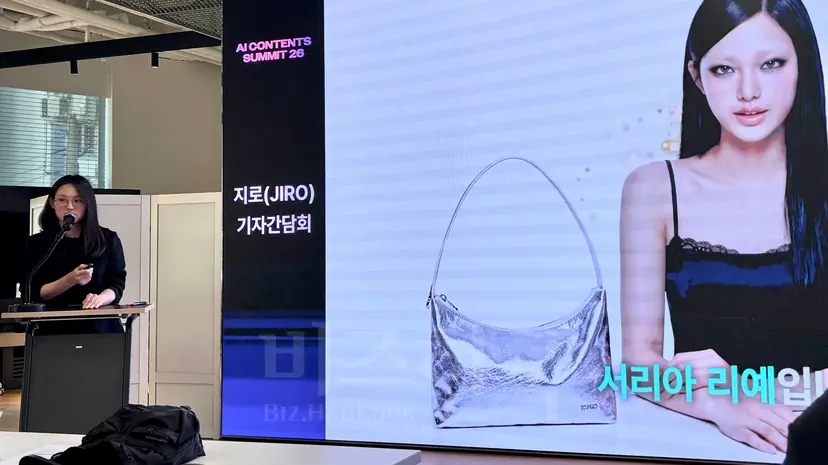
Jiro, the company behind the AI platform "DropShot AI," held a press conference at the Textile Center in Gangnam-gu, Seoul, on the 24th to unveil the production process and business direction of the AI girl group "Seoria." Since releasing their debut song "Burning" last August, they have showcased not only music videos and stage performances but also entertainment content modeled after traditional idol activities, such as "What’s In My Bag" segments featuring the members' personal items and idol athletic championships.
Seoria has established a worldview based on the legend of "Seoljuk-hwa," a secret female armed group from the Goryeo Dynasty. Each member was given a unique appearance and personality, and symbols and album art embodying the group's identity were also created. As of today, the debut music video has recorded 1.08 million views on YouTube.
By utilizing AI, the group bypassed many processes necessary for traditional idol production. Since planning, design, video generation, and editing were all performed in-house, the constraints involving external personnel and location scouting were minimized. However, the company explained that they generated approximately 5,000 images to achieve the desired results and created about 10,000 video clips for the music video.
Technical characteristics were integrated into Seoria from the planning stage. Hwang Gil-hwan, co-CEO of Jiro, explained, "We considered a boy group, but we judged that a girl group was more suitable to showcase the glamour and technical prowess that can be realized through AI," adding, "We spent two months in the planning process, including defining specific concepts."
From Adam to Seoria… The Changing Production Methods of Virtual Idols
Attempts to create virtual artists using technology have been continuous. While the past involved layering virtual appearances over real human voices and movements, we have recently reached a stage where the elements that make up an artist are entirely AI-implemented.
The cyber singer Adam, who debuted in 1998, had a 3D appearance, but the singing was performed by a real person. While it was a groundbreaking attempt at the time, there were limitations in the virtual character’s ability to communicate with fans in real-time, and it cost a significant amount to implement the character's movements.
Later, as graphics and motion capture technology advanced, the scope of virtual artists' activities expanded. With the COVID-19 pandemic accelerating the consumption of non-face-to-face content, virtual idols began to receive attention. This approach involves reflecting a real person's expressions and movements onto a virtual character in real-time. This enabled them to interact with fans not only through pre-recorded videos but also through live broadcasts and concerts. PLAVE demonstrated the scale of its fandom by selling out offline concert tickets within 10 minutes of release and entering the U.S. Billboard Global 200 chart last year.
The advent of generative AI is also bringing changes to the entities producing idols. Companies based on AI technology are entering the entertainment market, which was previously dominated by the ability to discover and train actual artists. Following Seoria, the five-member AI boy group "muuo:23" from Creation Zip-Up also debuted last month.
Beyond Content Production to Securing Proprietary IP… Copyright Protection is a Challenge
To develop AI idols into a sustainable business model, there are challenges to be solved. Discussions are still ongoing regarding the extent to which copyright should be granted for AI-generated results.
Recently, the song "Have You Become the Adult You Dreamed Of?" by the AI music project "Mamureu" has maintained the No. 1 spot on the Melon Top 100 from the 13th until today, bringing the copyright issue to the forefront. Although the track utilized the generative music AI "SUNO," human creators were responsible for the planning, lyrics, and overall production direction. However, it is known that the song is not registered with the Korea Music Copyright Association (KOMCA) and therefore does not settle royalties through the association.
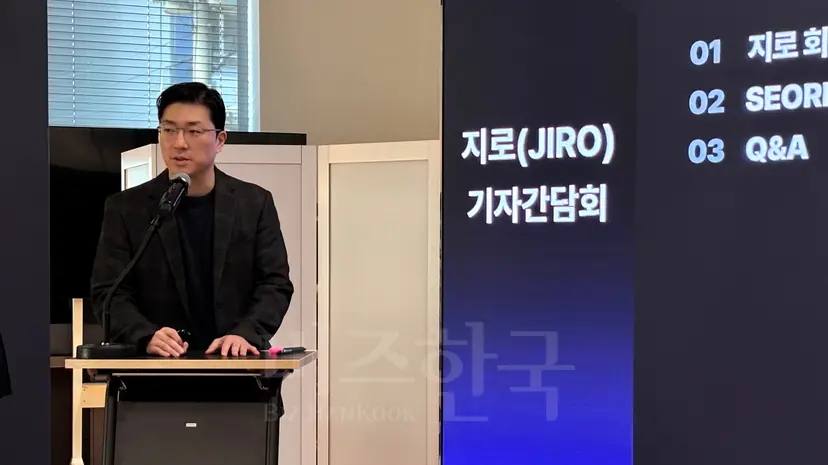
Following the same logic, it is difficult to guarantee copyright recognition for Seoria's music as it was created by AI. Jiro is also exploring ways to protect Seoria's IP. The company plans to secure rights as an independent IP by filing for domestic and international trademarks. Lee Jae-seok, co-CEO of Jiro, stated, "We plan to continuously release music like traditional idols while expanding the scope of IP usage to include advertising models and feature-length animations," adding, "We aim to go beyond supporting content production using AI technology to securing original IP and creating revenue."
"Fundamental Limitations in Emotional Aspects"
Technical limitations also exist in communicating with fans in real-time. While existing virtual idols can instantly reflect a real person's movements and expressions onto a virtual character, for AI idols to operate in this way, they must be able to generate video and audio in real-time. The time delay occurring in this process must be reduced to allow for natural conversations with fans.
CEO Lee Jae-seok stated, "We are conducting technical experiments to reduce the latency currently occurring in the real-time generation process," adding, "It is under development with a goal for disclosure in the first half of next year." He further explained, "We are exploring new methods of activity, such as experiential content that utilizes AI's unique characteristics, rather than simply following the performance methods of existing idols even in offline settings."
Even after overcoming technical limitations, it remains uncertain whether they can break down the public's resistance toward entities created by AI. This is because, in the existing idol industry, not only music and performance but also the members' personalities, growth processes, and emotional bonds built with fans act as crucial competitive advantages.
Regarding this, Seong Mi-kyung, a researcher at the Korea Creative Content Agency (KOCCA), projected, "Due to their nature as digital entities, they have high scalability in a mobile-centric content consumption environment and can reduce risks caused by the private lives or unexpected actions of real celebrities," adding, "They will continue to grow over the next five years and become a new catalyst for the global entertainment and music industry."
However, she pointed out, "The core of an idol fandom is an emotional bond with a real person, but a relationship with an artificial entity is bound to have fundamental limitations in terms of emotional aspects like attachment or bond."