

[BizHanKook] On October 6th, OpenAI released a massive collection of mathematical research manuscripts. These included over 700 documents containing proofs for various problems. The mathematical community’s reaction to this progress is a mix of anticipation and discontent. While they look forward to a new era of solving long-standing problems, they also express a sense of loss, feeling that the significance of human-led proof is fading away.
Of course, these 700 manuscripts did not all solve completely different problems, nor have they all been verified. However, it is a clear shift that AI has begun to perform tasks that researchers previously spent long hours on at a much faster pace. Interestingly, a similar situation is unfolding in the field of astronomy.
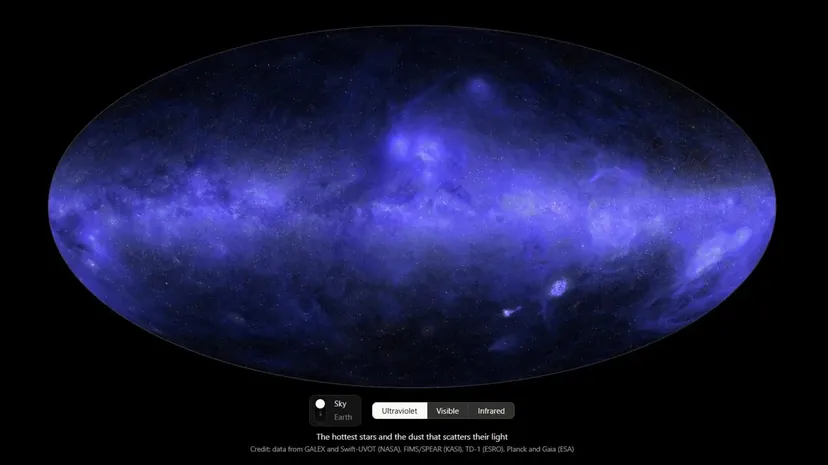
Exactly two days later, Anthropic stepped in. They unveiled a somewhat unique space map. Brice Ménard, an astrophysicist at Johns Hopkins University and a researcher at Anthropic, revealed an ultraviolet all-sky map created with Claude. It is a complete map that even fills in the gaps that previous telescopes could not cover. While parts of the map are based on actual observational data, the rest is a predictive map reconstructed by AI based on those findings.
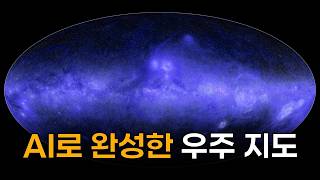
The starting point for this map was GALEX, an ultraviolet space telescope that operated from 2003 to 2013. GALEX surveyed 64% of the sky in far-ultraviolet and 76% in near-ultraviolet. About one-third of the far-ultraviolet map was empty. Stars that emit extremely bright energy are dazzling even in ultraviolet light, making them difficult for telescopes to observe. It is hard to see the background universe beyond them. Furthermore, the galactic disk, where stars are densely packed, and the direction of the Milky Way were not observed, as they were intentionally avoided to prevent damage to the telescope's detectors.
However, when viewed in ultraviolet, the familiar night sky looks completely different. As ultraviolet rays emitted by hot stars are scattered by surrounding dust, dust clouds that were not clearly visible in visible light become much more apparent. By examining the distribution of clouds and the scattering of light, one can feel the incredible interaction between stars and interstellar matter.
Ménard had Claude collect all the ultraviolet observational data released to date and integrate it into a single map. Several AI agents collaborated to perform the calculations. First, they aligned approximately 38,000 observational regions captured by GALEX, as the brightness of the same part of the sky could vary depending on the time and conditions of the observations.
They also corrected for light emitted from Earth’s upper atmosphere and light scattered by interplanetary dust. Data from other ultraviolet telescopes, such as Swift, as well as South Korea’s long-launched STSAT-1 (Science and Technology Satellite-1), played a crucial role. While the FIMS equipment on the satellite had a slightly lower resolution, it scanned the sky toward the galactic disk that GALEX had missed. Even with data from these various exploration tools, there were still gaps remaining. AI statistically modeled and traced these gaps.
Various studies have already identified the correlations between specific light emitted by stars, dust clouds, and ionized hydrogen, and ultraviolet light. Therefore, even in areas not observed in ultraviolet, if data observed in other wavelengths already exists, the ultraviolet appearance can be estimated. To map the entire sky in all directions, they also utilized Gaia data, which has observed almost all stars within our galaxy. In areas without ultraviolet observational data, they estimated ultraviolet brightness based on the star's temperature, color, and the degree to which starlight is weakened as it passes through dust.
To verify the accuracy of the calculation results, they conducted a blind test by covering parts of the sky already observed in ultraviolet. They compared how similar the AI-generated result was to the actual observed ultraviolet map, and the overall error was about 12%. Although the error is still significant, it produced a remarkably good ultraviolet map.
Looking at the finished map, dust clouds around young, hot stars are clearly revealed. One can also see rings forming circles along interstellar gas bubbles created by exploding massive stars, as well as faint, thread-like dust structures far from the galactic disk. It has become possible to collect images that were previously seen separately and connect them in a holistic context to create a complete map.
Unique regions that could not be explained by the distribution of existing interstellar dust clouds also appeared. A structure shining brightly in far-ultraviolet appeared in high-latitude regions, which is a newly confirmed structure based on this study that adds to existing observational results.
Then, how should we accept this map, which the AI completed by filling in gaps without ever seeing the actual sky? This leads to a very difficult and troublesome philosophical question: can a map filled in by calculation without telescope observation be considered a map of the real universe? This map reflects predictions and laws supported by observations. In science, prediction is a very important tool. However, one must carefully examine what assumptions it relies on. Of course, the authors added a caveat that it should not be thought of as a literal map of the real universe.
If AI can draw a map without seeing the actual universe, are new telescopes no longer needed? On the contrary, this map can help in selecting the next observational targets. While drawing the map, the AI assigns prediction scores. It can measure the uncertainty of its predictions, from areas it is confident about to areas where the prediction is not certain. Therefore, one can devise a strategy to prioritize telescope observations in areas where the prediction is uncertain to reinforce the data.
Furthermore, if there is a region that differs significantly from the AI-drawn map when observed in reality, it is possible that new, unknown phenomena or answers to new physics are hidden there. If we take it a step further, we can harbor the expectation that, eventually, AI will not only use the relationships we already know but also suggest new principles that explain the universe.
There is even an incredible idea to actually test this question: the so-called "Einstein Test." If the Turing Test is an experiment to see if AI thinks like a human and speaks naturally, the Einstein Test is an experiment to see if AI can directly generate scientific theories based on data about the universe.
For example, it involves feeding the AI only the data available before the publication of the special theory of relativity and having it solve problems that were unsolved at the time. In fact, a language model with approximately 3.3 billion parameters was trained using only books and newspapers from before 1900. Then, they examined whether the AI could achieve the next step—the amazing leap that is the theory of relativity—on its own.
Unfortunately, it did not produce an answer at the level of rediscovering the theory of relativity. While some answers emerged, such as the notion that light could transmit energy discontinuously or that gravity and acceleration are ultimately similar concepts when viewed locally, it could not construct a coherent physical theory. In the end, it only produced a plausible theory of relativity after humans provided critical hints, such as "the speed of light is always constant."
Recently, an AI analyzed over 100 million images by learning from the Hubble Space Telescope's observational data archive. In just two and a half days, the AI identified candidates for galaxies it considered peculiar, and more than 1,300 actual peculiar galaxies were confirmed among them. Furthermore, 800 of those were galaxies that no astronomer had ever reported before. There were galaxies distorted by collisions and others that had undergone extreme gravitational lensing. In old data observing the real universe, the AI found valuable information that humans had missed.
Of course, if AI technology continues to develop in the future, just like with the Turing Test, AIs that succeed in the Einstein Test may emerge. We can even imagine something more startling. What if an AI, having learned only data up to 1900, suggests a solution in a completely different direction than relativity while searching for the answer to a riddle that plagued physicists at the time? If it suggests a completely different direction that no one in actual history has ever talked about, and it explains the universe better than the theory of relativity—would that truly be the truth, closer to the reality of the universe?
We must now learn to handle AI more wisely. We need to cultivate the discernment to judge whether the new theories and space maps presented by AI are real or not. If we blindly trust and rely on AI, and simply follow its answers, we might find ourselves looking at the universe in a state of great delusion, not even realizing it if the AI accidentally hallucinates. The most important thing in the AI era is to not forget the fact that the correct answer exists above our heads, in the actual universe.
Who is the author Ji Woong-bae? He loves cats and the universe. After watching 'Galaxy Express 999' as a child, he dreamed of spreading the beauty of the universe. He is currently an assistant professor in the Division of Liberal Arts at Sejong University, where he engages in various scientific communication activities, including lectures and writing. He has written books such as 'On the Uselessness of Astronomers', 'We Are All Born Astronomers', and 'Strange Questions That Come to Mind When Looking at the Universe', and translated 'How I Killed Pluto', 'Quantum Life', and 'UFO', among others.