

[비즈한국] The recent exposure of "front-running" cases involving law firm employees and media reporters was largely due to the role of AI and algorithms. Among countless transaction records, these systems identified traces of specific accounts buying and selling before and after public announcements. Financial authorities, led by the Korea Financial Intelligence Unit (KoFIU), use these traces of large-scale buy and sell orders as intelligence to verify specific circumstances. They have built a structure where investigations can be launched based solely on suspicious trading patterns, even without tip-offs.
In line with evolving stock manipulation techniques, financial authorities have also begun utilizing AI to respond quickly. Financial regulators, including the Financial Services Commission (FSC), the Financial Supervisory Service (FSS), the Korea Exchange (KRX), and the KoFIU, are extensively upgrading their "AI investigation and surveillance models" to detect unfair trading in the capital markets.
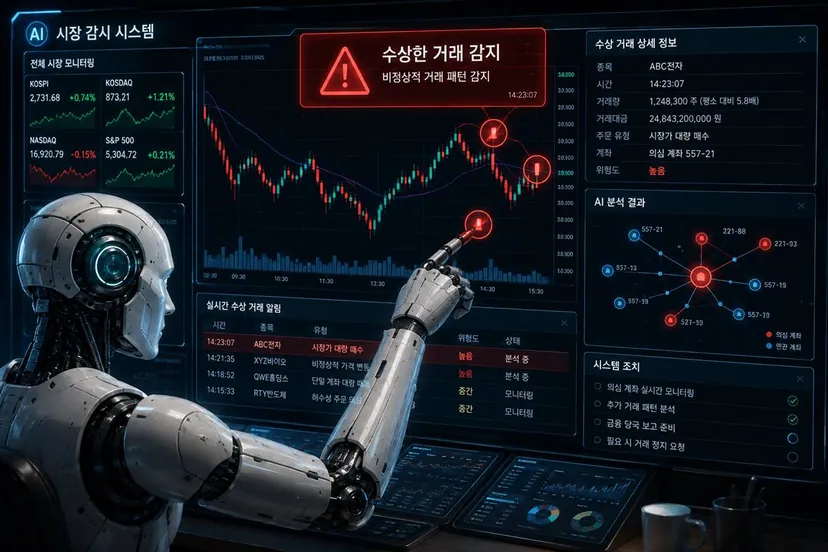
Financial Supervisory Service to Introduce AI Investigators
The FSS plans to fully operate an AI model that investigates unfair capital market practices, such as stock manipulation, starting in 2028. The system allows AI to identify abnormal trades and linked accounts, and even secure evidence through necessary follow-up investigations. There are also plans to build an "AI agent" to assist with administrative tasks like report drafting. To achieve this, the FSS has selected LG CNS as the preferred bidder for the "AI-based Unfair Trading Response System Project."
This marks a shift away from traditional investigation methods based on intelligence, aiming to increase instances of AI-assisted probes. The strategy is to enhance "professionalism" by training the AI not only on public information such as stock prices, trading volumes, and disclosures, but also on non-public materials secured by regulators during investigations, as well as past case data including investigative plans, reports, and handling opinions.
The system will be equipped to detect signs of unfair trading, such as non-capital mergers and acquisitions (M&A) and stock manipulation, at an early stage. LG CNS plans to build a dedicated model tailored to FSS operations based on existing general-purpose AI models.
Financial Authorities: "Already in wide use, efficiency is a key advantage"
In fact, general-purpose AI is already a commonly used investigative tool for financial authorities. Securities firms and banks report to the KoFIU if: 1) there are traces of large amounts of capital entering accounts that previously had little activity just before news or disclosures that could trigger drastic stock price fluctuations, or 2) a recurring pattern is observed where a large volume of stock is bought and then disposed of as soon as an announcement or news is released.
Financial authorities then use AI to identify suspicious account clusters and analyze the trading circumstances. Investigations are initiated based solely on transaction traces, without knowing "who" the account holder is. While past investigations relied on intelligence to determine how an account holder accessed sensitive information, the current method works backward from the accounts themselves. A new system is being established where AI quickly identifies the skeleton of complex account tracking—a task that previously required investigators and examiners to stay up all night for months—to serve as the starting point for investigations.
A legal expert with experience dispatching to financial authorities hinted, "I cannot go into detail, but by utilizing AI and algorithms, we are continuously uncovering suspicious traces even in transaction records from years ago," adding, "Once certain criteria are input to flag suspicious situations, abnormal signs from market manipulators can be quickly sifted out from tens of thousands of transaction records."
Even if stock manipulation syndicates operate in cellular structures, splitting accounts and dispersing price-manipulation orders, all execution details and large-scale fund movements remain in the databases of the exchange and the KoFIU, making it possible to verify records from as far back as 10 years.
A former prosecutor turned lawyer explained, "There have been many cases where criminals who went uncaught in the 80s or 90s due to lack of technology were eventually apprehended in the 2000s as technology evolved. Stock manipulation is the same. Cases that were simply passed over in the past will now become subject to investigation as AI catches suspicious trades."
A legal expert formerly with the KoFIU added, "In the past, there was no logic to catch front-running or the use of undisclosed information from two or three years prior, but now, as the KoFIU's ability to analyze abnormal trades evolves through AI technology, the number of detections is increasing. Once the next-generation AI program, which has absorbed the private investigative know-how of financial authorities, is introduced, the speed of investigations will also become much faster."