

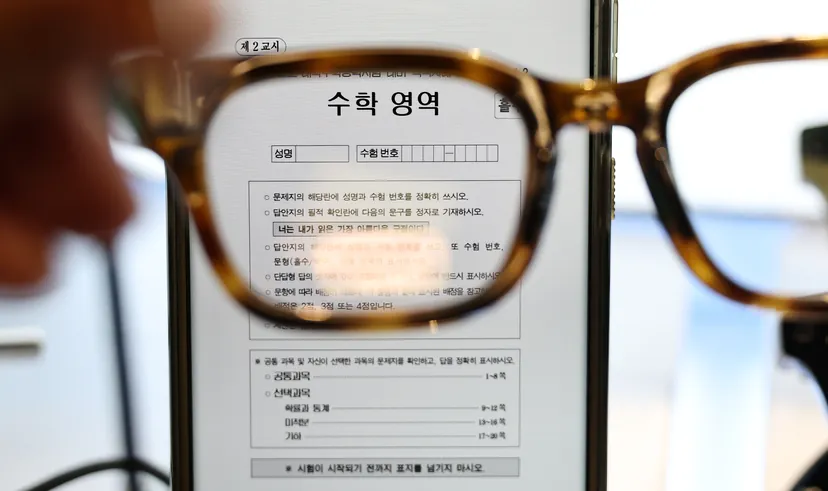
[BizHanKook] As concerns over cheating on exams using artificial intelligence (AI) smart glasses grow, the technologies used to detect them are becoming increasingly diverse. The response methods are becoming more granular, ranging from radio detectors that pick up wireless signals emitted by glasses to AI apps that analyze their physical appearance, and AI proctoring solutions that monitor the behavior of examinees. These efforts go beyond simply finding the device itself, aiming to capture clues that could be used for cheating through various channels.
Radio, appearance, behavior: Expanding the scope of detection clues
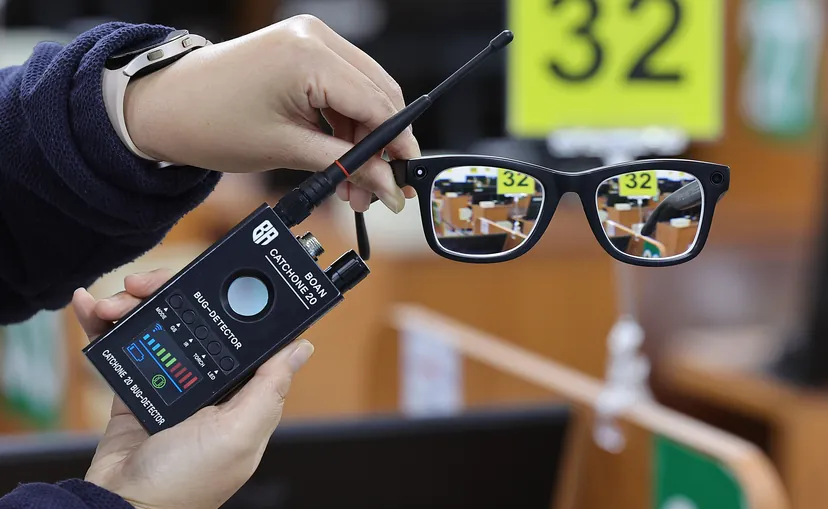
The Korea Road Traffic Authority introduced radio detectors at all driver's license testing centers nationwide starting on the 9th. The Korea Communications Agency (KCA) also issued an order for a project titled "Development of AI Smart Glass Radio Detection Equipment" on the 2nd. The portable equipment currently under development aims to identify the presence of smart glasses by analyzing low-energy Bluetooth (BLE) signals and to detect suspicious circumstances related to AI service usage by examining Wi-Fi traffic and data transmission patterns.
Beyond reading radio waves, technology that directly examines the physical appearance of the glasses has also emerged. "ExamGuard," an open-source web application recently released on GitHub by a domestic developer, scans for nearby devices via Bluetooth and compares the appearance of glasses captured by a camera against images of various products. On the 17th, Representative Lee Jun-seok of the Reform Party also unveiled a prototype of "KoriyoSCAN," an app that records Bluetooth and Wi-Fi signals in an empty testing room and then notifies users of any new signals captured after examinees enter.
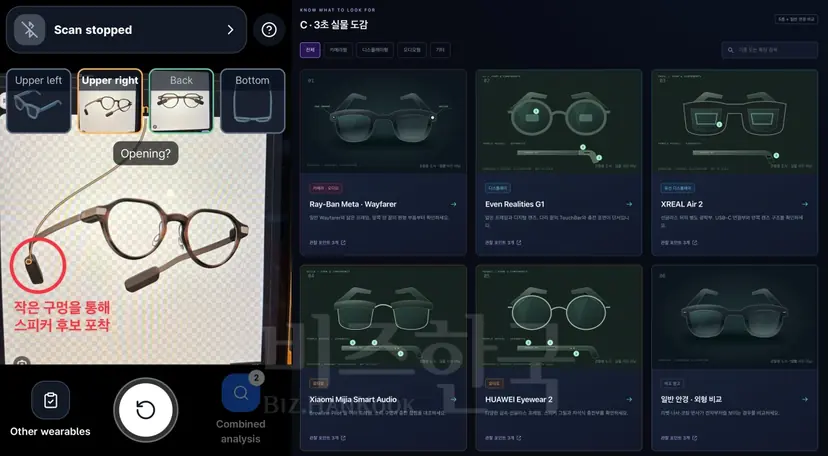
Among these, an approach that uses AI to analyze traces of electronic components remaining on the frames is also drawing attention. "NoCheat," conceived at the Ministry of Science and ICT’s "Everyone's AI Lab" and released as an app last month, photographs glasses from four directions to locate potential electronic components like camera lenses, microphone and speaker holes, charging contacts, and buttons. It started from the premise that while a camera's indicator light can be covered with a single sticker, it is difficult to hide all the components that do not exist on regular glasses. It also reads brand names and logos engraved on the inside of the temples or hinges. It is a method of finding visual clues based on small components.
Lim Jun-hyun, the developer of the NoCheat app, explained the background of its development to Bizhankook: "AI glasses cannot perform their functions on their own; they often require a wireless connection to a smartphone during the process of moving photos, sending questions to AI, and receiving answers. I thought that along with methods of reading radio signals, a way to verify clues left on the actual glasses was also necessary."
If you take and upload photos of the glasses from four directions in the app, it bundles the analysis results into a report, suggesting which parts to check and providing the reasoning. Gemini 3.8 Flash is used for photo analysis. Along with this, a Bluetooth detection function is also provided. For example, in the case of the "Even Realities G1," which is a pair of smart glasses without a camera, it was possible to analyze the product based on brand markings and small holes shown in the web image. This demonstrates that external components or structures can serve as clues for identification, even in glasses without cameras.
However, the AI does not make the final judgment on whether a device is smart glasses. It focuses on marking suspicious areas in the photo to help a proctor re-examine the physical object. There is a possibility that screws or ornaments on regular glasses could be mistaken for components due to light reflection or low image quality. According to NoCheat, 43 of the 347 items in its glasses catalog are currently linked to detection candidates.
For devices that cut off communications or hide their appearance, using heat as a clue is also being discussed. Lim said, "Glasses that operate without communication must perform calculations internally, so they will generate high levels of heat. If thermal imaging inspection is conducted in parallel, the heat from electronic components can serve as a clue even if there is no communication signal."
Recently, some companies have introduced a method of recording the appearance of glasses during online exams for post-test comparison. Grepp, a domestic AI-based assessment solution company, added a precision glasses verification feature to its online exam proctoring service "Monito" in August. This method involves photographing the examinee's glasses from various angles before the exam, and if a suspicious situation occurs during the test, the proctor compares them with the original photos. According to Grepp, 21 companies and institutions have adopted this feature within two months of its introduction. In the future, they plan to add a feature using Vision Language Models (VLM) to analyze behaviors such as switching glasses or repeatedly touching them during the exam.
Overseas remote exam proctoring solutions like "Honorlock" and "Respondus Monitor" support proctor reviews by using webcam footage to detect abnormal behaviors, such as the examinee leaving their seat or the appearance of other people.
No "all-purpose detector"... Government strengthens inspections 2 days before the CSAT
As the appearances and communication methods of smart glasses become more diverse, the need for a multi-layered response system that examines wireless signals, visual information, and examinee behavior together—rather than relying on a single specific detection technology—is growing. The assessment is that there is no definitive alternative yet.
Radio detection technology is vulnerable to devices that operate without external communication, such as on-device AI, and appearance analysis may miss unknown products or devices with covered components. In exams like the College Scholastic Ability Test (CSAT), where proctors' mobile phone usage is restricted, establishing detection measures is even more difficult. An industry official pointed out, "Behavioral analysis can misinterpret normal behavior as cheating or miss blind spots of the camera. The issue of resistance to such monitoring cannot be ignored either." Even if suspicious signals or behaviors are captured, whether actual cheating occurred must still be confirmed separately by a proctor.
Recently, ultra-small cameras hidden in buttons or watches have been mentioned as cheating tools. Since these also require wireless communication to receive answers via AI and leave behind physical clues like lens holes, there is room to expand the application of smart glasses detection technology.
The government plans to deploy approximately 8,400 additional proctors for the CSAT on the 19th to conduct full inspections for smart glasses in every period and take measures such as covering clothing buttons with stickers to prepare against ultra-small cameras. If suspicious circumstances are discovered, they plan to use metal detectors to verify whether the examinee is in possession of electronic devices.
They are also preparing for potential abnormal communication signals within the testing site and external communication via Wi-Fi. They intend to pursue post-test tracking for any cheating that was not caught on-site. Once a suspicious individual is identified, the plan is to cooperate with four global big tech companies to verify whether AI services were used and to obtain communications-related data, such as records of AI service access, access times, and locations associated with the suspicious phone number from telecommunication companies, to investigate whether cheating occurred.
Prime Minister Han Seung-soo stated, "Through cooperation with global big tech companies, we have decided to actively cooperate in follow-up investigations and requests for probes in cases where illegal activity is suspected, such as suspected instances where exam papers were captured as images to obtain answers via AI."