

[비즈한국] How quickly a nation can secure vaccines and treatments in response to new infectious diseases has emerged as a core challenge for national infectious disease research and development (R&D). The government has unveiled, for the first time, its 4th National Infectious Disease Crisis Response Technology Development Strategy, which focuses on leveraging artificial intelligence (AI) to rapidly translate research results into practical applications. The plan aims to shorten development timelines during crises by accumulating vaccine candidates and research data during non-crisis periods and linking AI design with experimental verification.
The 4th strategy, introduced at the 13th Infectious Disease Research Forum held at the JW Marriott Dongdaemun Square Seoul on the 10th, is a mid-to-long-term plan (2027–2031) that sets the direction for future national infectious disease R&D. The forum served as a venue to gather expert opinions on the strategy, review the current status of high-priority vaccine development, and share plans for building "K-AI PPX," a Korean AI-based vaccine development engine.
When asked by BizHankook about the biggest difference between this and previous strategies, Jung Young-ki, Acting Director of the National Institute of Infectious Diseases, replied, “It is the construction of an infectious disease R&D system that utilizes AI for rapid commercialization.”
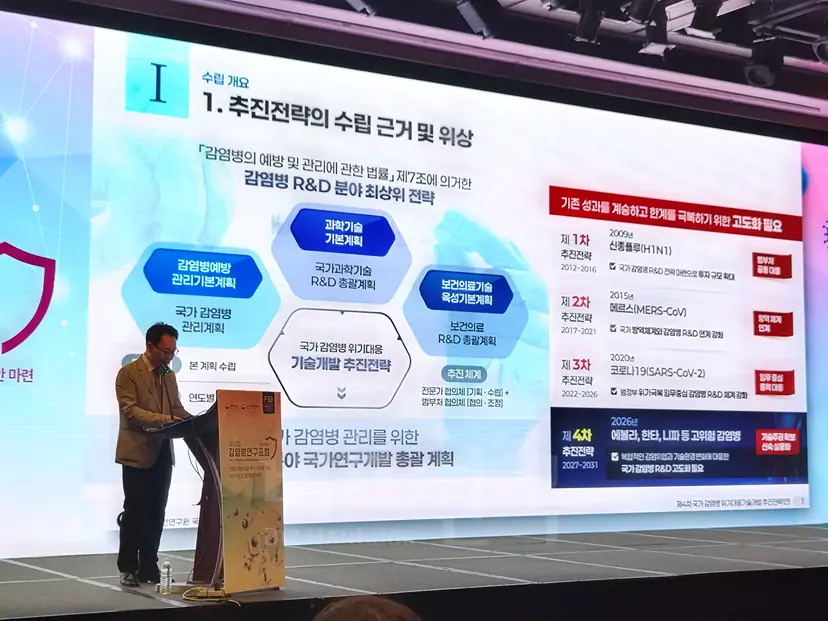
Connecting Vaccine Development: AI-Driven Antigen Design and Experimental Verification
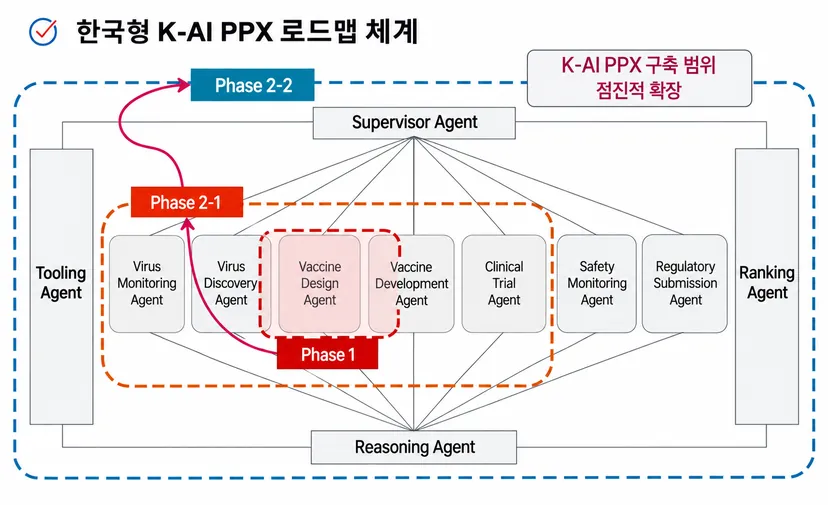
As a concrete measure for this direction, the development of "K-AI PPX," a Korean AI-based vaccine development engine, is underway. PPX stands for “Pandemic Preparedness Engine for Disease X,” representing a development system designed to prepare for as-yet-unknown infectious diseases. The long-term vision is to build an AI-based integrated platform that connects decentralized data and research stages across institutions and nations, supporting everything from disease monitoring and pathogen discovery to preclinical/clinical development and regulatory approval.
The starting point is to connect AI-driven antigen design with experimental verification. In a pilot project to be implemented from 2027 to 2029, the system will identify viruses and targets, design antigens using AI, and then evaluate their potential through computer simulations and in vitro experiments. Verification results are then fed back into AI learning and antigen redesign. This iterative process aims to enhance the accuracy and efficiency of developing candidate materials.
Lee Yu-kyung, head of the Vaccine Research and Development Division at the Korea National Institute of Health, explained that they are working in collaboration with CEPI (Coalition for Epidemic Preparedness Innovations) to conduct a three-year AI pilot project covering virus analysis and discovery, antigen design, initial verification, and redesign. The goal is to integrate these sophisticated AI agents into the Korean vaccine development engine and CEPI's global pandemic response platform.
Lee stated, “Once AI agents are integrated into domestic and international platforms, we will be able to utilize the abundant resources and data of the global pandemic response platform, which will dramatically strengthen our rapid response capabilities.”
The scope of implementation will be expanded in stages. Initially, it will focus on antigen discovery, design, and verification systems, later expanding to include functions like virus monitoring, clinical trial prediction, vaccine formulation development, and regulatory linkage. The core objective is to move beyond applying AI to isolated studies and instead ensure that the entire vaccine development process is organically connected.
The Public Vaccine Development Support Center will oversee the construction, in cooperation with an internal task force and external research consortia. Lee explained that Seoul National University, the International Vaccine Institute (IVI), the Korea Institute of Science and Technology Information (KISTI), and Bio-X are participating in close collaboration. The plan is to utilize vaccine libraries, research data, and high-performance computing resources to support AI design and laboratory verification.
Procedures for international cooperation are also underway. The Korea National Institute of Health held a workshop with CEPI last July to discuss strategies for building the Korean PPX and potential collaboration. A proposal for cooperation with CEPI's PPX is scheduled to be submitted this December, with related research planned as a new 2027 project under the National Strategic Vaccine Development Support Program.
From Existing AI Research to Rapid Commercialization: The Key is Institutional Cooperation
The focus on AI and rapid development is not entirely new to the 4th strategy. The 2025 implementation plan of the 3rd strategy also included multi-ministerial cooperation for the development of treatments incorporating digital technologies like AI, as well as the rapid development of vaccines and treatments. The future challenge lies in connecting the technologies and data accumulated in individual studies to accelerate actual development.
Existing achievements and limitations intersect at this point. While the mid-term review of the 3rd strategy cited the approval of domestic COVID-19 vaccines and the establishment of research infrastructure as successes, it noted that results leading to practical commercialization tended to be concentrated on COVID-19 vaccines, treatments, and protective supplies. Strengthening the system to connect inter-ministerial research results to follow-up development and supporting commercialization by the private sector were identified as areas for improvement.
Kim Nam-joong, a professor at the Department of Internal Medicine at Seoul National University College of Medicine, who served as the chair of the panel discussion, noted, "Until now, vaccine development in our country has lacked organic connection across research fields and remained somewhat fragmented." He assessed, "This 4th National Infectious Disease Crisis Response Technology Development Strategy has overcome these limitations and effectively consolidated efforts within an organic structure."
Kim further emphasized, "However, merely establishing the plan is not the end. The key moving forward will be ensuring that this organic linkage is realistically and effectively implemented in the field."