

[비즈한국] AI is transforming warfare. This isn't just about unmanned drones or suicide boats. From command and control to logistics and operations, the emergence of Large Language Models (LLMs) is bringing innovations to every aspect of future warfare that are incomparable to the conflicts of the past.
Aircraft operation—which requires the deepest analytical thinking under the most extreme conditions humans must endure—is no exception, especially when it comes to fighter jets engaging in aerial combat. In the classic movie ‘Top Gun: Maverick,’ the protagonist Maverick (Tom Cruise) responded to Admiral Cain’s claim that human pilots would soon become obsolete by saying, “Maybe so, sir, but not today.” However, the reality is that future aerial combat demands a new type of fighter pilot where AI and humans are fused.
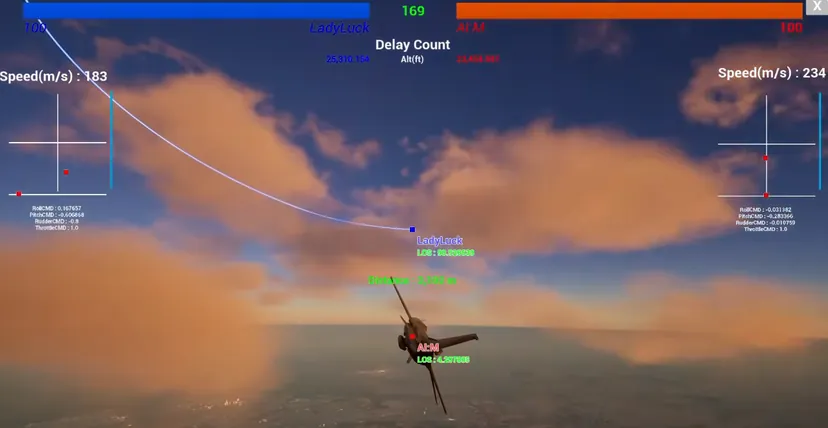
Against this backdrop, the 1st Korea Aerospace University President’s Cup ‘2026 AI Pilot Top Gun Challenge,’ which drew 873 participants across 290 teams from over 80 universities nationwide, provides an opportunity to rethink the ‘appearance of future air combat,’ going beyond a simple university competition. The competition held its preliminary rounds on August 27–28 to finalize the 16 teams for the main event, with the finals scheduled for September 17 at the Korea Aerospace University auditorium.
Looking at the preliminary round videos posted on YouTube, one might easily mistake it for a simple flight simulation. However, the sophisticated technical judgment required and the hints it provides for future AI-based aerial warfare are of a level hard to believe for a student-led competition.
If you break down the tasks that participating teams must actually solve using the official manual, it becomes clear that this is not just an “F-16 simulator game.” Flight Dynamics (FDM) is handled by the JSBSim kernel, and the learning framework is Ray RLlib-based PPO/SAC. Five observation modes are provided, ranging from 12 to 37 dimensions, and the action space is fixed to four axes: roll, pitch, rudder, and throttle. The curriculum learning stages consist of 15 levels, progressing in difficulty from survival, pursuit, and entering the Weapons Engagement Zone (WEZ), to head-on angle sweeps, and finally, full-scale dogfights.
While the technical terminology may be difficult to grasp, the core is simple. The AI receives a vast amount of information. It starts with the enemy’s position and its own position clearly visible. In this situation, the AI is not tasked with handling the complex maneuvering of the fighter jet, but rather determining the direction and attitude of the plane to solve the problem of ‘how to fire the cannon at the enemy.’ In other words, it forces the AI to decide on maneuvers equivalent to how a dog would snap at an opponent's neck in a ‘dogfight.’
The match is a 200-second 1:1 gun-based dogfight. Entering the range of the machine gun results in an automatic hit determination. An interesting aspect is the capability of the machine gun over time, which must have been designed by a master of aerial combat. For the first 100 seconds, a hit is registered only if the attack angle—the line between the player and the enemy aircraft—is within 2 degrees. In the final 50 seconds, this angle (firing range) expands to 6 degrees, and the machine gun range also increases from 3,000 to 4,000 feet. In the beginning, shooting is impossible without precise tracking, testing the AI agent's control capabilities; in the end, the expectation for avoidance and war of attrition is lowered, forcing decisive action. It is a design that embeds curriculum learning within the rules.
The problems not set by the organizers are even more important. Since the status information of both friendly and enemy forces is provided in full, there is no radar detection or tracking problem. There is only one machine gun, and the decision to fire itself is not within the action space. There is always only one opponent, and there is no loss of communication or electronic warfare. What this competition trains is not the entire brain of an unmanned fighter, but the geometry of close-quarters combat.
This type of competition has existed before. DARPA’s 2020 ‘AlphaDogfight Trials’ can be considered the origin of such AI pilot competitions. Similar to the Aerospace University’s Top Gun Challenge, AI agents fought in a tournament-style simulation, and the winning team, Heron Systems, saw its F-16 agent defeat an experienced Air Force pilot, ‘Banger,’ with a 5-0 score.
The decisive difference between this Aerospace University Top Gun Challenge and AlphaDogfight is openness. AlphaDogfight was an invitation-only event for 8 companies and research institutes, and the final technical reports were marked as For Official Use Only (FOUO). The Korea Aerospace University competition is an open event for 84 teams, with every match broadcast live on YouTube, and it encourages the release of algorithms from winning teams. The Top Gun Challenge is effectively the world’s first ‘open AI pilot aerial combat competition.’
Of course, AlphaDogfight differed in that it demonstrated the capabilities of the AI pilot by creating the X-62A, which used the AI agents from the competition results to actually fly a real aircraft. The X-62A went beyond simple autonomous AI flight to conduct actual dogfights against human-piloted F-16s, and over the course of 21 test flights, it updated more than 100,000 lines of flight control software. Unlike the U.S., the reality is that for us, controlling a fighter jet with an AI agent we created is still a distant goal.
Professor Lim Sang-min (Defense Acquisition Program Administration), an adjunct professor at Korea Aerospace University who first planned the AI aerial combat competition starting from an intramural level, told our publication, “The 200-second dogfight unfolding in the simulations for this Top Gun Challenge is not just a simulation; it is the first step and technical starting point for the ‘Physical AI Pilot’ that will soon emerge,” adding, “I hope that through this competition, students will grow into core leaders who will guide the future of South Korea’s aerospace and defense AI sectors.”
As Professor Lim said, this Aerospace University AI Pilot Top Gun Challenge carries significance beyond a mere university competition. Above all, in that it has acquired data applicable to weapons that will be deployed in war using AI agents for the first time in Korea, and that it has fostered personnel who have trained and challenged themselves with this data, it is no exaggeration to say that this competition is the starting point for cultivating the core talent that will build future 6th-generation fighter jets.
However, it is also true that there is a long way to go. This competition allowed reinforcement learning, imitation learning, supervised learning, behavior trees, heuristics, and hybrids, because it is difficult to determine the predictability of behavior with AI based on Large Language Models (LLMs), which are familiar to us, and there is immense difficulty in injecting learning and consistency. However, AI using the ‘Behavior Tree’ method, which determines behavior according to conditions, can expose weaknesses where behavior becomes very easy to predict the moment the algorithm is exposed to the enemy. Ensuring that reliability and creativity coexist—hiding the algorithm from the enemy while ensuring the AI performs actions that are unpredictable to the enemy—will be the key to victory in future 6th-generation fighter aerial combat.
I hope this competition will serve as a starting point for confirming the basics of AI pilots and for the blooming of ‘agent-centric aerial combat’ in Korea.