

[비즈한국] On July 30, at the ‘9th Defense Science and Technology Exhibition’ held by the Defense Acquisition Program Administration at the Yangjae AT Center, the Agency for Defense Development (ADD) unveiled the MR-X (Mission Reconfigurable-eXtra large) Unmanned Underwater Vehicle (UUV). Compared to previous versions that were limited to reconnaissance missions, the MR-X has been significantly scaled up. It is expected to become a ‘game changer’ in future naval warfare as it can autonomously track enemy submarines or lay mines in enemy ports.
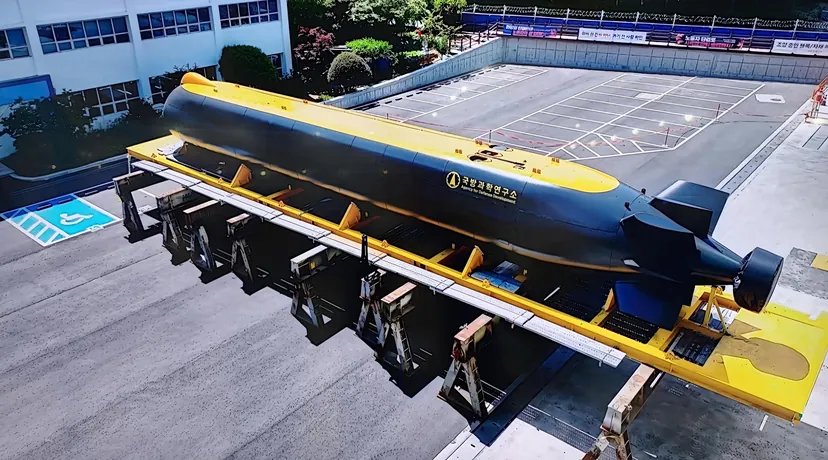
The MR-X, originally referred to as the Mission Reconfigurable Extra-large Unmanned Underwater Vehicle (MRXUUV), is a technical demonstrator model for a project that began in October 2022. Led by the ADD, Hanwha Ocean, Hanwha Systems, and LIG Nex1 participated in its production. It serves as a follow-up to the Anti-Submarine Warfare Unmanned Underwater Vehicle (ASWUUV), which successfully completed its first autonomous navigation in 2022.
The most notable feature of the MR-X is its size. It possesses a hull much larger than the small, torpedo-sized UUVs previously produced by research institutes and corporations. With a length of approximately 20 meters, a diameter of about 3 meters, and a displacement of around 50 tons, it is comparable to the U.S. Orca XLUUV, which has a maximum length of 26 meters. Utilizing this large hull, the MR-X offers significantly enhanced mission scalability and capabilities compared to smaller UUVs, which are typically limited to tasks like mine clearance.
The primary capability of the MR-X is reconnaissance. It is equipped with a small, long-range detection periscope capable of day/night surveillance, allowing it to infiltrate enemy lines and detect hostile vessels. Its AI-based surveillance and reconnaissance capability enables it to automatically identify targets and scan its surroundings extremely rapidly, thereby reducing the periscope's exposure time.
Another feature of the MR-X is its underwater reconnaissance capability using a large sonar array. The bow of the MR-X is equipped with an active sonar, while both sides are fitted with passive sonars. Using these, the MR-X can infiltrate dangerous enemy waters to autonomously detect critical underwater targets, such as North Korea's ballistic missile submarines (SSBNs). Once an enemy submarine is detected, the MR-X can surface and use satellite communication, UHF, or LTE to transmit the enemy submarine's location to information ships or ground headquarters. Since it can penetrate territorial waters that the enemy considers safe, it becomes extremely difficult for enemy submarines to remain hidden.
The core feature of the MR-X is its ability to carry armament in a ‘multi-purpose module.’ The front section of the hull, which is used to house additional batteries or equipment depending on the situation, can be loaded with mines, allowing the vehicle to infiltrate enemy ports, covertly lay mines, and then retreat. During the recent Iran-related conflicts, the Iranian Navy used boats or manned submersibles to lay mines despite the threat of U.S. airstrikes; the MR-X, however, can blockade enemy ports without any risk to human life, providing a tremendous advantage for our naval operations.
For these operations, the MR-X features multiple propulsion systems. Auxiliary thrusters allow for ultra-precise, low-speed control, ensuring mines can be laid accurately at designated locations. Power for the five-blade propeller is provided by hydrogen fuel cells and lithium-ion batteries—technology also applied to the Jangbogo-III submarine. This enables the MR-X to conduct continuous operations for approximately 45 days, facilitating long-term infiltration missions. Research and development for the MR-X is scheduled to continue until September 2027, and at the Defense Science and Technology Exhibition, the ADD released a video showing the submarine conducting underwater navigation tests.