

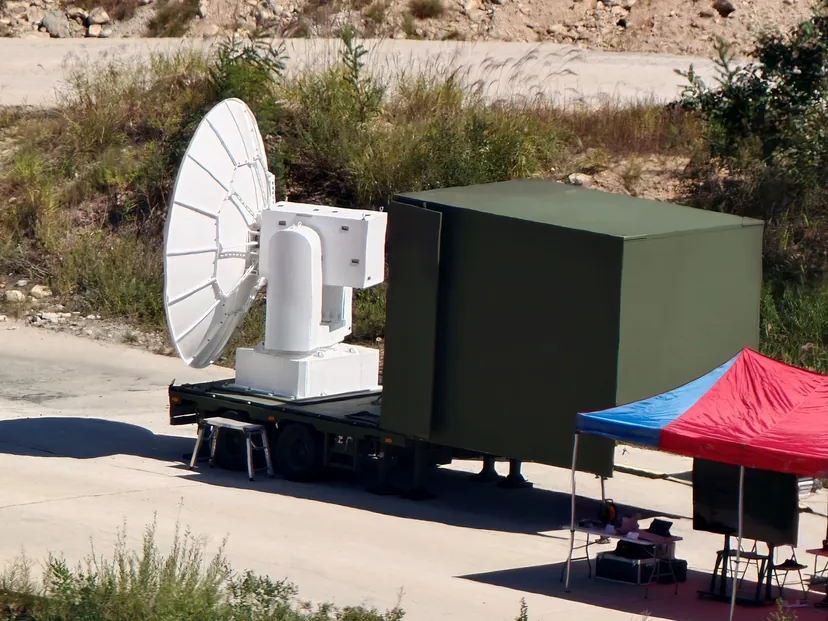
[비즈한국] At the ‘2026 Defense Drone Technology Exhibition’ held by the Ministry of National Defense at the Pocheon Rodriguez Live Fire Complex on September 16, the Agency for Defense Development (ADD) unveiled for the first time a ground-based High Power Microwave (HPM) weapon system currently under development. HPM weapons are electromagnetic armaments that damage a drone's circuits with powerful electromagnetic waves. Unlike guns, missiles, or lasers, they can neutralize multiple drones simultaneously, raising expectations that the South Korean military’s ability to counter North Korea's ‘swarm drone’ attacks will be significantly enhanced once deployed in the field.
In modern warfare, it is common for weapon systems to take over a decade to develop and remain in service for more than 30 years, but drones are an exception. Since the war in Ukraine, drones are not just evolving year by year, but are undergoing rapid advancements that surpass previous generations every few months.
However, as military drones become increasingly intelligent and lethal, the importance of anti-drone capabilities is growing, yet we are still struggling to build an effective anti-drone system. During the Air Force's anti-swarm drone live-fire exercise on June 23, when eight 20mm Vulcan anti-aircraft guns were fired, the public criticized the military, saying, ‘Thousands of rounds fired at 50 stationary drones couldn't neutralize them.’ In reality, small swarm drones are extremely difficult to counter. A variety of weapon systems are being introduced, such as the Hanwha Systems’ ‘Cheongwang’ laser air defense weapon, mobile laser cannons, and LIG Nex1’s multi-layered anti-drone integrated system.
The HPM, unveiled by the ADD for the first time, is the most eye-catching anti-drone weapon among them. While some media outlets reported that an HPM weapon was first displayed at the 50th anniversary ceremony of the Agency for Defense Development in 2020, the equipment shown at that time was actually a single-shot EMP pulse emitter, not an HPM weapon capable of continuously emitting strong electromagnetic waves.
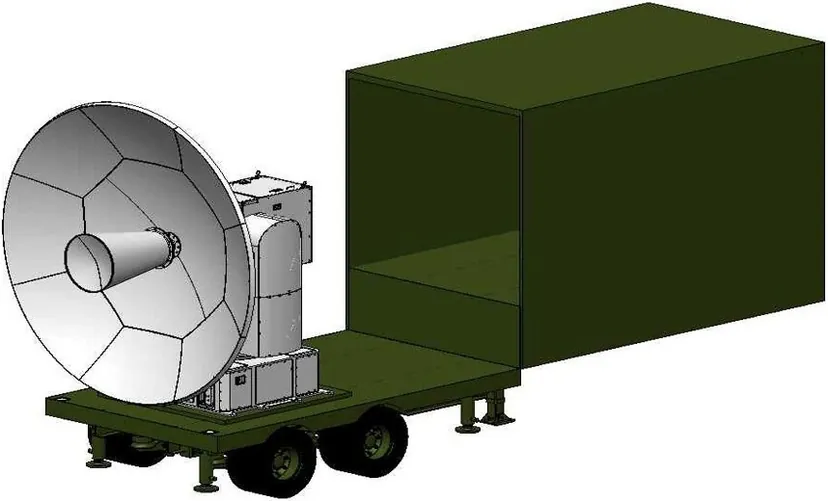
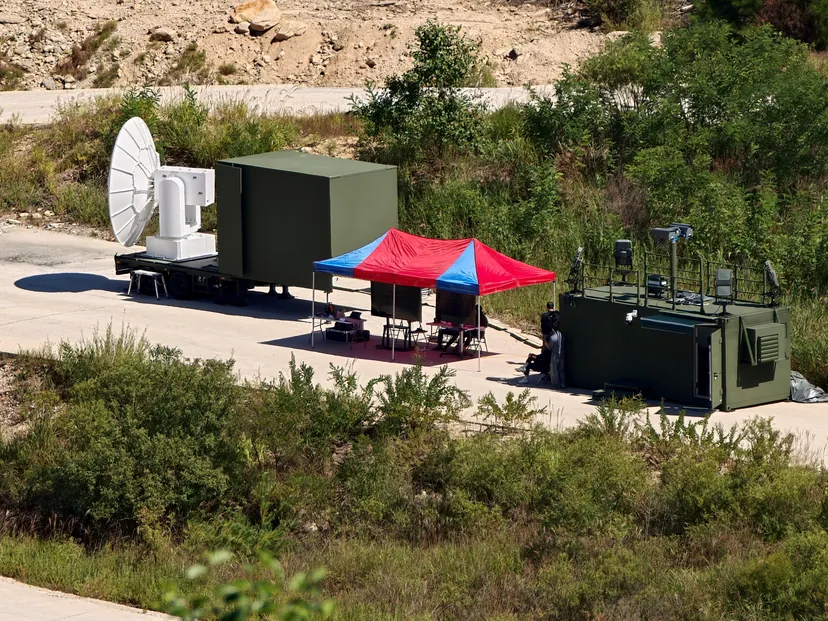
In contrast, the HPM weapon unveiled this time is a ‘true HPM’ that responds to enemy drones using electromagnetic output rather than a single-shot EMP. It is characterized by its ground-based configuration, featuring a large dish antenna—suitable for weaponized use—and power/control equipment mounted on a towed trailer. After the ‘swarm attack’ tactic, which involves sending dozens to hundreds of cheap drones simultaneously, became a reality in the wars in Ukraine and the Middle East, this weapon has emerged in physical form as one of the most promising countermeasures alongside lasers.
According to field data, the HPM weapon developed by the ADD has an output of 500,000 kW and an effective range of 500m. The HPM fires a wide beam of powerful microwaves, inducing overcurrent in the electronic circuits of drones within range and frying them entirely. In simple terms, it applies the same principle used by a microwave oven to cook food to the ‘brains’ of a drone.
In other words, while existing anti-drone weapons that use radio waves employ jamming to disrupt communications or navigation—a ‘soft kill’—the HPM weapon is a ‘hard kill’ weapon that physically destroys the target.
In particular, HPM weapons have a unique advantage over other hard-kill systems when it comes to drone swarms. It is difficult for machine guns or rifles to hit micro-drones without precise targeting, and while hard-kill kamikaze drones are cheaper than missiles, cost remains an issue. Laser weapons offer rapid response, but have limited firing rates, requiring multiple laser units to counter simultaneous, multi-target threats. While some research suggests laser weapons could create a ‘curtain’ effect, it is difficult to achieve weapon-grade power given the nature of light energy.
On the other hand, the HPM weapon has superior multi-target attack capabilities compared to any existing hard-kill anti-drone system. Because it uses the properties of electromagnetic waves to cause circuit failure through ultra-high voltage, it can respond with far less energy than a laser that would need to melt the drone's surface. Andy Lowery, CEO of Epirus, a leading manufacturer of existing HPM weapons, stated, “The proliferation of fiber-optic guided drones has revealed a new operational gap in anti-drone defense,” adding that “weaponizing electromagnetic interference to shoot them down is a major breakthrough.”
For this reason, countries around the world are accelerating the development of HPM weapons. In a live-fire test at Camp Atterbury, Indiana, last August, the ‘Leonidas’ system from the U.S. firm Epirus neutralized 100% of 61 drones, with 49 of them downed by a single pulse. Beyond this, the U.S. is developing the Mjolnir, a successor to the Air Force Research Laboratory's (AFRL) THOR, and is also working on HPM weapons for unmanned aerial vehicles.
Other countries are also pouring efforts into HPM development. The Radio Frequency Directed Energy Weapon (RFDEW), promoted by the UK's Defence Science and Technology Laboratory (Dstl) and the Defence Equipment and Support (DE&S), neutralized over 100 drones in tests last year, with a cost per shot of 10 pence (approx. 180 won) at a range of 1km. China's Norinco claims its truck-mounted ‘Hurricane 3000’ has an effective range of over 3km. Furthermore, China is reportedly researching the development of a 100GW-class HPM weapon.
However, HPM weapons are not without weaknesses. They are less effective against military missiles that have robust electromagnetic shielding, and they may struggle if it is difficult to inject current into the drone's interior through its antennas or other openings. It is difficult for them to exert an effect on military unmanned aerial vehicles that are well-protected by Electromagnetic Interference (EMI) systems.
Another issue is the need to match the ‘resonant frequency’ of the enemy drone. Because the frequency that easily burns out circuits varies depending on how electricity flows inside the drone, it is difficult to be effective without strong Electronic Intelligence (ELINT) capabilities to grasp the enemy's characteristics. Furthermore, sourcing the power required to create ultra-high-output pulses in the field is another challenge.
Nevertheless, the direction is clear. As shown by North Korean drone infiltrations, existing air defense networks cannot perfectly filter out the threat of small drones. Machine guns are limited by ammunition, missiles by cost, and jamming by autonomous drones. There is no doubt about the necessity of a multi-layered defense system that combines lasers, jamming, interceptor drones, and HPM. We must ambitiously pursue new technologies, such as the active use of Gallium Nitride (GaN) semiconductor devices for HPM advancement, the development of small gas turbine generators using domestic jet engines currently under development, and the creation of ‘HPM hard-kill drones’—which receive power via tether cables to fire electromagnetic waves—along with missile-warhead and aircraft-mounted HPM weapons.