

[비즈한국] This week was far from a market-wide surge. While risk appetite in traditional financial markets recovered, the reactions of Bitcoin and Ethereum remained relatively limited. Instead, buying interest shifted selectively toward Layer 1 protocols like Cardano and Algorand, multi-chain infrastructure, and projects featuring token buyback and burn mechanisms.
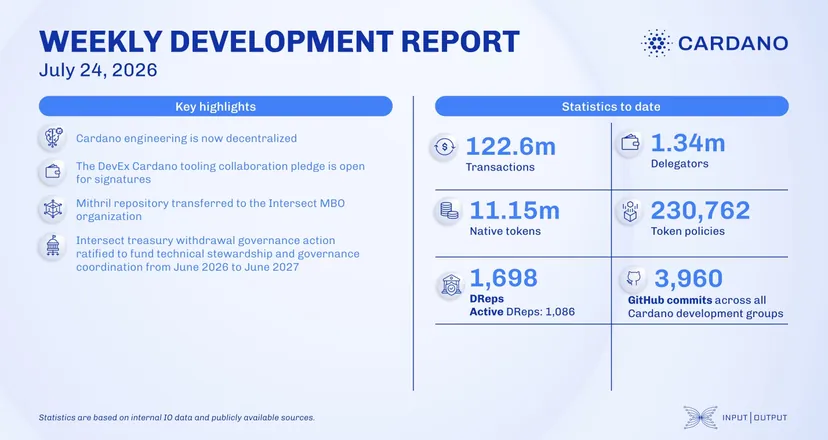
According to CoinMarketCap, a global cryptocurrency data aggregator, Cardano (ADA) took the number one spot among the top 100 cryptocurrencies with a 20.06% gain between 7:00 on July 31 and 7:00 on August 7. Its current price is 290 KRW, with a 7.02% increase over the last 24 hours.
Pump.fun (PUMP) came in second with an 18.58% rise; it is currently priced at 3.39 KRW and saw a 1.48% decline over the last 24 hours. Ethena (ENA) ranked third with a 13.92% gain to 132 KRW, rising 1.18% in the last 24 hours. MemeCore (M) was fourth, rising 13.73% to 1,603 KRW, though it dropped 7.59% over the past day. Fifth-place Algorand (ALGO) rose 12.41% to 126 KRW, down 0.6% in the last 24 hours. Rounding out the top gainers were LayerZero (ZRO) at 1,174 KRW (+8.37%), Pi Coin at 128 KRW (+7.65%), Polkadot (DOT) at 1,173 KRW (+6.71%), Cosmos (ATOM) at 1,937 KRW (+5.89%), and Polygon (POL) at 106 KRW (+5.29%).
ADA is the native asset of Cardano, used for fees, staking, and on-chain governance. It is a Layer 1 blockchain that processes smart contracts based on a Proof-of-Stake (PoS) consensus mechanism and an eUTXO structure.
While it is difficult to attribute the price increase to a single cause, several announcements regarding real-world utility and interoperability were made around this period. On July 28, the Cardano Foundation announced a partnership with German data cooperative Reef Data eG to record payment flows on "Reeve," a Cardano-based transparency platform. Furthermore, in early August, the IBC connection between Cardano and Injective became operational on the testnet, enabling bidirectional asset transfers. However, it has not yet reached the mainnet phase, so it remains to be seen whether this will lead to actual liquidity expansion.
Pump.fun is a token launch platform built on Solana that allows anyone to issue tokens and create initial liquidity. PUMP is the native token of this ecosystem.
This week, the structural mechanism where platform revenue drives token demand acted as a catalyst. Pump.fun allocates half of its protocol revenue to buying and burning PUMP tokens in the market, disclosing these transactions on-chain. Despite an 18.58% weekly gain, the token fell 1.48% in the last 24 hours, indicating some profit-taking following the surge.
Ethena operates the synthetic dollar USDe, which offsets price volatility by combining spot crypto assets with equivalent short positions in futures. Holders of sUSDe, which deposits USDe, receive derivatives funding and staking yields, while ENA is used for protocol governance.
Recently, the process for re-electing the Risk Committee was underway, and discussions regarding the "Fee Switch"—which would link protocol revenue to ENA—were revisited. Conversely, a scheduled token unlock event took place on August 2. Therefore, the 13.92% increase is better viewed as a rebound bolstered by governance updates rather than a reaction to a finalized value-redemption scheme.
MemeCore is a Layer 1 blockchain specifically for memecoins. The M token is used for network gas fees, validator staking, and governance, connecting memecoin trading and participation activities to a reward system via its "Proof of Meme" structure.
The recent price movement, rather than being triggered by a single major announcement, appears more as a recovery after a significant drop. M previously rebounded after the foundation launched a $10 million strategic buyback program in early July following a sharp decline in June. While it rose 13.73% this week, it fell 7.59% in the last 24 hours, showing strong profit-taking.
Algorand is a Pure Proof-of-Stake (PPoS) Layer 1 blockchain where ALGO is used to participate in validation and network operation. It is uniquely designed to allow consensus participation without separate locking or slashing mechanisms.
On July 21, the "x402 Global Challenge" began, which involves automatic blockchain payments for API usage fees. This competition for developers tests use cases such as AI agents and micropayments through real mainnet transactions. However, there is insufficient evidence to link this solely to this week's rise. The 12.41% weekly gain followed by a 0.6% dip in the last 24 hours suggests that buying momentum has somewhat slowed.
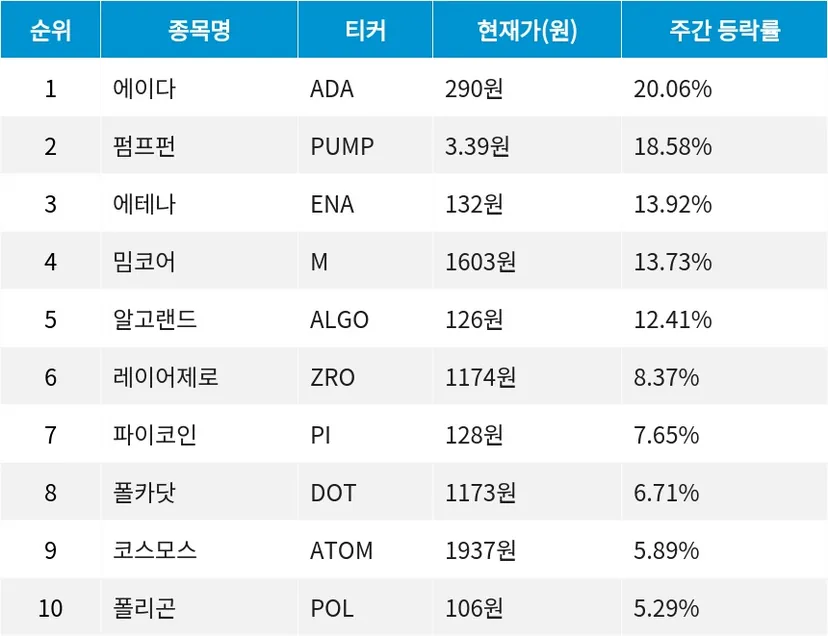
The defining characteristic of the market this week was extreme differentiation in returns by individual coin rather than a broad altcoin rally. While ADA, the top gainer among the top 100, rose 20.06%, the biggest loser, Odiera, dropped nearly 50%.
Odiera had shown a sharp rally of around 50% just the week before. However, the unlock of approximately 21.25 million BEAT tokens on August 1 led to a massive sell-off, causing it to flip from the top of the gainers to the biggest loser within just one week. While the list of gainers might suggest funds are spreading into altcoins, a broader market view shows that capital is not staying put, but rather shifting quickly from surging tokens to others with new catalysts.
Ultimately, the 32nd week of the cryptocurrency market is best viewed as a high-volatility, sector-differentiated environment where limited liquidity is rapidly rotating between assets, amplifying both gains and losses, rather than a market-wide recovery in risk appetite.
※ This article was written by the generative AI of BizHankook and MetaVX.