

[비즈한국] It has been found that among facilities subject to national safety management, over 500 have defects in key structural parts that determine their stability and safety. There are also over 4,000 facilities with no safety ratings because they have not undergone mandatory safety inspections or assessments within the required periods. This means that not only are there facilities with confirmed defects, but also a significant number of facilities whose safety status has not been timely verified.
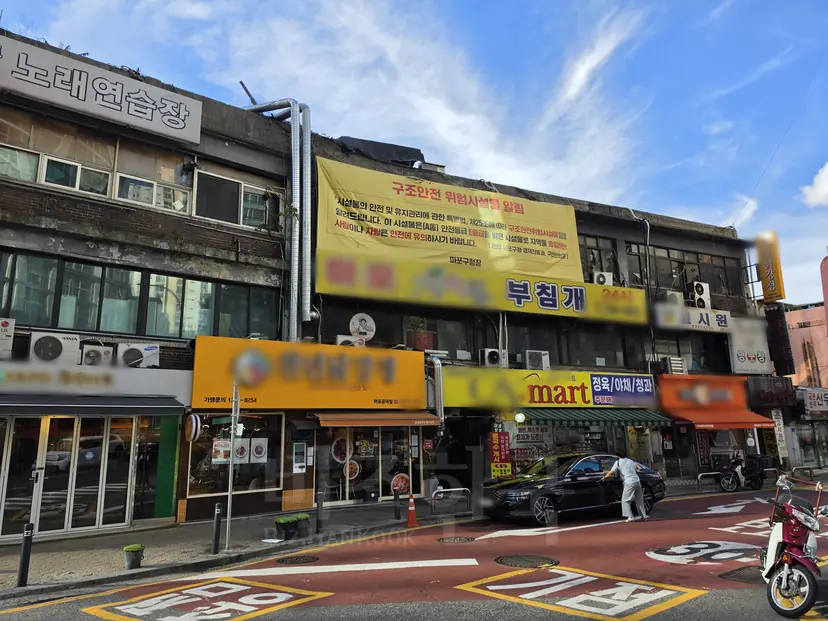
513 Facilities with Key Structural Defects… 6 out of 10 are Privately Owned
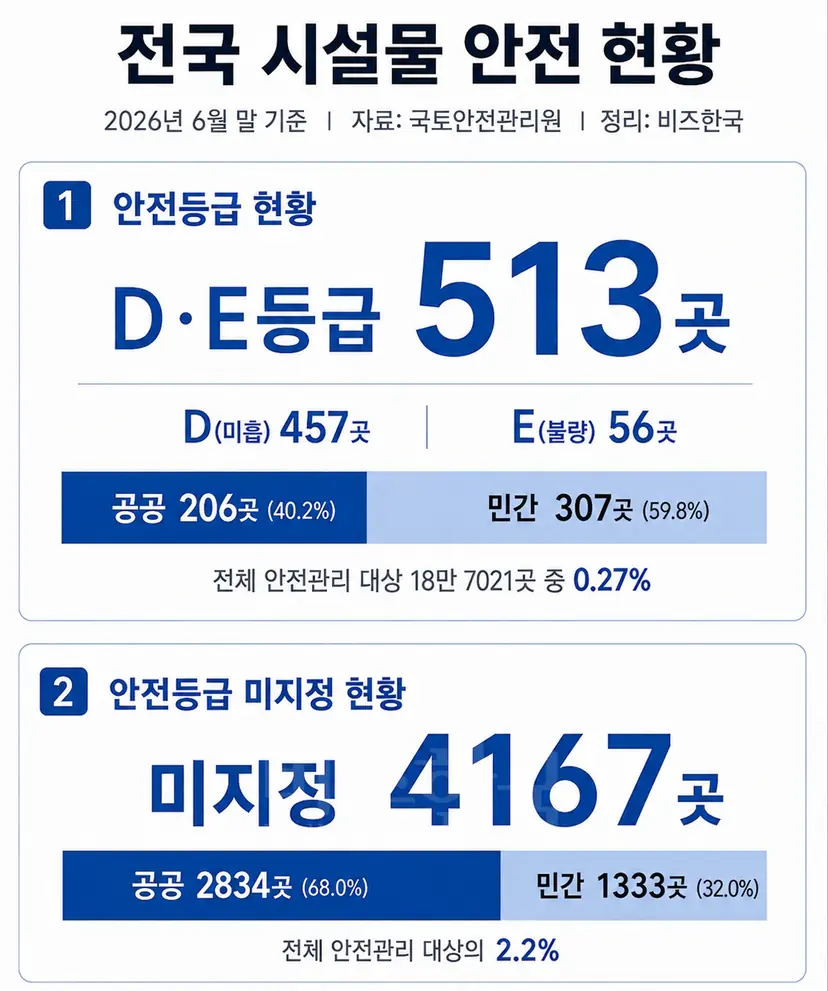
According to the ‘Status of Facility Safety Ratings’ data obtained by BizHankook through an information disclosure request to the Korea Authority of Land & Infrastructure Safety, there were a total of 513 facilities nationwide with defects in major components as of the end of June this year. There are 457 D-grade (insufficient) facilities, which require immediate repair and reinforcement and a decision on whether to restrict use, and 56 E-grade (poor) facilities, which have serious defects posing a risk to facility safety, requiring immediate closure and reinforcement or reconstruction.
Facility safety ratings are divided into five levels based on condition. A (Excellent) is the best state with no issues; B (Good) means the facility functions well but requires some minor repairs. C (Fair) means there are minor defects in major components but the overall safety is not compromised. The level requiring urgent action due to defects in major components begins at D-grade. In the case of E-grade, there are serious defects in major components, requiring immediate prohibition of use.
There are 187,021 facilities subject to national safety management. Under the Facility Safety Act, facilities that meet a certain scale or require continuous safety management are subject to statutory safety management. This includes not only buildings but also bridges, tunnels, ports, and dams. The facility management entity must conduct regular safety inspections and assessments and take necessary measures, such as repairs and reinforcement, based on the designated safety rating results.
More dangerous facilities were identified in the private sector. Among publicly managed facilities, there were 206 total facilities with D-grades (182) and E-grades (24). In contrast, private facilities accounted for 307 total, with 275 D-grades and 32 E-grades. While the total number of safety management subjects was similar between public (90,306, 48%) and private (96,715, 52%), about 6 out of 10 D and E-grade facilities belonged to the private sector.
Lee Kang-seok, a professor at Hanyang University and president of the Korea Institute for Structural Maintenance and Inspection, said, "Of the 187,021 total facilities under management, D and E grades account for about 0.27%, which is 513 facilities. Looking only at the total ratio, it is difficult to call it high, but in terms of structural safety, it is a figure that can never be taken lightly." He added, "More important than the number itself is how quickly necessary measures, such as restricting use or carrying out repairs and reinforcements, are taken after a rating is determined."
4,167 Facilities Have Not Undergone Safety Inspections or Assessments… No Safety Ratings
There are also 4,167 facilities that have not been assigned safety ratings because they have not undergone safety inspections or assessments. This accounts for 2.2% of all safety-managed facilities, consisting of 2,834 public facilities and 1,333 private facilities. These are not merely cases where safety ratings were not registered; they are facilities that have failed to undergo necessary inspections or assessments even though the statutory deadlines have passed. Consequently, it is impossible to verify the current level of safety of these facilities through safety ratings.
Facility safety ratings are determined based on the results of safety inspections and assessments. Facilities subject to precise safety inspections must undergo their first inspection within 3 years of completion or usage approval (4 years for buildings). Once a safety rating is determined, the interval between inspections and assessments shortens as the condition worsens. Facilities subject to precise safety assessments are required to undergo their initial assessment within 1 year after 10 years have passed since completion or usage approval.
An official from the Korea Authority of Land & Infrastructure Safety explained, "There are cases where management entities are unaware that their facilities are subject to management, and there are cases where small-scale entities lack the capacity to carry them out." They added, "For non-compliance cases, we send official letters to management entities to guide them to perform the omitted inspections and assessments. I am aware that the Ministry of Land, Infrastructure and Transport or local governments impose fines or conduct joint inspections."
Professor Lee Kang-seok said, "The safety of a structure is not just about 'whether there is a problem now,' but about how early performance degradation is discovered and how timely the intervention is," adding, "It is crucial to strengthen preventive maintenance systems rather than reactive responses, especially for small-scale or aging facilities that may have relatively weaker management conditions."