

[비즈한국] Every time geopolitical risks shake the global raw material market, the economic fundamentals of countries dependent on fossil fuel imports suffer a severe blow. The Russia-Ukraine war and rising military tensions in the Middle East have maximized uncertainty in energy supply, reinforcing the realization that energy transition is not merely a moral declaration for environmental protection, but a matter of 'security' directly linked to the survival of the national economy. Against this backdrop, policymakers, legislators, and experts from the financial and industrial sectors of South Korea and Germany—nations that have declared their entry into the era of renewable energy—gathered to discuss practical implementation strategies.
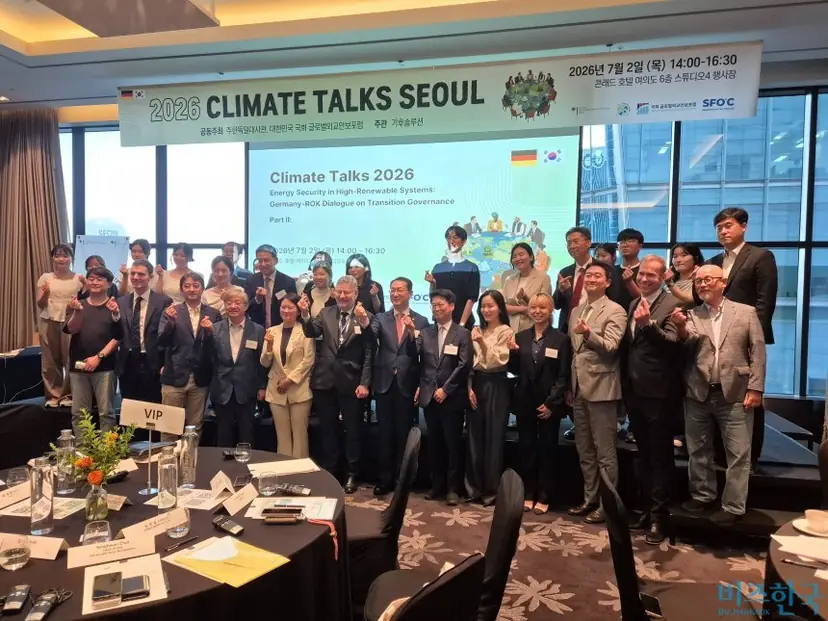
‘Climate Talk Seoul 2026,’ co-hosted by the German Embassy in Seoul and the Global Diplomatic and Security Forum of the National Assembly, and organized by Solutions for Our Climate (SFOC), was held on July 2 at the Conrad Hotel in Yeouido, Seoul. The event, held under the theme 'Energy Security in the Era of Renewable Energy Transition: Korea-Germany Governance Dialogue,' addressed the structural limitations of South Korea, where the share of renewable energy power generation remains low at around 10%, and explored multi-faceted ways to secure financing and expand infrastructure for large-scale renewable energy projects based on the experiences of both Korea and Germany.
Addressing the Climate Crisis: Moving Beyond Environmental Logic to Geopolitical Survival Strategy
In his opening remarks, Joern Beissert, Deputy Head of Mission at the German Embassy in Seoul, stated, "Europe is experiencing the urgency of the climate crisis firsthand as recent heatwaves exceeding 40 degrees Celsius have claimed numerous lives." He emphasized, "Recent geopolitical crises demonstrate how vulnerable a system dependent solely on fossil fuels is. Expanding renewable energy is not just climate policy; it is security and defense policy that protects the nation." Deputy Head of Mission Beissert shared that Germany was able to significantly reduce its reliance on fossil fuel imports thanks to the proactive expansion of wind and solar power, highlighting the tangible benefits for protecting the national economy.
Kyeon Jong-ho, Ambassador for Climate Change at the Ministry of Foreign Affairs, also conveyed the tension at the forefront of climate diplomacy, supporting the keynote by stating, "Geopolitical instability and energy security crises have served as a powerful reminder of the structural vulnerabilities in our energy system, which is heavily dependent on fossil fuels." He added, "Transitioning to clean energy is now a powerful and urgent mandate not only for environmental sustainability but also for national security and economic resilience."
The Reality of South Korea's Energy System as Viewed by Lawmakers
In the policy dialogue, Rep. Park Jihye (Democratic Party of Korea), a former environmental lawyer; Rep. Kim Gunn (People Power Party), a career diplomat; and Rep. Lee Ju-young (Reform Party), a former medical doctor, appeared on a panel to present their respective parties' visions for national energy strategy.
Rep. Park Jihye cited the expansion of renewable energy to 100 gigawatts (GW) by 2030 as a core task, stating, "Although we have constantly called for renewable energy expansion, our generation share remains at 10% while fossil fuels account for 60%." She argued, "The most urgent task is to increase the grid's capacity to facilitate smooth power supply. I have proposed legislation to provide the basis for issuing green government bonds so that public finance can serve as a catalyst for reforming power market conditions to introduce storage and flexibility services."
In contrast, Rep. Kim Gunn emphasized the importance of realistic implementation infrastructure over ideal figures. Rep. Kim stated, "When I was ambassador to the UK, every time I turned on the TV news, I saw reports of conflicts with local residents over power grids to transport generated electricity rather than the offshore wind power projects themselves." He argued, "The path toward renewable energy expansion is never easy, and we must resolve the realistic bottleneck of public acceptance. Rather than being buried in setting overly idealistic goals, we must approach this from the perspective of a realistic and balanced energy mix, including nuclear power, to minimize shocks to the market."
Rep. Lee Ju-young soberly pointed out the geopolitical isolation facing South Korea. Rep. Lee noted, "Unlike Europe, South Korea has the unique characteristic of being a 'power island' with no electricity grids connected to neighboring countries." She advised, "As a high-power-consuming country focused on advanced manufacturing, a stable supply source is essential if we are to sustain our future competitiveness in physical AI and semiconductors. Excessive reliance on specific countries for supply chains, such as solar panels, could lead to another form of security dependency, so independent technological prowess and diversified industrial scenarios must be established first."
Normalization of Market Mechanisms and Construction of Financial Pipelines
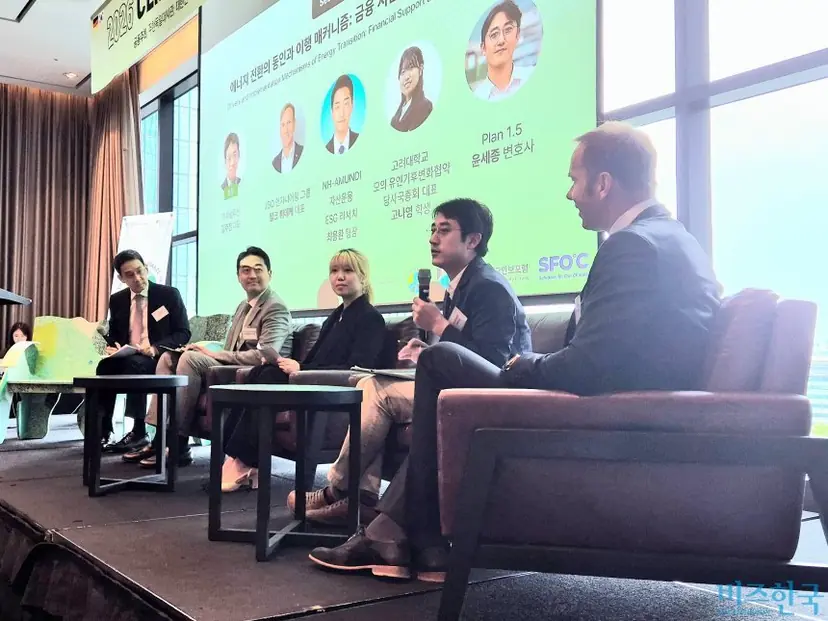
Falk Luedeke, CEO of the German JBO Engineering Group, a world-leading offshore wind and civil engineering firm, suggested 'predictability' in planning, profitability, and licensing as the key financing conditions for successful large-scale renewable energy projects in his keynote speech. CEO Luedeke said, "Compared to Europe, South Korea faces higher foundation installation costs and technical challenges due to tougher seabed soil conditions and wind speeds. To offset these cost-increasing factors, it is essential to provide the market with clear 'predictability' through the establishment of clear licensing standards and a stable profit model that excludes speculative elements."
In the ensuing expert discussion, diagnoses followed on how to transplant this predictability into the Korean market. Lawyer Yoon Se-jong of Plan 1.5 targeted the price distortion problem that hinders the self-sustainability of the domestic renewable energy market. Lawyer Yoon pointed out, "Ultimately, the most important key to lowering project risk is creating a price environment where projects can succeed." He noted, "There are limits to forcing down the unit cost for renewable energy operators, but mechanisms to normally increase the price of fossil fuels that emit greenhouse gases are already in place as systems."
He continued, "Although South Korea runs a solid emission trading system that covers 73% of greenhouse gas emissions, it has artificially kept fossil fuel prices low, for instance by imposing carbon prices on only 10% of the power generation sector. The government must move away from the practice of overly suppressing energy prices for political purposes such as price management; only then can economies of scale be realized and a virtuous cycle of competition begin."
Choi Yong-hwan, ESG Research Team Leader at NH-Amundi Asset Management, representing the financial investment industry, pointed out the absence of a channel to connect private capital liquidity to practical climate investment. Team Leader Choi explained, "The current global capital market is in a state where 'capital is waiting'; there is abundant investment capital, but a lack of attractive project pipelines where risks are precisely controlled."
He added, "To bridge the gap between these complex and sophisticated climate policies and capital injection, it is necessary to benchmark the KfW (Kreditanstalt für Wiederaufbau) model from Germany." He proposed, "Just as KfW has smoothly connected private capital by injecting large-scale funds and sharing risks over the past 10 years, it is urgent for the Korean market to establish institutional cornerstones like a Climate Investment Corporation or Green Finance Corporation that can precisely measure, report, and verify (MRV) the carbon reduction contribution of investment funds and lead private investment."